Quercetin: Benefits, Mechanisms, And The Mast Cell Stabilizer Question
By Jacob Gordon, INHC, FMT-CThis article contains affiliate links. As an Amazon Associate, MyBioHack earns from qualifying purchases at no extra cost to you. We only link products we research and stand behind.
Quercetin is one of the most studied dietary flavonoids, and it has quietly become a staple in mast cell, allergy, and longevity protocols.
In this post, we will discuss what quercetin actually does at a mechanistic level, where the evidence is strong versus overstated, the bioavailability problem that undermines most products, and how to dose it.

What Is Quercetin
Quercetin is a flavonol, a subclass of plant polyphenols, found in onions, capers, apples, and many other plants.
In food it mostly exists as glycosides (quercetin bound to a sugar, such as isoquercitrin or rutin), not as the free aglycone sold in most supplements.
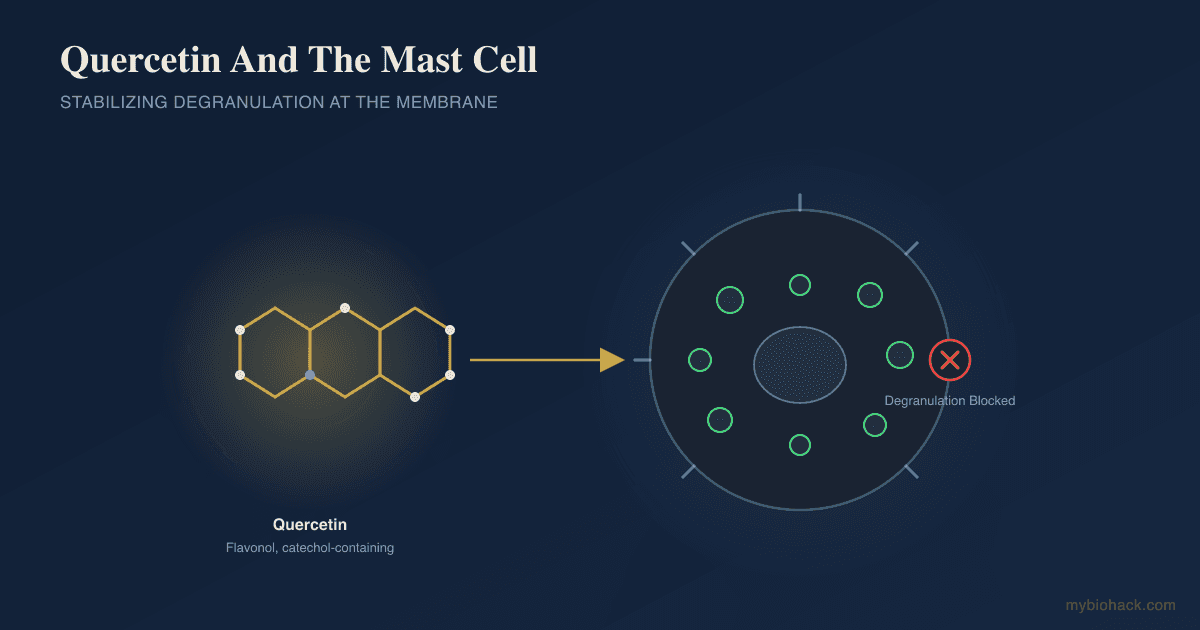
It is a catechol-containing molecule, which is central to both its antioxidant chemistry and how the body inactivates it.
Chemically it sits in the same family as fisetin, and the two are frequently compared, which is why this site already has a dedicated piece on fisetin as the "better quercetin" question.
This post is the dedicated deep-dive on quercetin itself.
Benefits Of Quercetin
The honest summary is that quercetin has strong mechanistic and in vitro data, moderate animal data, and a smaller but growing body of human data.
Where a benefit rests mostly on cell or animal work, it is flagged as such.

- Mast cell stabilization (strongest mechanistic case, mostly in vitro on human cells): quercetin inhibits histamine, prostaglandin D2, and cytokine release from human mast cells, and in one comparison it outperformed the pharmaceutical mast cell stabilizer cromolyn at blocking IL-8 and TNF. R
- NRF2 activation (animal and cell data): quercetin upregulates the NRF2/Keap1 antioxidant pathway, raising downstream enzymes like NQO1 and HO-1. R
- Anti-allergic effect on real symptoms (human RCT, using a bioavailable glycoside): enzymatically modified isoquercitrin reduced ocular symptoms of cedar pollen allergy in a double-blind placebo-controlled trial. R
- Senolytic activity as part of a combination (small human trials): dasatinib plus quercetin reduced senescent cell burden in people with diabetic kidney disease. R
- Antioxidant and anti-inflammatory signaling (cell and animal data): quercetin suppresses NF-kB-driven inflammatory transcription in multiple models, including TNF-driven inflammation in human hepatic cells and TNF gene expression in normal human blood cells. R R R
- Possible antiviral support (in vitro and one open-label clinical signal): quercetin inhibits viral replication in cell culture and, as a phytosome, was associated with faster recovery in early COVID-19. R
- Zinc ionophore capacity (in vitro only): quercetin can move zinc across membranes into cells, the mechanistic basis behind the popular quercetin-plus-zinc stacks. R
- Exercise and recovery (small and inconsistent): meta-analysis shows only trivial effects on VO2max and endurance, mainly in untrained people. R
The Mast Cell Stabilizer Question
This is the benefit most people take quercetin for, and it is worth being precise about what the evidence supports.
Quercetin inhibits mast cell degranulation, meaning it reduces the release of preformed mediators like histamine when the mast cell is triggered.
In cultured human mast cells it blocked histamine and PGD2 secretion and, notably, was more effective than cromolyn at blocking the cytokines IL-8 and TNF driven by substance P. R
Substance P signaling is one of the nerve-driven triggers behind flushing and MCAS, which is covered in depth in the post on mast cells, substance P, and neurogenic inflammation.
A broad screen of flavonoids found quercetin and its relatives inhibit both IgE-mediated and non-IgE (PMACI) histamine release from mast cells. R
More recent work shows quercetin also blunts MRGPRX2-mediated degranulation, the receptor behind many "pseudo-allergic" and drug-triggered reactions, via the MyD88/NF-kB and PI3K/AKT pathways. R
There is an important honesty caveat here.
Most of this is in vitro, done on isolated cells at concentrations that are difficult to reach in human blood with oral dosing (this is the bioavailability problem, discussed next).
The strongest human evidence comes from bioavailable quercetin glycosides rather than plain quercetin, such as the cedar pollinosis trial where enzymatically modified isoquercitrin lowered ocular allergy symptoms. R
So the mechanism is real and the human allergy signal exists, but the standard cheap quercetin dihydrate capsule is probably the weakest way to access it.
For the broader picture on why histamine drives so many symptoms, see the guide on histamine intolerance, and for telling apart the two overlapping conditions, histamine intolerance versus MCAS.
Quercetin also fits upstream approaches, since a large share of body histamine and mast cell activation originates in the gut, as covered in gut serotonin and mast cell activation.
The Bioavailability Problem And How To Solve It
Plain quercetin aglycone is poorly absorbed, and this is the single biggest reason products underperform their in vitro promise.
It has low water solubility, is extensively metabolized in the gut wall and liver, and is rapidly conjugated and cleared.
There are a few evidence-based ways to improve on this.

Phytosome (lecithin) delivery is the best-supported.
Binding quercetin to sunflower phospholipids (the Quercetin Phytosome, marketed as Quercefit) raised plasma quercetin up to roughly 20-fold versus unformulated quercetin in a human pharmacokinetic study. R
This is the same phytosome form used in the COVID-19 clinical trial, which matters because it means the human clinical signal was generated with an absorbable version, not raw powder. R
Quercetin Phytosome: The most bioavailable widely available form, and the one that most closely matches the dosing used in human trials.
Combining with bromelain is the classic pairing.
Bromelain is a proteolytic enzyme from pineapple that is thought to improve quercetin absorption and adds its own anti-inflammatory effect, which is why the two are so often sold together.
Quercetin with Bromelain: A common and inexpensive stack, though the absorption boost from bromelain is less rigorously quantified than the phytosome data.
Taking it with vitamin C and dietary fat is the low-cost approach.
Vitamin C helps regenerate oxidized quercetin and supports its stability, and dietary fat improves micellization and uptake of this fat-soluble molecule.
A pilot study using this exact stack, quercetin phytosome plus zinc and vitamin C, reduced seasonal allergic rhinitis symptoms in children, which is a useful human signal for the combination rather than the isolated molecule. R
Vitamin C: Best taken alongside quercetin, and the two are frequently combined in the same allergy and antiviral formulas.
The Zinc Ionophore And Antiviral Claims
This is where popular messaging has run well ahead of the evidence, so it is worth separating what is shown from what is inferred.
The zinc ionophore claim comes from a 2014 study showing quercetin can rapidly increase labile (free) zinc inside cells and inside a synthetic liposome model, meaning it can shuttle zinc across membranes. R
Zinc, once inside the cell, can inhibit viral RNA polymerase in vitro, so the logic is that quercetin carries zinc in and zinc blocks the virus.
The problem is that both halves of that chain were established in cell and liposome models, not in infected humans.
In infected Vero E6 cells, quercetin plus zinc produced a greater-than-twofold inhibition of viral replication, which is a real in vitro effect but a modest one. R
Quercetin also shows direct antiviral activity against coronaviruses in cell and animal models independent of the zinc mechanism, including in vitro inhibition of the SARS-CoV-2 main protease (3CLpro) at low micromolar concentrations. R
The one meaningful human data point is a randomized (but open-label, single-center, unblinded) trial in early COVID-19, where quercetin phytosome added to standard care sped viral clearance and symptom resolution. R
That is encouraging but not definitive, because open-label unblinded trials are prone to bias and the study was small.
The honest position is that quercetin is a plausible antiviral adjunct with real in vitro mechanisms and one supportive but weak clinical trial, and the confident "quercetin is a zinc ionophore that treats viruses" framing overstates data that is mostly preclinical.
Senolytic Activity And The D+Q Combination
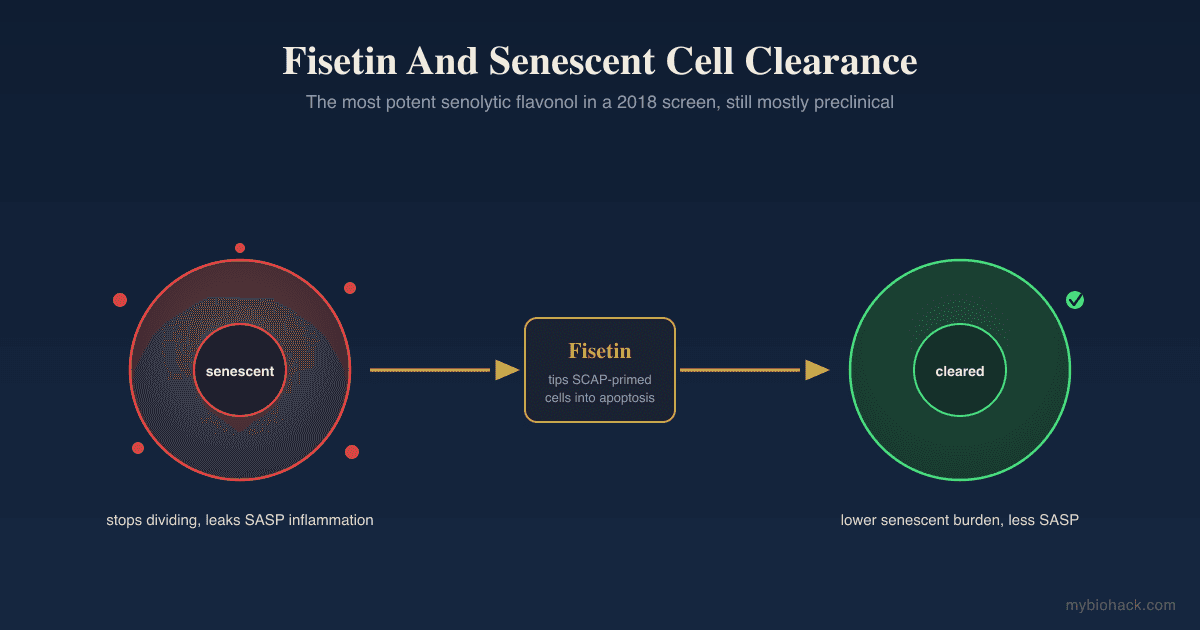
Quercetin is one of the two original senolytics, compounds that selectively kill senescent ("zombie") cells that accumulate with age and secrete inflammatory signals.
Almost all of the human senolytic evidence uses the combination of the leukemia drug dasatinib plus quercetin (D+Q), not quercetin alone.
In a first-in-human open-label pilot in idiopathic pulmonary fibrosis, intermittent D+Q was feasible and improved several physical function measures in 14 patients. R
In people with diabetic kidney disease, three days of D+Q reduced senescent cell burden in adipose tissue and lowered circulating inflammatory (SASP) factors. R
A later open-label pilot in early Alzheimer's disease (SToMP-AD) showed the combination reaches the central nervous system and was well tolerated, with reductions in blood SASP factors, though the trial was tiny and uncontrolled. R
Two honest caveats matter.
These trials are tiny, and dasatinib is a prescription chemotherapy agent with real toxicity, so this is not a "take quercetin for longevity" endorsement.
Whether quercetin alone, at supplement doses, meaningfully clears senescent cells in humans is not established, and this is exactly the gap where fisetin is often positioned as the better senolytic candidate.
Natural Sources
Dietary quercetin comes almost entirely from plants, and cooking method and the sugar it is bound to affect how much you absorb.
- Apples (with skin)
- Capers (the most concentrated common source)
- Elderberries and other dark berries
- Kale and leafy greens
- Onions, especially red onions
- Red wine and green tea (smaller amounts)
Food sources deliver quercetin as glycosides, which are often better absorbed than the free aglycone in cheap supplements, so a caper-and-onion-heavy diet is not a trivial contributor.
Dosage And Safety
Common supplemental doses range from 500 to 1000 mg one to two times daily, and the human senolytic and antiviral trials used the higher end (roughly 1000 to 1250 mg per dose).
For a phytosome product, effective plasma levels are reached at lower label doses because absorption is far higher, so follow the specific product's guidance rather than matching raw-powder milligrams.
Quercetin is generally well tolerated, but there are real caveats worth knowing.
- At very high doses (above 1000 mg daily for extended periods) safety reviews flag possible kidney irritation, and intravenous quercetin has caused dose-limiting nephrotoxicity, so chronic oral megadosing is not advised and anyone with pre-existing kidney disease should avoid it. R
- It inhibits several drug-metabolizing enzymes and transporters (including CYP3A4 and P-glycoprotein), so it can raise levels of some medications and should be cleared with a clinician if you take prescription drugs. R R
- It has mild anticoagulant potential and theoretically stacks with blood thinners.
- In vitro it inhibits thyroid peroxidase, and in animals it suppressed thyroid-restricted gene expression and thyroid function, so people with thyroid disease should be cautious with sustained high doses (this remains a largely preclinical concern). R R
- Because it inhibits COMT (see Genetics), people who are slow COMT metabolizers may be more sensitive to it.
Testing
Quercetin is most often used by people managing mast cell and histamine issues, so the relevant objective markers are the ones that reflect mast cell burden and allergic activity.
Blood And Urine Markers
Tryptase is the most specific baseline mast cell marker, and a persistently elevated level raises the question of a clonal mast cell disorder rather than simple activation.
Plasma histamine can support a histamine-excess picture, though it is labile and must be handled carefully by the lab.
I use the Immune Zoomer (Vibrant Wellness) to assess mast cell markers and systemic autoantibodies together, or individual Tryptase and Plasma Histamine tests (Quest) when a targeted look is enough.
Functional Lab Panels
Because so much mast cell activation is driven from the gut, I use the Gut Zoomer (Vibrant Wellness) to assess dysbiosis, intestinal permeability, and the microbial triggers upstream of histamine load, or the GI-MAP (Diagnostic Solutions) as a PCR-based alternative.
For personalized interpretation of these results, a consultation is the better route than guessing.
Mechanisms Of Action
Simple:
- Quercetin calms the immune cells (mast cells) that dump histamine, so it acts like a natural version of an allergy-stabilizing drug.
- It switches on the body's own antioxidant defense system (NRF2) and quiets the main inflammation switch (NF-kB).
- It can carry zinc into cells, which is the basis for its antiviral reputation, though that part is mostly shown in the lab, not in people.
Advanced:
- Mast cell stabilization Quercetin inhibits calcium influx and downstream degranulation in mast cells, reducing release of histamine, PGD2, tryptase, and the cytokines IL-8 and TNF, including substance-P-triggered and MRGPRX2-mediated (non-IgE) activation via the MyD88/IKK/NF-kB and PI3K/AKT/Rac1/Cdc42 pathways. R Consistent with this, quercetin blunts histamine-driven intracellular calcium elevation in human cells acting through the histamine H4 receptor and PLC/PKC signaling. R
- NRF2/Keap1 activation By modifying reactive cysteines on Keap1, quercetin frees NRF2 to translocate to the nucleus and drive antioxidant response element (ARE) transcription of NQO1, HO-1, and glutathione-synthesis enzymes. R Note that reflexively maximizing NRF2 is not always desirable, as covered in why NRF2 activation can make you more sick.
- Zinc ionophore activity Quercetin forms a lipophilic complex with Zn2+ and ferries it across the plasma membrane and lipid bilayers, raising intracellular labile zinc, which can then inhibit viral RdRp; this is demonstrated in Hepa 1-6 cells and liposome models. R
- Senolysis Quercetin (paired with dasatinib) transiently disables the pro-survival (SCAP) networks that senescent cells depend on, tipping them into apoptosis and lowering the senescence-associated secretory phenotype. R
Genetics
COMT
COMT encodes catechol-O-methyltransferase, the enzyme that methylates catechol structures, including catecholamines, catechol estrogens, and catechol-containing flavonoids like quercetin.
Quercetin is both a substrate for COMT (methylated into isorhamnetin and tamarixetin) and an inhibitor of the enzyme, and its methylation consumes SAM and generates SAH, which further slows COMT. R
rs4680 (Val158Met): the Met/Met "slow" variant already clears catecholamines and catechol estrogens sluggishly, and adding a COMT-inhibiting, COMT-consuming compound like quercetin may increase sensitivity or methylation demand in these individuals. R
NQO1
NQO1 encodes NAD(P)H quinone dehydrogenase 1, a phase II antioxidant enzyme and a direct downstream target of NRF2.
Quercetin's NRF2 activation raises NQO1 expression, so people carrying loss-of-function NQO1 variants may get less of quercetin's antioxidant benefit.
rs1800566 (C609T, P187S): the T allele produces an unstable, low-activity NQO1 enzyme, blunting the protective payoff of NRF2 activators. R
For the deeper story on rebuilding NRF2 signaling when it is blocked, see DJ-1/PARK7 and reviving NRF2.
More Research
Enzymatically modified isoquercitrin (EMIQ) is worth knowing about as a specific bioavailable glycoside, since it is the form that produced the cleanest human allergy result, reducing ocular symptoms of cedar pollinosis in a placebo-controlled trial. R
Exercise claims deserve tempering, because the pooled meta-analysis found quercetin's effect on VO2max and endurance was trivial and largely limited to untrained subjects, so it is not a meaningful ergogenic aid. R
For biomarker and mast cell testing I use the Immune Zoomer (Vibrant Wellness) and, for gut-driven histamine load, the Gut Zoomer.
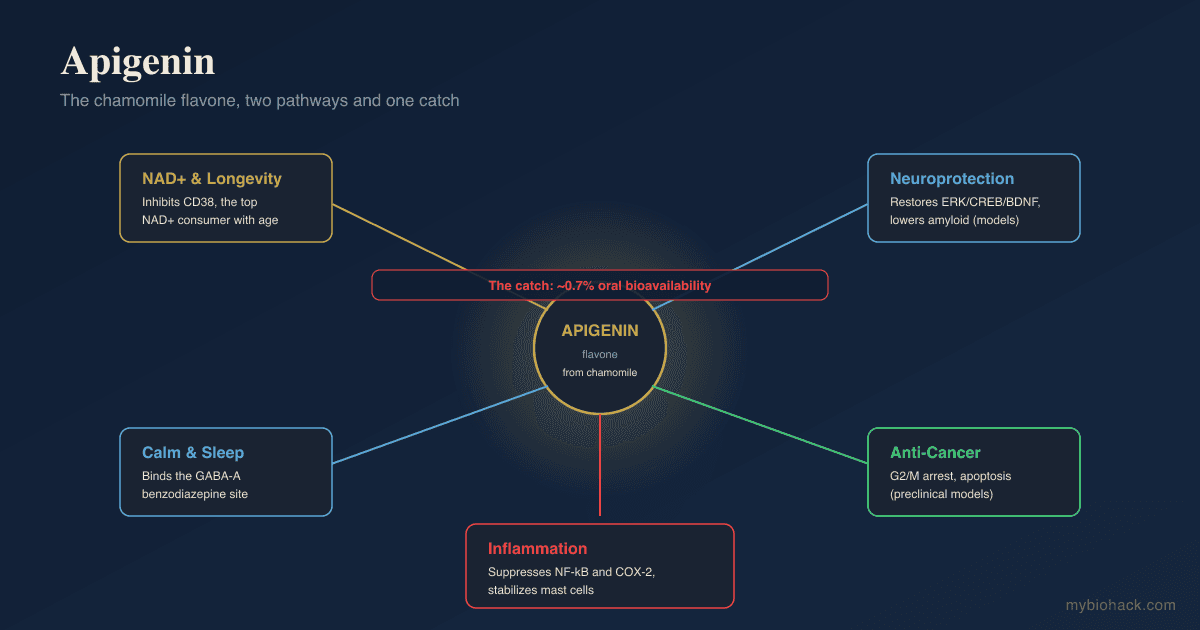
Quercetin versus fisetin remains the most common practical question, and rather than repeat it here, the tradeoffs (fisetin's better senolytic profile versus quercetin's stronger mast cell and antiviral data) are laid out in the fisetin deep-dive and the related flavonoid post on apigenin.
The gut-first framing matters more than the supplement choice for most people with mast cell symptoms, which is why the upstream driver covered in gut serotonin and mast cell activation is often the higher-leverage intervention.
Jacob Gordon
INHC, FMT-C
Board Certified Health Coach
I spent years battling unexplained chronic illness before discovering biohacking, epigenetics, and functional medicine. Now I share that research at MyBioHack to help others find their own answers.
Book a ConsultationRelated Protocols & Supplements
Deep-dive chapters and recommended supplements for this topic
Quercetin
500mg 2x/day
Vitamin D3 + K2
5000 IU + 200mcg/day
DAO Enzyme
1 cap before meals