Iodine And Thyroid Health: Benefits, Safety, Selenium Connection, And Genetics
By Jacob Gordon, INHC, FMT-CIodine is an essential mineral that the thyroid gland requires in precise amounts to synthesize the hormones driving metabolism, growth, and immune function, yet both deficiency and excess carry serious consequences.
In this post, we will discuss what iodine is, how it supports thyroid hormone synthesis, the therapeutic contexts in which higher dosing is used, the critical interplay with selenium, the genetic variants that alter how an individual handles iodine, and the safety considerations everyone should understand before supplementing.

What Is Iodine
Iodine is a trace mineral and an essential component of the thyroid hormones triiodothyronine (T3) and thyroxine (T4).
The human body cannot synthesize iodine, so dietary intake is the sole source.
Iodine exists in several chemical forms, including iodide (the reduced, ionic form preferentially transported into the thyroid) and molecular iodine (I2, the form used in antiseptics and present in certain therapeutic preparations).
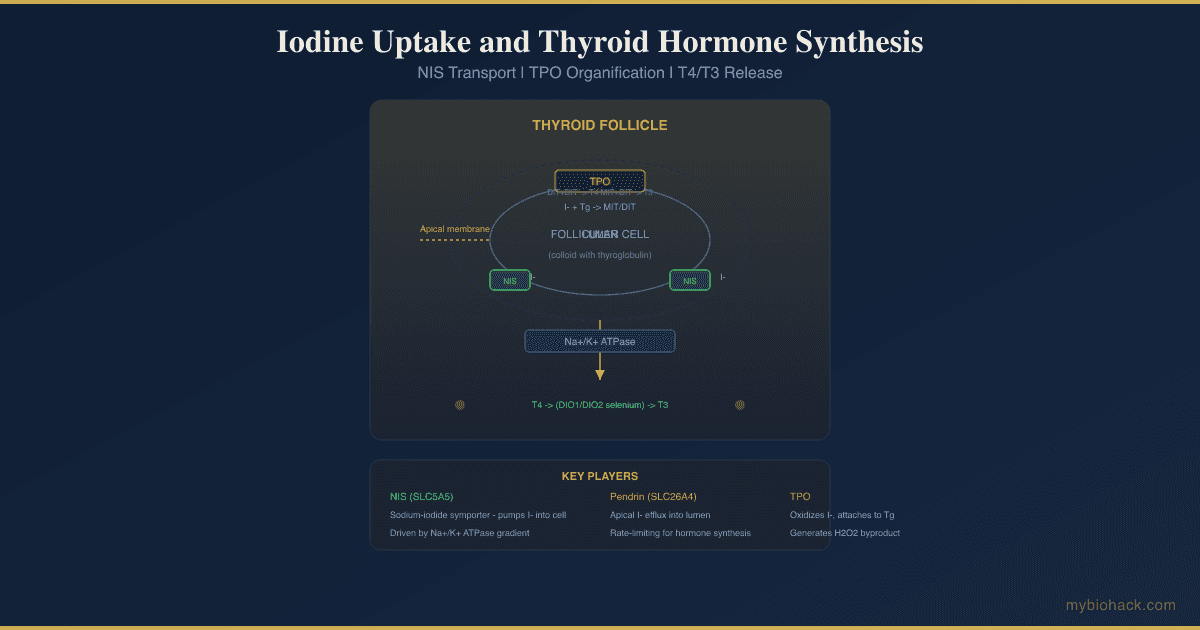
Once ingested, iodine is absorbed in the gastrointestinal tract, transported via the bloodstream, and actively pumped into thyroid follicular cells by the sodium-iodide symporter (NIS). R
What Is Iodine Used For
Iodine is used to support thyroid hormone production, maintain breast tissue health, support immune function, and act as an antioxidant in extrathyroidal tissues. R
In clinical medicine, high-dose iodine is used preoperatively in hyperthyroidism (Lugol's solution), for thyroid protection during nuclear emergencies (potassium iodide), and as a therapeutic agent in fibrocystic breast disease. R
The functional medicine community also uses iodine in milligram-range doses for general thyroid support, breast health, and halogen detoxification, though this practice remains controversial from a consensus-medicine perspective.
Benefits Of Iodine
1. Antioxidant Activity
Iodide functions as an electron donor that neutralizes reactive oxygen species, making it one of the earliest evolutionary antioxidants. R
In blood cells and extracellular fluids, iodide scavenges hydroxyl radicals and superoxide anions, reducing oxidative damage (though this area remains understudied in humans).
2. Breast Tissue Health
Breast tissue actively concentrates iodide via the same NIS mechanism used by the thyroid. R
Iodine deficiency is associated with fibrocystic breast changes, and supplementation at 3.0 to 6.0 mg per day has been shown to reduce breast pain, tenderness, and nodularity in randomized trials. R
A 1993 study by Ghent and colleagues found that 70% of women with fibrocystic breast disease improved on sodium iodide therapy, though side effects at those doses were significant. R
The iodine-selenium connection matters here too, since selenium-dependent antioxidant enzymes protect breast tissue from the oxidative byproducts of iodine metabolism.
3. Immune Function
Iodine supports innate immune activity through the peroxidase partner system present in exocrine glands, including salivary glands, mammary tissue, gastric mucosa, and the respiratory tract. R
In these tissues, iodide combines with hydrogen peroxide and peroxidase enzymes to generate reactive iodine species that are antimicrobial.
This system is an evolutionary ancient defense mechanism that predates the adaptive immune system. R
4. Thyroid Hormone Synthesis
Iodine is the rate-limiting substrate for T3 and T4 production.
Without sufficient iodine, the thyroid cannot produce adequate hormone, leading to a compensatory rise in Thyroid Stimulating Hormone (TSH) and eventual goiter formation. R
Natural Sources Of Iodine
Cod and other white fish: approximately 100 to 150 mcg per 3-ounce serving.
Cranberries and strawberries: plant-based sources with modest iodine content.
Dairy products: iodine content varies by region and depends on iodophor sanitizers used in milking equipment.
Eggs: approximately 25 mcg per large egg, mostly in the yolk.
Iodized salt: approximately 77 mcg per gram of salt (the primary source in the U.S. diet).
Seaweed (kelp, nori, wakame, kombu): the most concentrated natural source, with wide variability (some kelp contains over 4,000 mcg per gram).
Shrimp and other shellfish: moderate sources.
The iodine content of plant foods depends heavily on soil iodine levels, which have declined globally due to soil depletion. R
Dosage And Safety
Recommended Dietary Allowance
The RDA for iodine is 150 mcg per day for non-pregnant adults, 220 mcg per day during pregnancy, and 290 mcg per day during lactation. R
The Tolerable Upper Intake Level (UL) is 1,100 mcg per day for adults.
The American Thyroid Association advises against consuming iodine or kelp supplements containing 500 mcg or more of iodine per day, citing insufficient evidence of benefit and documented risk of thyroid dysfunction. R
Therapeutic Dosing
Functional medicine practitioners sometimes use iodine in the milligram range (typically 3 to 50 mg per day), often in the form of Lugol's solution (5% iodine and 10% potassium iodide), Iodoral (a tablet form of Lugol's), or nascent iodine (a purported atomically reduced form).

The evidence for benefit at these doses is mixed.
Fibrocystic breast disease is the best-supported indication for milligram-range iodine, with trials using 3 to 6 mg per day showing significant symptom reduction. R
There is no strong evidence supporting routine milligram-range iodine supplementation for thyroid health in iodine-sufficient individuals.
Iodine-Induced Thyroid Dysfunction
Hyperthyroidism: The Jod-Basedow phenomenon describes iodine-induced hyperthyroidism, most often seen in individuals with pre-existing nodular goiter or latent Graves' disease who are suddenly exposed to high iodine loads. R
Hypothyroidism: The Wolff-Chaikoff effect is a transient suppression of thyroid hormone synthesis that occurs when intrathyroidal iodine levels become excessive. R
In healthy thyroids, the gland escapes this inhibition within 24 to 48 hours by downregulating NIS expression. R
Individuals with autoimmune thyroiditis, subclinical thyroid dysfunction, or a history of thyroid surgery often fail to escape, leading to persistent iodine-induced hypothyroidism. R
Selenium Protects Against Iodine Excess

This is the single most important safety consideration.
Selenium is required for the function of glutathione peroxidases (GPx) that neutralize the hydrogen peroxide generated as a byproduct of thyroid hormone synthesis. R
When iodine intake is high and selenium is deficient, the thyroid gland experiences unopposed oxidative stress that can cause tissue damage. R
Supplemental selenium has been shown to restore GPx activity, protect TPO function, and improve thyroid hormone profiles in animal models of iodine excess. R
Anyone considering iodine supplementation above the RDA should establish adequate selenium status first, ideally for two to four weeks before initiating iodine.
(And selenium itself needs to be dosed carefully: see the safety section of that post for the narrow therapeutic window.)
Bromine Displacement
Iodine and bromine are both halogens that compete for NIS transport and tissue uptake. R
When iodine is supplemented, it can displace bromine stored in tissues, leading to a temporary detoxification syndrome known as bromism.
Symptoms include acneiform skin eruptions, fatigue, brain fog, headache, and metallic taste.
This effect is generally self-limited and can be managed with salt loading (sodium chloride accelerates renal bromide excretion) and dose reduction.
Acneiform Eruptions
Iodine supplementation, particularly at milligram doses, can trigger acneiform skin eruptions.
This is thought to reflect both bromine displacement and direct irritation of sebaceous glands by iodine.
Reducing the dose or switching to a different form of iodine (e.g., from Lugol's to nascent iodine) may help.
Contraindications
Hashimoto's thyroiditis with established hypothyroidism, Graves' disease, thyroid nodules (especially toxic nodules), and a history of thyroidectomy or radioactive iodine treatment are all relative contraindications to unsupervised iodine supplementation.
Pregnancy and lactation increase iodine requirements, but excess is equally dangerous.
Autoimmune thyroid disease requires particular caution, since iodine excess can accelerate thyroid autoimmunity in genetically susceptible individuals. R
Chronic high iodine intake has been linked to increased frequency of autoimmune thyroiditis in population studies. R
Testing
Blood Markers
I use the Foundation Zoomer to assess baseline thyroid function alongside CBC, CMP, and metabolic markers.
TSH: the most sensitive screening marker for thyroid dysfunction; elevated TSH suggests hypothyroidism, suppressed TSH suggests hyperthyroidism. (
Quest Diagnostics, reference range approximately 0.4 to 4.0 mIU/L)
Free T4: the prohormone secreted by the thyroid; low levels indicate hypothyroid state. (
Quest Diagnostics)
Free T3: the active hormone; a low free T3 relative to free T4 suggests impaired deiodinase conversion, often driven by selenium deficiency or genetic variants in DIO1/DIO2.
Reverse T3: elevated rT3 relative to free T3 indicates a block in T4-to-T3 conversion, which can occur with selenium deficiency, inflammation, or caloric restriction.
Thyroid Peroxidase Antibodies (TPOAb) and Thyroglobulin Antibodies (TgAb): markers of autoimmune thyroiditis.
I use the Immune Zoomer to assess these alongside systemic autoantibodies and mast cell markers.
Urinary Iodine
Urinary iodine concentration (UIC) is the standard population-level measure of iodine status, collected as a spot or 24-hour sample.
Median UIC of 100 to 199 mcg/L indicates adequate iodine intake at the population level. R
Individual UIC is highly variable day to day and is influenced by recent dietary intake, so a single spot urine is not reliable for individual assessment, but a 24-hour collection provides more useful data.
Functional Lab Panels
I use the Nutrient Zoomer to assess selenium, zinc, copper, magnesium, and other micronutrient status that interacts with thyroid function.
Selenium status is best assessed via plasma selenium concentration or the activity of glutathione peroxidase in red blood cells.
I use the Cellular Zoomer to evaluate oxidative stress, organic acids, and methylation markers that inform the broader metabolic context of thyroid health.
For genetics, I use the Methylation Genetics panel to evaluate relevant polymorphisms in DIO1, DIO2, TPO, and SLC26A4.
Comprehensive Bundles
For patients with complex thyroid presentations, I use the General Wellness Bundle (Foundation + Hormone + Nutrient + Cellular) to get a complete picture, or the POTS Bundle (Cellular + Hormone + Gut + Neural) when dysautonomia or metabolic instability is present alongside thyroid dysfunction.
Mechanisms Of Action
Simple:
- Iodine is the raw material the thyroid gland uses to build thyroid hormones.
- When you eat iodine, it enters thyroid cells through a specialized pump called the sodium-iodide symporter, where it is attached to the protein thyroglobulin by the enzyme thyroid peroxidase.
- This produces T4 and T3, which are then released into the bloodstream based on signals from the pituitary gland.
- Selenium appears in this picture because the enzymes that turn T4 into active T3, and the enzymes that protect the thyroid from the oxidative chemistry required to build these hormones, both depend on selenium.
Advanced:
- Thyroid Hormonogenesis The sodium-iodide symporter (NIS, encoded by SLC5A5) transports iodide into thyroid follicular cells against a concentration gradient driven by the Na+/K+ ATPase pump. R Intracellular iodide is then transported across the apical membrane into the follicular lumen by pendrin (SLC26A4). In the lumen, Thyroid Peroxidase (TPO) oxidizes iodide to a reactive form and incorporates it into tyrosyl residues on thyroglobulin (Tg), producing monoiodotyrosine (MIT) and diiodotyrosine (DIT). Coupling of MIT and DIT produces T3, while coupling of two DIT molecules produces T4. The entire process generates hydrogen peroxide as a byproduct, requiring robust antioxidant defense.
- Deiodinase System The three selenoproteins DIO1 (liver, kidney, thyroid), DIO2 (brain, pituitary, thyroid, brown adipose), and DIO3 (placenta, fetal tissues) control thyroid hormone activation and inactivation. R DIO1 and DIO2 convert T4 to active T3 by removing an outer-ring iodine. DIO3 inactivates T4 to reverse T3 (rT3) and T3 to T2. All three contain selenocysteine at their catalytic center, making selenium availability rate-limiting for their function.
- Wolff-Chaikoff Escape Excess intrathyroidal iodide triggers a transient block in thyroid hormone synthesis mediated by iodolactones and iodoaldehydes that inhibit TPO activity. R Healthy thyroids escape this block within 24 to 48 hours by downregulating NIS transcription, reducing iodide transport into the cell, and allowing intrathyroidal iodine levels to fall below the inhibitory threshold. R Failure of escape (common in autoimmune thyroiditis) leads to persistent iodine-induced hypothyroidism.
- Peroxidase Partner System In extrathyroidal tissues, iodide combines with H2O2 and peroxidase enzymes (including lactoperoxidase in breast tissue, salivary peroxidase, and gastric peroxidase) to generate reactive iodine species that kill microorganisms. R This system is active in mammary tissue during lactation, salivary glands, gastric mucosa, and the respiratory epithelium. It represents an evolutionary ancient innate immune mechanism.
- Iodide as Antioxidant Iodide acts as an electron donor that neutralizes reactive oxygen species, including hydroxyl radicals and superoxide anions. R This is most relevant in tissues exposed to high oxidative stress, including the thyroid itself, breast tissue, and phagocytic immune cells.
Genetics
DIO1
The DIO1 gene encodes Type 1 Iodothyronine Deiodinase (D1), a selenoprotein responsible for converting T4 to active T3 in the liver, kidney, and thyroid, and for clearing reverse T3 from circulation.
Common variants in DIO1 alter the efficiency of T4-to-T3 conversion and influence circulating T3/T4 ratios.
rs2235544 The C-allele is associated with increased D1 enzyme activity, resulting in higher free T3/free T4 ratio, lower free T4, and lower reverse T3. R This variant may confer more efficient peripheral thyroid hormone conversion, potentially reducing the need for T4 replacement in hypothyroidism but also increasing susceptibility to tissue-level hyperthyroidism if iodine is oversupplemented.
rs11206244 This intronic variant has been studied in the context of T4 dose requirements, though its functional effects are less clearly established than rs2235544. R
DIO2
The DIO2 gene encodes Type 2 Iodothyronine Deiodinase (D2), a selenoprotein that provides local T3 production in the brain, pituitary gland, thyroid, and brown adipose tissue.
D2 activity is particularly important for central nervous system thyroid hormone homeostasis and for TSH feedback regulation in the pituitary.
rs225014 (Thr92Ala) This missense variant results in lower D2 catalytic activity and has been associated with reduced T3 responsiveness in peripheral tissues. R
Some studies report that carriers of the Ala92 allele have worse baseline quality of life scores on T4 monotherapy and may benefit from combination T4/T3 therapy.
This variant affects local T3 availability in the brain and pituitary without necessarily altering serum thyroid hormone levels.
rs12885300 (258 A/G) The G-allele is associated with increased DIO2 transcription and enzymatic activity, shifting the T3/fT4 ratio toward T3 production. R
This may protect against the effects of iodine deficiency but could increase vulnerability to iodine-induced hyperthyroidism at high iodine intakes.
TPO Highest Population Risk
The TPO gene encodes Thyroid Peroxidase, the enzyme that catalyzes iodine organification and thyroid hormone synthesis.
TPO is also the primary autoantigen in autoimmune thyroiditis, and TPO gene variants are major genetic determinants of TPO antibody positivity.
rs11675434 The T-allele is associated with increased risk of TPOAb positivity and higher TPO antibody titers. R
This variant is one of the strongest genetic predictors of autoimmune thyroid disease in both cross-sectional and longitudinal studies.
rs6605278 Located in the 3'UTR of the TPO gene, this variant was the most strongly associated SNP with TPOAb seroconversion in the Tehran Thyroid Study. R
Multiple exonic variants in TPO (particularly in exons 8 and 11) have been linked to increased TPOAb binding and susceptibility to subclinical hypothyroidism, though the specific functional effects of individual variants remain under investigation. R
SLC26A4
The SLC26A4 gene encodes pendrin, an anion transporter that mediates iodide efflux from the thyroid follicular cell into the colloid lumen.
Pendrin is also expressed in the inner ear and kidney, and biallelic mutations in SLC26A4 cause Pendred syndrome, characterized by sensorineural deafness and goiter. R
Common variants in SLC26A4 have been associated with altered iodide transport efficiency and variable susceptibility to goiter, though the functional significance of individual polymorphisms is still being characterized.
Because pendrin is rate-limiting for the second step of thyroid iodide handling (apical efflux), variants that reduce pendrin activity may reduce thyroid hormone synthetic capacity, especially under high-iodine conditions where NIS-mediated uptake is not the limiting factor.
More Research
- Autoimmune thyroiditis and iodine intake follow a U-shaped relationship, meaning both too little and too much iodine increase risk. The selenium status of a population is a major modifier of this curve, with low selenium shifting the risk toward the excess-iodine side. R
- Fibrocystic breast disease is the strongest clinical indication for milligram-range iodine therapy, with trials showing benefit at 3 to 6 mg per day of molecular iodine (not potassium iodide, which showed higher side effect rates). R
- Iodine loading tests a 24-hour urine collection after a 50 mg iodine load. This approach is used by some practitioners to assess whole-body iodine sufficiency, but the test has not been validated in large prospective studies and is not endorsed by the ATA or Endocrine Society.
- Pregnancy is the period of greatest vulnerability to both iodine deficiency and excess. The fetal thyroid begins concentrating iodine at approximately 10 to 12 weeks of gestation, making maternal iodine status before and during early pregnancy critical for neurodevelopment. R
- Vegans and vegetarians are at higher risk for iodine insufficiency because plant foods contain little iodine unless grown in iodine-replete soil, and the shift away from dairy (a major iodine source in many countries) further reduces intake. R
- For biomarker testing I use the Foundation Zoomer to establish thyroid baselines and the Nutrient Zoomer to assess selenium and other mineral status before initiating any iodine protocol.
Jacob Gordon
INHC, FMT-C
Board Certified Health Coach
I spent years battling unexplained chronic illness before discovering biohacking, epigenetics, and functional medicine. Now I share that research at MyBioHack to help others find their own answers.
Book a ConsultationRelated Protocols & Supplements
Deep-dive chapters and recommended supplements for this topic
Ashwagandha (KSM-66)
600mg/day
Vitamin D3 + K2
5000 IU + 200mcg/day
Zinc
30mg/day with food