Near-Death Experiences And Ego Death: Psilocybin, Cancer Patients, The Dying Brain, And Safe Ways To Touch The State
By Jacob Gordon, INHC, FMT-CNear-Death Experiences (NDEs) often produce ego death, a temporary collapse of the ordinary self-model where the boundary between "me" and the world becomes less solid.
In this post, we will discuss how NDEs produce ego death, why psilocybin studies in cancer patients matter, which brain networks may create the self-boundary reset, and safer ways to approach ego-dissolution states without trying to nearly die.

Basics Of Ego Death
Ego death does not mean the personality is permanently destroyed.
It means the normal brain model that says "I am this separate body, this biography, this defensive story, and this future" temporarily loses its grip.
Researchers usually call this ego dissolution, and the Ego-Dissolution Inventory was developed to measure the acute loss of self-boundaries during psychedelic states R.
The subjective experience can feel like union, nothingness, cosmic love, death rehearsal, oceanic boundlessness, or a clean interruption of the story of being a separate self.
That is why NDEs and high-dose psilocybin sessions can produce similar life changes even though the triggers are different.
Both can put the self-model under enough pressure that the person briefly experiences consciousness without the usual autobiographical compression.
The useful question is not whether the state is "real" or "just chemicals."
The useful question is what kind of neural, psychological, and existential reset happens when the brain stops defending the ordinary self-story.
How NDEs Produce Ego Death
NDEs are one of the most direct ego-death triggers because the body creates the strongest possible prediction error: "I am dying."
When the organism is pushed toward cardiac arrest, coma, trauma, anesthesia, or severe physiological threat, the ordinary self-protection system can fail or reorganize.
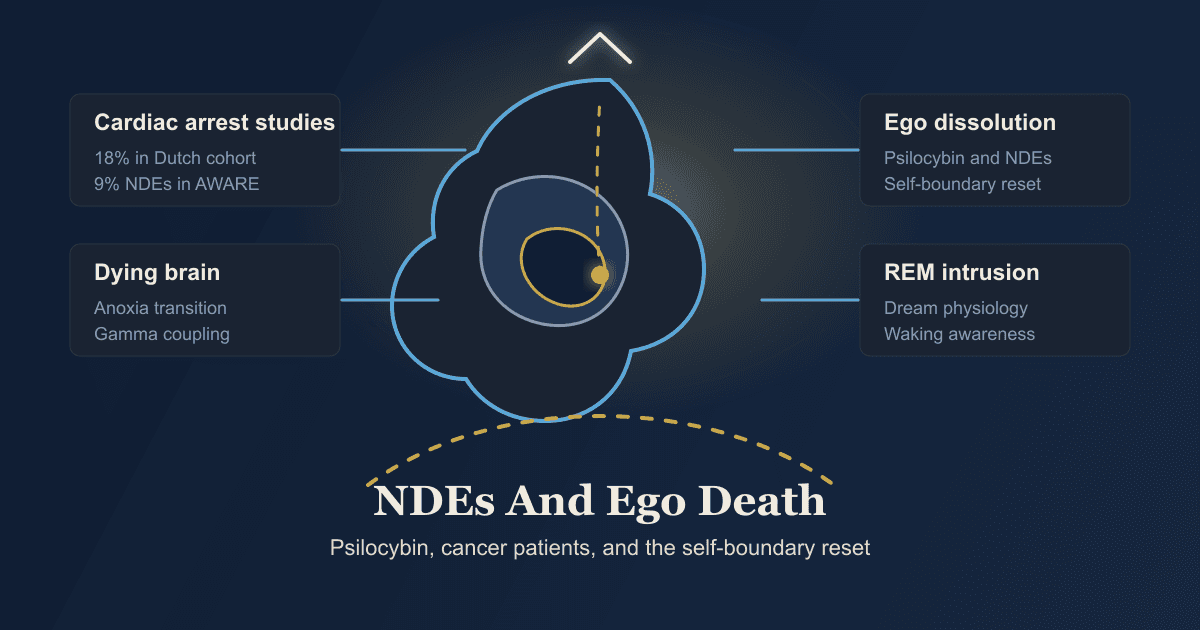
In a prospective Dutch cardiac arrest study, 344 resuscitated cardiac patients were interviewed, and 18% reported an NDE, with 12% describing a core experience R.
In the original AWARE study, 2060 cardiac arrest events produced 140 stage-one interviews, 9% reported NDEs, and 2% described explicit awareness with recall of seeing or hearing actual resuscitation events R.
AWARE II extended this multicenter approach and attempted to pair survivor reports with physiologic and cognitive monitoring during resuscitation R.
The ego-death part of the NDE usually comes from a cluster of features, not one isolated vision.
The ego-death features of NDEs include: (not exclusive list)
- Autobiographical compression (life review collapses the normal timeline into a single field of meaning)
- Body disidentification (the person no longer feels identical to the physical body)
- Boundary loss (the separation between self, light, presence, memory, and environment becomes less fixed)
- Death acceptance (the body may still be in crisis, but fear can drop out of the experience)
- Moral salience (relationships, harm, love, regret, and forgiveness become more important than status or control)
- Return with identity change (the person often comes back with altered priorities and a different relationship to death)
This is why NDEs can change people who had no interest in meditation, psychedelics, or spirituality before the event.
The state bypasses ideology.
The body delivers the death rehearsal first, and the meaning-making system catches up later.
Psilocybin, Cancer Patients, And Death Acceptance
Psilocybin is the best-studied pharmacologic model for voluntary ego dissolution in people facing death.
The cancer-patient studies matter because they test the same existential target that NDEs hit spontaneously: fear of death, loss of control, and identification with the threatened body.
In the Johns Hopkins randomized double-blind trial, psilocybin produced substantial and sustained decreases in depression and anxiety in patients with life-threatening cancer R.
In the NYU randomized controlled trial, psilocybin-assisted psychotherapy produced rapid and sustained reductions in anxiety and depression in patients with life-threatening cancer R.
A long-term follow-up of the NYU cohort found that many improvements in psychiatric and existential distress persisted years later R.
The important mechanism is not simply "psilocybin makes people happy."
The stronger model is that psilocybin can generate a high-salience mystical-type or ego-dissolution experience that changes how the person relates to death, disease, and the self that is afraid.
Psilocybin fMRI work found decreased activity and connectivity in hub regions including the Default Mode Network (DMN), a network heavily involved in self-referential thought and autobiographical narrative R.
The DMN is not "the ego" in a simple cartoon way.
But when DMN integrity loosens, the repetitive self-story can become less dominant, and that can allow a direct experience of being more than the disease narrative.
For a cancer patient, that may mean the difference between "I am dying" and "death is happening to this body, but awareness is not only the fear-story."
That is an NDE-like reframing without needing cardiac arrest.
It should also be said plainly: psilocybin remains illegal in many places, can destabilize vulnerable people, and is not the same thing as casually taking mushrooms alone.
The cancer studies used screening, preparation, supported dosing, and integration.
How The Self-Model Breaks Open
The self is not one brain region.
It is a living model built from body signals, memory, prediction, threat detection, social identity, and narrative control.
NDEs, psilocybin, ketamine, meditation, breathwork, and extreme awe all perturb that model from different angles.
During oxygen loss, the brain can pass through unstable transition states before electrical silence, with animal models showing surges of coherence and connectivity during cardiac arrest R.
During psilocybin, the brain appears to relax high-level self-model constraints, especially in networks involved in autobiographical control and self-reference R.
During ketamine, N-Methyl-D-Aspartate (NMDA) receptor disruption can generate dissociation, analgesia, altered self-location, and NDE-like reports R R.
During REM intrusion, dream physiology can blend with waking awareness, creating paralysis, sensed presence, visual phenomena, and self-location distortions R.
These are not the same pathway.
They converge on a similar result: the ordinary self-model becomes less dominant for a short window.
Alternative Routes To Ego-Dissolution States
The goal is not to chase ego death.
The goal is to safely loosen the rigid self-model enough to reduce fear, defensiveness, and identification with pain.
Safer routes toward ego-dissolution states include: (not exclusive list)
- Awe practice (nature, music, art, night-sky exposure, and sacred architecture can shrink self-focus without destabilizing the nervous system)
- Breathwork (gentle paced breathing can alter interoception and threat physiology, but hypoxia-chasing and prolonged breath holds are the wrong lesson from NDEs)
- Death contemplation (structured reflection on mortality can reduce avoidance when done slowly and with psychological support)
- Floatation and sensory reduction (reduced sensory input can soften body boundaries in some people, but it can also intensify anxiety if the nervous system is not ready)
- Meditation (experienced meditators show differences in DMN activity and connectivity, which fits the idea that training attention can loosen self-referential processing R)
- Psilocybin-assisted therapy (the strongest clinical evidence for death-related ego dissolution is in screened, supported cancer-patient settings, not recreational use R R)
- Trauma-informed parts work (identity softens when the defensive parts of the self are understood rather than attacked)
The common denominator is controlled surrender.
Too little intensity leaves the ego untouched.
Too much intensity overwhelms the system and turns ego dissolution into panic, depersonalization, or spiritual bypassing.
The therapeutic window is the place where the self can loosen without the body deciding it is unsafe.
How To Integrate Ego Death
Ego death is not the treatment.
Integration is the treatment.
An NDE, psilocybin session, meditation retreat, or breathwork event can create a temporary opening, but the nervous system has to metabolize the opening into behavior.
The first step is writing down what happened before the story mutates.
Separate direct memory from interpretation, and separate interpretation from decisions.
The second step is translating the state into small value changes.
If the state showed you that relationships matter more than control, that has to become one conversation, one apology, one boundary, or one changed daily pattern.
The third step is nervous-system grounding.
If the experience caused panic, derealization, insomnia, impulsivity, or obsession with returning to the state, use trauma-informed therapy, sleep repair, social anchoring, and amygdala and insula retraining before doing anything more intense.
The fourth step is humility.
Ego death can make people less afraid of death, but it can also make people overconfident about what they think they saw.
That is why integration needs both meaning and skepticism.
What To Stay Away From
The main traps around ego death include: (not exclusive list)
- Breath-hold hypoxia (using oxygen deprivation to imitate an NDE is physiologically reckless)
- Chasing annihilation (wanting the ego gone forever is often depression, shame, trauma, or dissociation wearing spiritual language)
- Drug stacking (combining psychedelics, dissociatives, cannabis, MAOIs, lithium, stimulants, or sleep deprivation raises risk without making the insight cleaner)
- Messiah inflation (the ego returns through the back door as "I am special because I lost my ego")
- Skipping medical context (an NDE after fainting, seizure-like activity, overdose, cardiac symptoms, or head trauma still needs medical evaluation)
- Spiritual bypassing (using unity language to avoid grief, conflict, responsibility, or trauma work)
The state is not automatically wise.
The state is a high-plasticity window.
What you install in that window matters.
Testing And Clinical Context
There is no blood test, EEG pattern, or brain scan that proves ego death.
Testing is for the medical or psychiatric terrain around the experience.
Medical Workup
Chest pain, fainting, seizure-like activity, palpitations, head trauma, severe shortness of breath, overdose, or suspected arrhythmia should be handled as medical events.
Cardiac arrest studies show that recall and awareness can occur around resuscitation, but they do not make cardiac arrest safer or less urgent R R.
Blood And Urine Markers
Foundation Zoomer can assess anemia, electrolytes, kidney markers, liver markers, thyroid status, and glucose patterns that may matter when someone has fainting, weakness, altered awareness, or post-event fatigue.
Cardio Zoomer can assess cardiometabolic and vascular risk markers when the event involved chest pressure, palpitations, exertional symptoms, or cardiac risk context.
Nutrient Zoomer can assess B vitamins, minerals, fatty acids, and amino acids that may influence sleep, nervous-system stability, and post-event recovery.
Psychiatric Screening
Psychedelic-assisted therapy research screens for psychiatric risk because ego dissolution can destabilize people with bipolar mania, psychosis vulnerability, severe dissociation, or poor support.
This is not moral judgment.
It is state-dependent neurobiology.
Mechanisms Of Action
Simple:
- Ego death happens when the brain's ordinary self-story becomes less dominant.
- NDEs can produce ego death because death threat forces a direct break in body identification.
- Psilocybin can produce ego dissolution by loosening self-referential network control.
- Meditation can approach the same territory more slowly by training attention away from self-narration.
Advanced:
- Anoxia-transition dynamics involve cortical depolarization, altered inhibitory tone, glutamate stress, and transient network reorganization during oxygen and energy failure R
- Default Mode Network loosening may reduce the dominance of autobiographical self-reference during psilocybin and experienced meditation R R
- DMT and 5-HT2A signaling can model parts of the NDE phenomenology, but mammalian brain DMT data do not prove a large endogenous DMT surge at death R R R
- Gamma coupling and dying-brain coherence may reflect transient integration during state collapse, but EEG activity is not automatically equal to reportable consciousness R R
- NMDA receptor disruption can produce dissociation, analgesia, altered self-location, and unusual salience, which is why ketamine is one of the stronger pharmacologic models of NDE-like states R R
- REM intrusion and arousal-system instability can blend paralysis, dream imagery, sensed presence, and waking awareness, which may explain some NDE-like episodes outside cardiac arrest R
Genetics
No Clinically Useful Ego-Death Gene
There is no clinically useful genetic test that predicts ego death, NDEs, or mystical experience.
That is the most important genetics point.
Genes affecting serotonin signaling, dopamine salience, sleep architecture, migraine aura, glutamate balance, COMT, or APOE may influence the nervous-system terrain, but none of that becomes an ego-death gene.
COMT
COMT helps clear catecholamines, and variation in catecholamine tone can shape stress reactivity, salience, sleep, and threat encoding.
That could change the terrain around an extreme state without explaining the state itself.
HTR2A
HTR2A encodes the serotonin 2A receptor, the major receptor target for classic psychedelics.
It is mechanistically relevant to psilocybin states, but it should not be framed as an ego-death gene.
KCNS And CACNA Channels
Potassium and calcium channel genes can shape excitability, migraine aura vulnerability, seizure threshold, and cortical spreading phenomena.
They may matter in people whose NDE-like or ego-dissolution episodes overlap with migraine, seizure-like events, or sensory auras.
More Research
- A prospective Dutch cardiac-arrest study found NDE reports in 18% of successfully resuscitated patients, but the experience was not simply explained by arrest duration, unconsciousness duration, medication, or fear before arrest R
- Clinical psilocybin cancer trials are best understood as supported death-rehearsal and ego-dissolution protocols, not generic mood-enhancement studies R R
- DMT can model several NDE features, but the pineal death-flood story is still a hypothesis, not an established human mechanism R R
- Ego dissolution can be measured as an acute psychedelic effect, but measurement does not tell you whether the interpretation attached to the state is accurate R
- For biomarker testing I use the Foundation Zoomer for broad physiologic screening, the Cardio Zoomer for cardiovascular context, and the Nutrient Zoomer when recovery, sleep, or nervous-system stability is part of the post-event picture.
- Meditation and psilocybin both intersect with self-referential network dynamics, but meditation is slower, more trainable, and less likely to overwhelm the system when practiced gradually R R
Jacob Gordon
INHC, FMT-C
Board Certified Health Coach
I spent years battling unexplained chronic illness before discovering biohacking, epigenetics, and functional medicine. Now I share that research at MyBioHack to help others find their own answers.
Book a ConsultationRelated Protocols & Supplements
Deep-dive chapters and recommended supplements for this topic
Lion's Mane
1000mg/day
Omega-3 (DHA)
2g/day
Phosphatidylserine
100mg 3x/day