7 Benefits of Spermidine (Autophagy, Longevity, And How To Get It From Food)
By Jacob Gordon, INHC, FMT-CThis article contains affiliate links. As an Amazon Associate, MyBioHack earns from qualifying purchases at no extra cost to you. We only link products we research and stand behind.
Spermidine is a natural polyamine that triggers autophagy, the cellular cleanup process that declines with age and that fasting is famous for activating.
In this post, we will discuss what spermidine is, its evidence-based benefits, where the human data is strong and where it is weak, the best food sources, and how to dose it.

What Is Spermidine
Spermidine is a polyamine, a small molecule your cells make, your gut bacteria produce, and you eat in food.
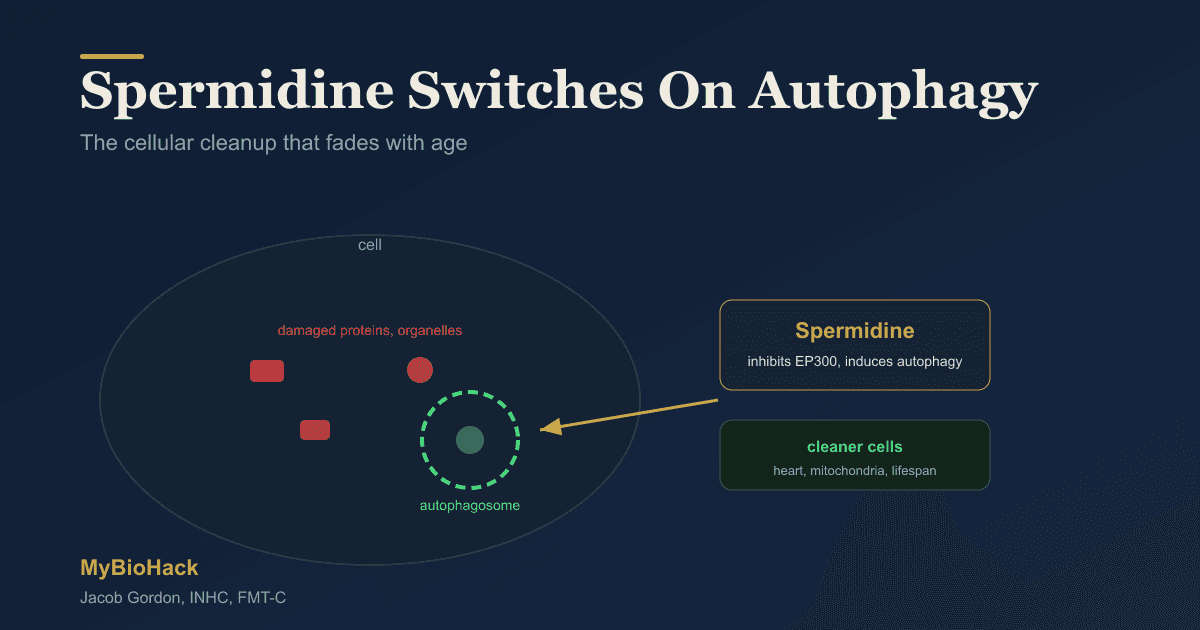
Its defining action is the induction of autophagy, the process by which a cell digests and recycles its own damaged components.
Autophagy declines with age, and that decline tracks with most age-related disease, which is why a compound that restores it is interesting for longevity.
Spermidine is the same pathway fasting works through, which makes it a tool for people who cannot or will not fast continuously.
Benefits Of Spermidine

1. Extends Lifespan In Animals
Oral spermidine extends lifespan in yeast, flies, worms, and mice, and the effect depends on autophagy. R
When the autophagy gene Atg5 is removed, the benefit disappears, which confirms autophagy is the mechanism rather than a side effect. R
2. Protects The Heart
In mice, spermidine reduced cardiac hypertrophy, preserved diastolic function, and improved mitochondrial respiration. R
In humans, higher dietary spermidine intake is associated with lower blood pressure and a lower incidence of cardiovascular disease. R
3. Supports Brain Aging (With An Honest Caveat)
This is where the evidence splits, and it is worth being clear about.
A small pilot trial found that spermidine improved memory in older adults with subjective cognitive decline. R
But the larger and more rigorous 12-month SmartAge trial found no memory or biomarker benefit from a wheat germ spermidine supplement compared to placebo. R
The dietary epidemiology still leans positive, with higher food intake associated with lower dementia risk, but the clean supplement trial was null.
So the honest read is that food-level spermidine looks protective, while the isolated supplement has not proven itself for memory.
4. Preserves Telomere Length
Spermidine supplementation has been associated with preserved telomere length, a marker of cellular aging. R
5. Improves Mitochondrial Function
By clearing damaged mitochondria through mitophagy, spermidine supports the quality of the mitochondrial pool rather than just the quantity. R
6. Supports Immune Function
Restoring autophagy improves the function of aging immune cells, part of why spermidine is studied as a geroprotector. R
7. Reduces Subclinical Inflammation
Spermidine feeding suppressed low-grade inflammation alongside its cardioprotective effects in animal models. R
Natural Sources
The strongest mortality data comes from dietary spermidine, not isolated supplements, so food is the first line.
The highest spermidine foods include: (not exclusive list)
- Aged cheese (concentration rises with aging time)
- Legumes (especially soybeans and chickpeas)
- Mushrooms (shiitake and king trumpet are highest)
- Natto (fermented soybeans, one of the densest sources)
- Nuts and seeds
- Wheat germ (the most concentrated common source at roughly 24 to 35 mg per 100 g)
A tablespoon of Wheat Germ on cereal or in a smoothie provides roughly 2 to 2.5 mg, which is in the range used in human trials.
Natto and a regular rotation of mushrooms and legumes build a meaningful daily load without any supplement.
Dosage And Safety
Human trials have generally used 0.9 to a few milligrams per day of spermidine from concentrated wheat germ extract.
At food-derived amounts there are no identified safety concerns.
Spermidine (Wheat Germ Extract): the form used in human studies, for those who want a standardized dose.
Isolated spermidine at very high doses has not been studied for long-term human safety, which is another reason to anchor intake in food.
Because spermidine works through autophagy, it pairs logically with fasting and exercise rather than competing with them.
Mechanisms Of Action
Simple:
- Spermidine tells your cells to clean out their own damaged parts.
- That cleanup process, called autophagy, normally fades as you age.
- The same process is what fasting switches on, so spermidine is a food-based way to nudge it.
- Cleaner cells, especially heart and mitochondria, is the through-line behind most of its benefits.
Advanced:
- Autophagy induction Spermidine inhibits acetyltransferases such as EP300 and promotes autophagy-dependent geroprotection, with lifespan benefits lost when core autophagy genes are knocked out. R
- Cardioprotective mitophagy Spermidine enhances cardiac autophagy and mitophagy, improves mitochondrial respiration, and increases titin phosphorylation to preserve diastolic function. R
- Lifespan extension Oral spermidine extends mammalian lifespan and reduces cardiovascular aging in an autophagy-dependent manner. R
Genetics
AMD1
AMD1 encodes a rate-limiting enzyme in polyamine synthesis, which influences how much spermidine your body makes on its own.
Variation in polyamine-pathway genes may explain why baseline spermidine levels differ between people.
ODC1
ODC1 encodes ornithine decarboxylase, the first committed step in producing the polyamines that spermidine is part of.
Activity here sets the tone for endogenous polyamine production.
More Research
- A 2022 review in Nature Aging details how spermidine induces autophagy through EP300 inhibition and why this underlies its geroprotective effects. R
- The landmark 2016 Nature Medicine study established mammalian lifespan extension and cardioprotection from oral spermidine. R
- The 12-month SmartAge randomized trial is the most important negative result, finding no memory benefit from a wheat germ spermidine supplement, which tempers the supplement hype. R
Where To Go From Here
Spermidine is one lever in a much larger autophagy and longevity picture that also includes fasting, exercise, and mitochondrial support.
If you want the full framework for how autophagy fits into recovery and aging, the Junction Dysfunction guide goes deep on the mitochondrial and cleanup mechanisms, and it is included with the Path plan at $120 a year.
If you are tracking your own longevity and metabolic markers over time, the Health Hub does that and comes with the Pro plan at $180 a year, along with unlimited use of the Biohacking Bot to help you build a stack around your goals.
You can also just start with a tablespoon of wheat germ.
That is the part the strongest evidence actually supports.
Jacob Gordon
INHC, FMT-C
Board Certified Health Coach
I spent years battling unexplained chronic illness before discovering biohacking, epigenetics, and functional medicine. Now I share that research at MyBioHack to help others find their own answers.
Book a ConsultationRelated Protocols & Supplements
Deep-dive chapters and recommended supplements for this topic
Lion's Mane
1000mg/day
Omega-3 (DHA)
2g/day
Phosphatidylserine
100mg 3x/day