8 Benefits Of MOTS-c: The Mitochondrial-Derived Peptide And Exercise Mimetic
By Jacob Gordon, INHC, FMT-CThis article contains affiliate links. As an Amazon Associate, MyBioHack earns from qualifying purchases at no extra cost to you. We only link products we research and stand behind.
MOTS-c is a tiny peptide your mitochondria make under metabolic stress that behaves like a molecular message telling the rest of the cell "you just exercised."
In this post, we will discuss what MOTS-c is, the benefits backed by rodent and early human data, how to raise it naturally, the injectable-peptide reality, and the mechanisms and genetics behind it.

What Is MOTS-c
Mitochondrial Open Reading Frame of the 12S rRNA type-c (MOTS-c) is a 16-amino-acid peptide encoded not in your nuclear DNA but inside the mitochondrial genome itself. R
Specifically, it is read from a short open reading frame tucked inside the 12S ribosomal RNA gene (MT-RNR1), which makes it unusual among signaling peptides, almost all of which are nuclear-encoded. R
MOTS-c belongs to a small family called Mitochondrial-Derived Peptides (MDPs), microproteins translated from tiny reading frames hidden in mitochondrial DNA. R
Its better-known sibling is Humanin, the first MDP ever discovered, and the family also includes the six small humanin-like peptides (SHLP1 through SHLP6). R
If Humanin is the family's cytoprotective survival signal, MOTS-c is the metabolic one, tuned to energy status and physical stress.
MOTS-c was first characterized in 2015, when it was shown to activate AMP-Activated Protein Kinase (AMPK) and improve insulin sensitivity in mice. R
What makes it genuinely strange is that it does not just circulate in the blood.
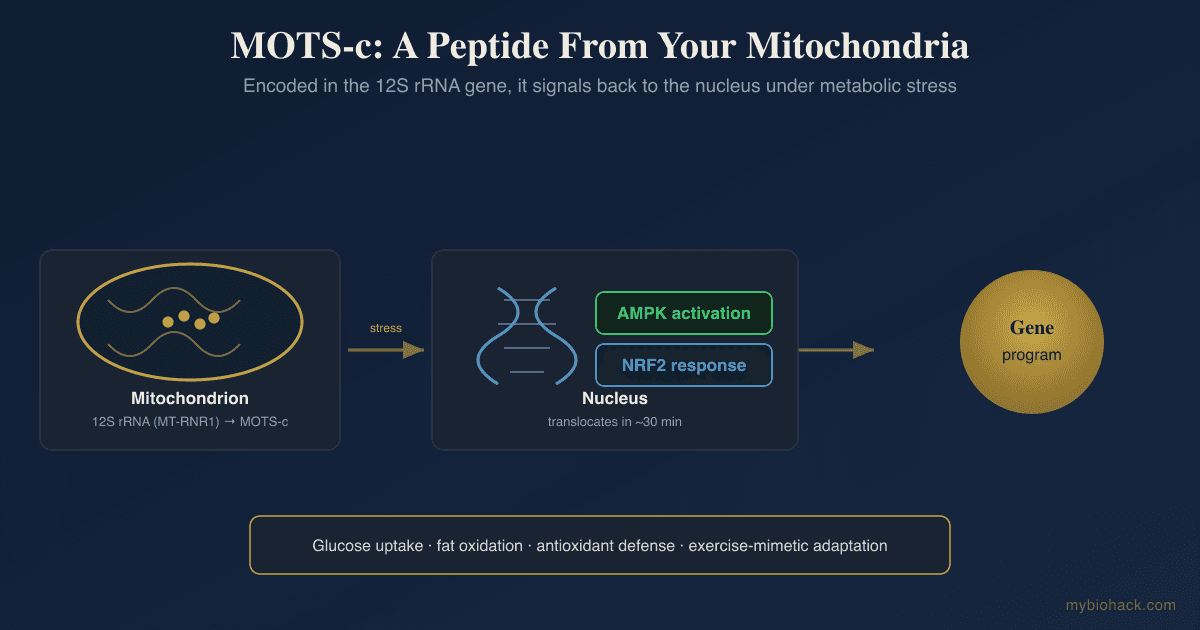
Under metabolic stress (glucose restriction, fasting, oxidative stress, or exercise), MOTS-c translocates from the mitochondria into the nucleus within about half an hour and directly influences which nuclear genes get switched on. R
That is retrograde signaling, the mitochondria talking back to the cell's control room, and MOTS-c is one of the clearest examples of it. R
Circulating MOTS-c is measurable in human plasma, and it declines as we age, which is part of why it attracts so much longevity interest. R
One honest caveat up front, most of the causal efficacy data comes from rodents, while the human data is largely association and expression work.
8 Benefits Of MOTS-c
I have ranked these by strength of evidence rather than alphabetically, because the gap between "shown in mice" and "shown in people" is the whole story with this peptide.
1. It Improves Insulin Sensitivity And Glucose Homeostasis
This is the founding observation and the most robust in animals.
In the 2015 discovery work, injected MOTS-c increased glucose uptake in skeletal muscle and prevented both diet-induced and age-related insulin resistance in mice. R
The effect was tied directly to AMPK activation, the same energy-sensing pathway that metformin and exercise recruit. R
In humans the link is currently correlational, lower endogenous MOTS-c tracks with worse metabolic status rather than proving that raising it fixes anything. R
2. It Acts As An Exercise Mimetic And Restores Physical Capacity
MOTS-c is exercise-induced, meaning a single bout of exercise raises it in human skeletal muscle and in circulation. R
In aged mice (roughly the equivalent of 65 to 70 human years), MOTS-c injected three times a week roughly doubled treadmill running capacity and let them outperform untreated middle-aged animals. R
Even when treatment started in late life, intermittent MOTS-c improved physical capacity and healthspan markers, which is why it gets called an exercise mimetic. R
Human work shows that long-term physical activity is associated with higher skeletal muscle MOTS-c, reinforcing the idea that it is part of how exercise pays off at the cellular level. R
This puts it conceptually alongside other exercise mimetics that route through AMPK and PGC-1alpha, though MOTS-c is the only one your own mitochondria manufacture on demand.
3. It Activates AMPK, The Cell's Master Energy Sensor
AMPK is the switch that flips when cellular energy runs low, shifting metabolism toward glucose uptake, fat burning, and mitochondrial maintenance.
MOTS-c activates it indirectly by interfering with the folate one-carbon cycle, which causes the AMPK-activating intermediate AICAR to accumulate. R
The nuclear arm of this effect is also AMPK-dependent, so MOTS-c is essentially an endogenous AMPK agonist that works from two directions at once. R
This overlaps with the broader logic of routing autophagy and mitochondrial biogenesis through the AMPK and mTOR axis.

4. It Reduces Diet-Induced Obesity And Improves Fat Metabolism
In mice fed a high-fat diet, MOTS-c treatment reduced fat accumulation and prevented diet-induced obesity. R
The peptide shifts skeletal muscle and fat tissue toward using glucose and lipids more efficiently, which is the metabolic-flexibility benefit people are chasing when they talk about it. R
There is no human weight-loss trial here, so treat this as a mechanistic promise, not a proven fat-loss tool.
5. It Strengthens Antioxidant Defenses Through NRF2
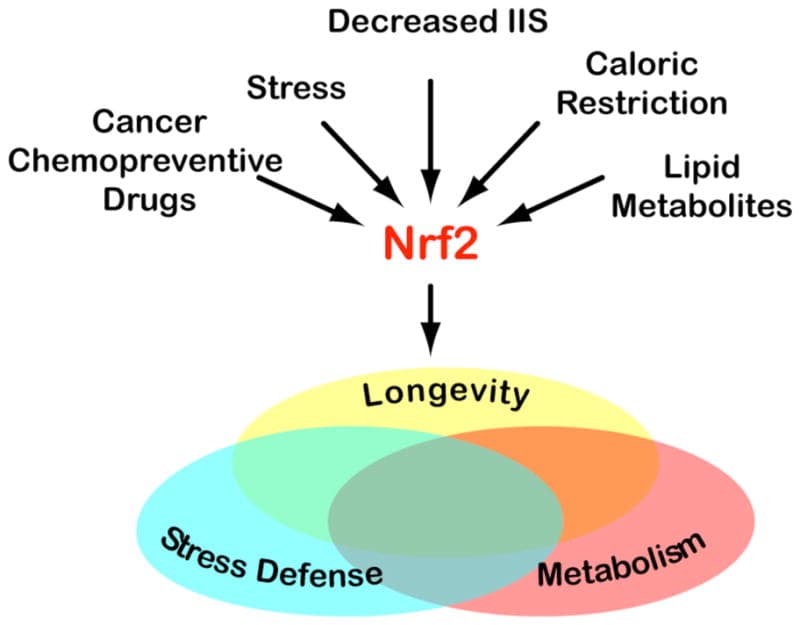
Once inside the nucleus, MOTS-c interacts with Nuclear Factor Erythroid 2-Related Factor 2 (NRF2), the transcription factor that governs the cell's antioxidant response. R
It preferentially switches on genes carrying antioxidant response elements, which is how a metabolic peptide ends up buffering oxidative stress. R
NRF2 is a hub you will see again and again in mitochondrial and redox biology, and MOTS-c is one of the endogenous levers that pulls it.
6. It Supports Vascular And Endothelial Function
Circulating MOTS-c is significantly lower in patients with coronary endothelial dysfunction than in people with healthy vessels. R
That association is interesting because the endothelium is a high-energy tissue, and MOTS-c may reflect (or help maintain) mitochondrial competence in the vessel wall. R
This is human data, but it is cross-sectional, so it tells us MOTS-c is a marker of vascular health, not yet that supplementing it repairs vessels.
7. It Protects Against Bone Loss
In an ovariectomy model of osteoporosis (the standard rodent stand-in for postmenopausal bone loss), MOTS-c reduced bone loss by inhibiting osteoclast differentiation through AMPK. R
It appears to work on both sides of bone remodeling, restraining the cells that break bone down while nudging the cells that build it up. R
Again this is a rodent finding, but it fits the pattern of a peptide that defends energy-hungry, high-turnover tissues.
8. It Tracks And May Buffer Age-Related Metabolic Decline
Plasma MOTS-c falls with age in humans, and MDPs as a family decline with age across tissues. R
There is a genuine paradox worth sitting with here, while circulating MOTS-c drops with age, skeletal muscle MOTS-c expression is actually about 1.5-fold higher in older and middle-aged men than in young men. R
The leading interpretation is that aging muscle ramps up local production as a compensatory response while losing the ability to release the peptide into circulation. R
That single observation is a good reminder that "low blood levels" and "make more of it" are not the same intervention.
How To Raise MOTS-c Naturally
The honest headline is that exercise is the only validated way to raise your own MOTS-c.

Exercise
Both acute exercise and long-term training raise MOTS-c in human skeletal muscle and blood, and this is the single best-supported lever you actually control. R R
Endurance and higher-intensity work both trigger the metabolic-stress signal that MOTS-c is built to respond to.
Fasting And Metabolic Stress
MOTS-c translocates to the nucleus specifically in response to glucose restriction, fasting, and oxidative stress, so time-restricted eating and fasting are plausible endogenous triggers. R
This is the same stress-signaling territory covered in neuropeptides, autophagy, and the mTOR/AMPK axis, and it overlaps with the NAD and NADPH redox machinery that fasting also engages.
Downstream AMPK Support (Not The Same As Raising MOTS-c)
Nothing you swallow has been shown to raise MOTS-c itself, so be skeptical of any supplement marketed that way.
That said, compounds that hit the same downstream node can be reasonable adjacents, as long as you understand they act below MOTS-c, not on it.
Berberine activates AMPK directly and is the closest over-the-counter analog to the metabolic arm of MOTS-c signaling (it does not raise the peptide).
Metformin is the prescription version of the same idea, also converging on AMPK.
Adjacent Mitochondrial Tools
If your actual goal is mitochondrial function rather than MOTS-c per se, several better-studied oral options exist.
These work through different mechanisms and do not raise MOTS-c, but they belong in the same conversation.
- Methylene blue (alternative electron carrier in the respiratory chain)
- Oxaloacetate (NAD+ ratio and fatigue)
- PQQ (mitochondrial biogenesis)
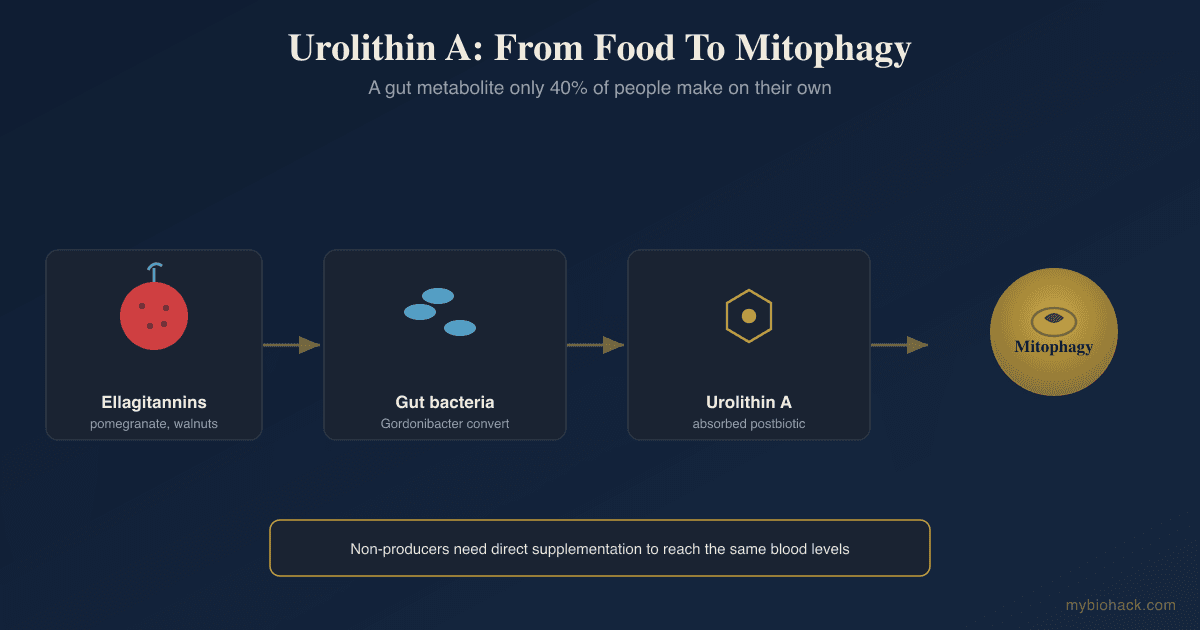
- Urolithin A (mitophagy)
Dosage And Safety
This is the section where the enthusiasm has to meet reality.
MOTS-c has no oral form.
As a peptide it is digested in the gut, so every research and clinical use has been by subcutaneous injection. R
There is no established human dose.
The rodent studies used weight-based dosing (commonly in the range of about 0.5 to 15 mg/kg depending on the model), which does not translate cleanly to a human protocol. R
The peptide clears from plasma quickly, with a short half-life on the order of tens of minutes in animals, while its biological effect outlasts that because the real action is transcriptional. R
On safety, the honest answer is that we do not have much.
No published, peer-reviewed human pharmacokinetic or safety trial of administered MOTS-c has read out, and the reported effects from research and off-label use are mostly mild injection-site reactions. R
Regulatory status matters here too.
MOTS-c is not an FDA-approved drug, and as of 2026 it is available only as a research chemical or through compounding channels, an area that has come under tightening regulatory scrutiny for peptides generally.
I am walking through the science because it is legitimately interesting, not because I am telling you to inject an unapproved peptide with no human safety file.
If you want personalized guidance on any of this, that is a consultation conversation, not a self-experiment.
Mechanisms Of Action
Simple:
- MOTS-c is a small signal your mitochondria release when energy is low or you are under physical stress, and it tells the cell to burn fuel more efficiently.
- It flips on AMPK, the same "you need energy" switch that exercise and fasting activate.
- It can move into the nucleus and change which genes turn on, including genes that protect against oxidative damage.
Advanced:
- Folate cycle and AICAR-driven AMPK activation MOTS-c inhibits the folate one-carbon cycle and its tethered de novo purine biosynthesis, causing the intermediate AICAR (ZMP) to accumulate, and AICAR is a classic allosteric activator of AMPK. R
- Retrograde mito-to-nuclear signaling Under glucose restriction, serum deprivation, or oxidative stress, MOTS-c translocates from mitochondria to the nucleus within roughly 30 minutes in an AMPK-dependent manner and regulates a broad stress-response gene program. R
- NRF2 and the antioxidant response element In the nucleus MOTS-c interacts with NRF2 (NFE2L2) and other stress-responsive transcription factors to activate genes bearing antioxidant response elements, linking metabolic sensing to redox defense. R
- Skeletal muscle proteostasis and adaptation MOTS-c regulates nuclear genes tied to metabolism and proteostasis in muscle, which is the proposed basis for its exercise-mimetic effect on physical capacity. R
Genetics
MT-RNR1
MT-RNR1 is the mitochondrial 12S ribosomal RNA gene, and the short reading frame that encodes MOTS-c sits inside it.
Because it is mitochondrial, MOTS-c is inherited maternally, and variation in this region can alter the peptide itself.
rs111033358 (m.1382A>C) is the well-studied variant, changing the 14th amino acid from lysine to glutamine (the K14Q substitution). R
MT-RNR1 (m.1382A>C, K14Q): Highest-Studied Metabolic Risk Variant
This variant is essentially specific to the Northeast Asian population and sits within mitochondrial haplogroup D4b2, which is otherwise associated with exceptional longevity. R
The K14Q form of MOTS-c is a weaker insulin-sensitizer, and across large cohorts men (but not women) carrying the C-allele show a higher prevalence of type 2 diabetes. R
The most useful part is the gene-by-environment finding, the diabetes risk clustered in male carriers with the lowest physical activity, so exercise appeared to blunt the genetic penalty. R
In other words, the same lever that raises MOTS-c (movement) is also what compensates for the less-functional version of it.
More Research
Association is not causation (the recurring caveat): the human MOTS-c literature is dominated by cross-sectional and expression studies, while the interventional efficacy data is still overwhelmingly rodent, so I read the injectable-peptide hype with that gap firmly in mind. R
For biomarker testing I use the Insulin Resistance Panel (Quest) or a standalone Fasting Insulin to track the metabolic axis MOTS-c is supposed to influence, since insulin sensitivity is the readout that actually matters to most people asking about this peptide.
MOTS-c and post-viral fatigue is one I flag as my own hypothesis rather than settled science, given that mitochondrial dysfunction in skeletal muscle is now well documented in long COVID and related post-viral states, and a peptide that senses and defends mitochondrial energy status is at least mechanistically interesting there. R
I connect that thread to my Junction Dysfunction work on why energy-starved, stressed tissue struggles to recover, but I want to be clear that no one has tested MOTS-c as a post-viral therapy.
The muscle-versus-plasma paradox remains genuinely unresolved, older muscle expresses more MOTS-c while blood levels fall, and until we understand the secretion defect it is unclear whether "low circulating MOTS-c" is a cause of aging or a downstream readout of it. R
The MDP family is bigger than MOTS-c, and the sibling peptide Humanin has its own aging and neuroprotection literature, so the smarter framing is probably mitochondrial-derived peptides as a signaling system rather than MOTS-c as a single magic molecule. R
If you want to go deeper on any of this, the Biohacking Bot can pull the specific studies and cross-reference them against your own labs and goals.
Jacob Gordon
INHC, FMT-C
Board Certified Health Coach
I spent years battling unexplained chronic illness before discovering biohacking, epigenetics, and functional medicine. Now I share that research at MyBioHack to help others find their own answers.
Book a ConsultationRelated Protocols & Supplements
Deep-dive chapters and recommended supplements for this topic
Quercetin
500mg 2x/day
Vitamin D3 + K2
5000 IU + 200mcg/day
Magnesium Glycinate
400mg at bedtime