Urolithin A: Mitophagy, Muscle, And The Mitopure Question
By Jacob Gordon, INHC, FMT-CThis article contains affiliate links. As an Amazon Associate, MyBioHack earns from qualifying purchases at no extra cost to you. We only link products we research and stand behind.
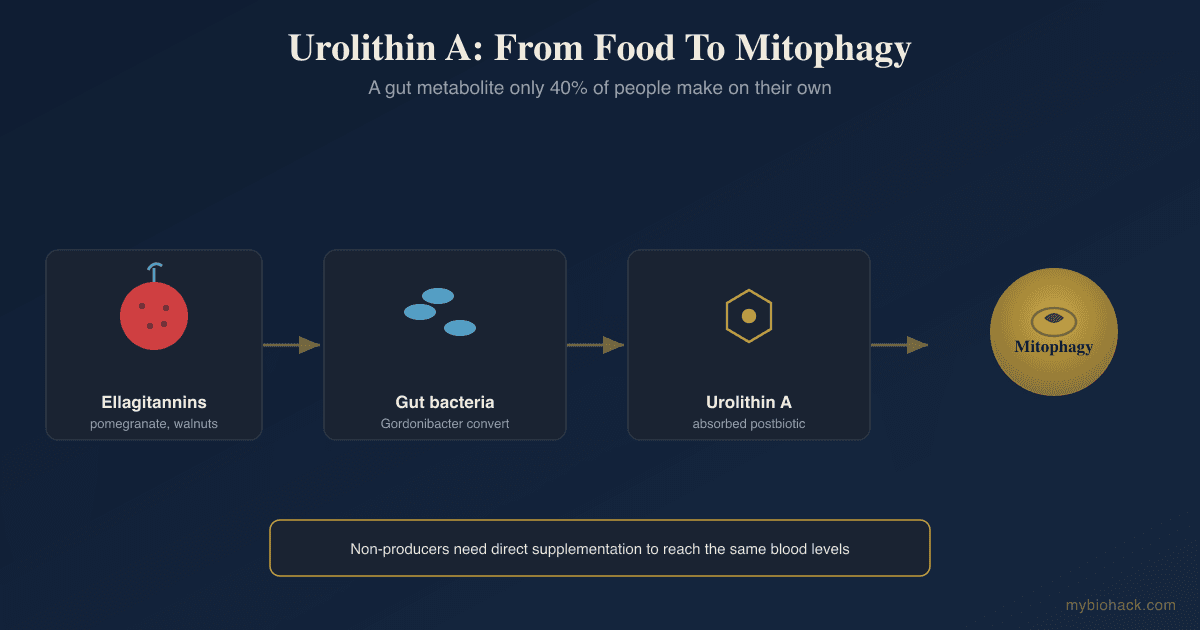
Urolithin A is a gut bacterial metabolite that switches on mitophagy, the recycling program that clears out damaged mitochondria, but only about 40% of people make meaningful amounts of it on their own.
In this post, we will discuss what urolithin A is, the benefits backed by human trials, where it comes from, how to dose it, the producer versus non-producer problem, and the mechanisms and genetics behind it.

What Is Urolithin A
Urolithin A (UA) is not something you eat directly.
It is a postbiotic, meaning your gut bacteria make it from precursors in food.
The precursors are ellagitannins and ellagic acid, polyphenols found in pomegranate, walnuts, and certain berries.
When the right microbes are present, they convert ellagic acid through a series of steps into urolithin A, which is absorbed far better than the parent compounds. R
The reason urolithin A matters is mitophagy, the selective autophagy pathway that identifies worn-out mitochondria and recycles them before they leak reactive oxygen species and damage the cell.
Mitophagy declines with age, and the buildup of dysfunctional mitochondria is one of the recognized drivers of aging and frailty.
Urolithin A is the first oral compound shown to induce mitophagy in animals after normal dietary consumption, and it is the only mitophagy inducer with multiple placebo-controlled human trials behind it. R
The catch is that not everyone makes it.
Roughly 40% of people are urolithin A "producers" with a microbiome capable of the full conversion, while the rest produce little or none no matter how much pomegranate they eat. R
That single fact is why direct supplementation exists and why it is not redundant with diet.
Benefits Of Urolithin A
The human evidence is unusually good for a supplement of this class, though most of the funded trials come from one company.
I have ranked these by strength of evidence rather than alphabetically because the order is the whole point.
1. It Induces Mitophagy
This is the headline mechanism and the most replicated.
In worms, urolithin A prevented the age-related accumulation of dysfunctional mitochondria and extended lifespan, and in rodents it improved exercise capacity in two separate models of age-related muscle decline. R
In the first human trial, four weeks of 500 mg or 1,000 mg shifted skeletal muscle mitochondrial gene expression and plasma acylcarnitine profiles in a direction consistent with improved mitochondrial function. R
This places it in the same conceptual family as autophagy inducers like spermidine, but acting specifically on the mitochondrial subset.
2. It Improves Muscle Strength And Exercise Performance
In a four-month randomized, double-blind, placebo-controlled trial in overweight middle-aged adults, urolithin A increased muscle strength by roughly 12% versus placebo. R
The same trial showed clinically meaningful improvements in aerobic endurance (peak oxygen consumption) and in the six-minute walk test. R
There is a big caveat here, the predefined primary endpoint (peak power output) did not reach significance, so the strength and endurance findings are secondary outcomes. R
3. It Improves Muscle Endurance In Older Adults
A separate four-month randomized clinical trial in adults aged 65 to 90 tested muscle fatigue resistance. R
Participants taking urolithin A performed significantly more contractions before fatigue in both hand and leg muscles compared to placebo. R
This is the population where sarcopenia matters most, so endurance gains without a training program are meaningful.
4. It Lowers Biomarkers Of Mitochondrial Dysfunction And Inflammation
Beyond performance, urolithin A moves the blood markers that track mitochondrial stress.
Across trials it reduced plasma acylcarnitines and ceramides, both of which rise when fat oxidation in mitochondria is impaired. R
It also lowered C-reactive protein, a general marker of systemic inflammation. R
5. It Strengthens The Gut Barrier
Urolithin A acts directly on the intestinal lining, which makes sense given that is where it is produced.
In preclinical colitis models, urolithin A and a synthetic analogue enhanced gut barrier integrity by upregulating tight junction proteins through the aryl hydrocarbon receptor (AhR) and NRF2 pathways, while reducing inflammation. R
This is relevant to anyone working on dysbiosis and intestinal permeability, though the barrier data are still animal and cell based.
6. It Counters Immune Aging
A 2025 randomized, placebo-controlled trial gave 1,000 mg per day to healthy middle-aged adults for four weeks. R
Urolithin A expanded naive-like, less exhausted CD8+ T cells and increased their fatty acid oxidation capacity, shifting the immune profile in a younger direction. R
This is the same mitochondrial fitness mechanism applied to immune cells rather than muscle.
7. It May Protect The Aging Brain
Mitophagy failure is implicated in neurodegeneration, and restoring it inhibits amyloid-beta and tau pathology and reverses cognitive deficits in Alzheimer's models. R
In a mouse model of Alzheimer's, urolithin A reduced amyloid-beta load and improved cognitive deficits. R
This is genuinely preliminary (animal models only), so treat the brain claims as a hypothesis, not an established human benefit.
Natural Sources
The foods that contain the precursors are not the foods that guarantee the product.
You need both the ellagitannins and the gut bacteria to turn them into urolithin A.
Foods richest in ellagitannins and ellagic acid (precursors only):
- Blackberries
- Pomegranate (juice, arils, and especially the peel and membrane)
- Raspberries
- Strawberries
- Walnuts
Here is the problem.
When researchers gave people pomegranate juice, only about 40% converted the precursors into meaningful urolithin A, because the rest lacked the necessary microbes. R
Direct urolithin A supplementation produced more than six times the plasma exposure of pomegranate juice and, crucially, raised levels consistently across everyone regardless of their microbiome. R
So eating pomegranate and walnuts is worthwhile for many reasons, but it is not a reliable way to get urolithin A unless you already know you are a producer.

Dosage And Safety
The doses used in the human trials are 500 mg and 1,000 mg per day. R
The 1,000 mg dose is where most of the muscle endurance, immune, and biomarker effects were strongest, while 500 mg was enough to move mitochondrial gene expression. R
Urolithin A is sold both as generic powder and as Mitopure, the branded synthetic form made by Amazentis that was used in nearly all of the published clinical trials.
The Mitopure question is worth addressing directly.
The generic and branded versions are the same molecule, so the difference is purity, dose verification, and the fact that the clinical data were generated on the branded material.
If you want the exact thing that was tested, that is Mitopure, but a third-party-tested generic at the same dose is chemically identical.
On safety, urolithin A had a favorable safety profile in the first-in-human trial with no serious adverse events. R
The four-month and four-week trials reported no difference in adverse events versus placebo, and it has self-affirmed GRAS status in the United States. R
There are no long-term human safety data beyond a few months, and pregnancy and lactation have not been studied, so those groups should avoid it.
Mechanisms Of Action

Simple:
- Urolithin A tells your cells to recycle their broken mitochondria and build new ones, which is the same thing fasting and exercise do, just through a different switch.
Advanced:
- Mitophagy induction. Urolithin A enhances the PINK1/Parkin pathway by increasing expression of both PINK1 and Parkin, the kinase-ligase pair that tags depolarized mitochondria for engulfment by autophagosomes. R
- AMPK and mTOR. It activates AMPK and inhibits mTOR, the central nutrient sensor that suppresses autophagy, mirroring the signaling state of calorie restriction and fasting. R
- Mitochondrial biogenesis. By raising PGC-1alpha, the master regulator of mitochondrial biogenesis, it couples the clearing of old mitochondria to the building of new ones, which is why this is exercise-like signaling rather than simple cleanup. R
- AhR and NRF2. In the gut epithelium it signals through the aryl hydrocarbon receptor to activate NRF2, upregulating tight junction proteins and antioxidant response genes to reinforce the barrier. R
- Immunometabolism. In CD8+ T cells it increases fatty acid oxidation capacity and preserves a naive-like, less exhausted phenotype, applying the same mitochondrial fitness gains to the immune compartment. R
Genetics
The genetics that matter most for urolithin A are not yours, they belong to your gut bacteria.
Gut Microbiome Metabotype
Whether you produce urolithin A is determined by your gut bacterial community, which sorts people into three metabotypes.
Metabotype A produces urolithin A, metabotype B produces a mix including isourolithin A and urolithin B, and metabotype 0 produces essentially none. R
The conversion depends on bacteria such as Gordonibacter and certain Enterocloster species that encode the dehydroxylase enzymes required to finish the pathway. R
Metabotype is not fixed for life, it shifts with age and with the composition of the microbiome, which is part of why producer status is unreliable. R
AHR
The aryl hydrocarbon receptor (AhR) is the host receptor that urolithin A binds in the gut to trigger barrier and antioxidant gene expression.
Variation in AhR signaling tone influences how strongly the gut-barrier and anti-inflammatory effects land, although urolithin A pharmacology has not been mapped to specific human AhR variants.
NFE2L2
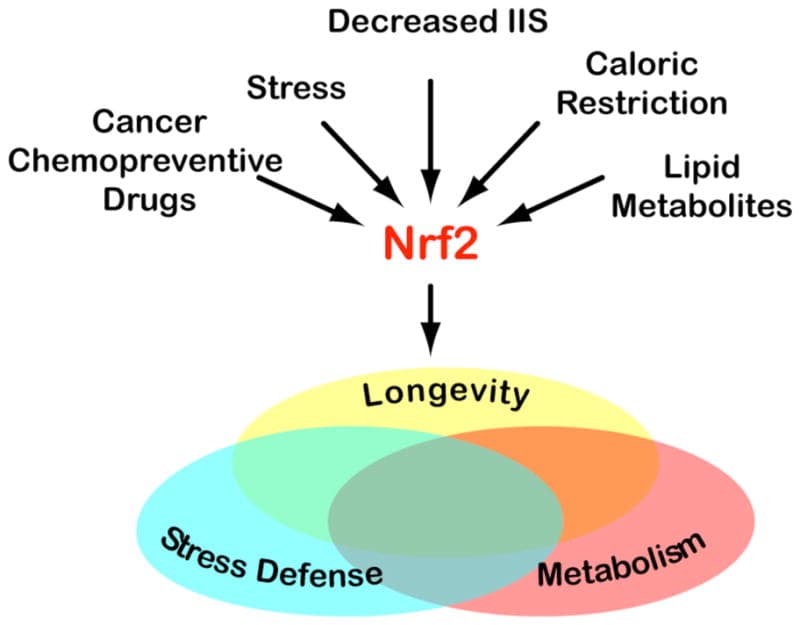
NFE2L2 encodes NRF2, the transcription factor downstream of AhR that drives the antioxidant and tight junction response.
This is the same pathway targeted by sulforaphane, so NRF2 tone shapes the overlap between the two.
More Research
The honest summary is that urolithin A has the best human mitophagy evidence of any supplement, with real but modest effect sizes and a notable funding caveat.
Most of the placebo-controlled trials were sponsored by Amazentis, the maker of Mitopure, which does not invalidate them but warrants independent replication.
Brain and gut-barrier benefits are still animal and cell based, so they are mechanistic promise rather than proven human outcomes. R
It pairs logically with other mitochondrial and longevity tools that act on adjacent pathways, including spermidine for broad autophagy and NAD+ for redox capacity, though no human trial has tested these combinations.
For tracking mitochondrial health biomarkers I use the Cellular Zoomer (Vibrant Wellness) to assess organic acids and oxidative stress, and the Cardio Zoomer (Vibrant Wellness) to track ceramides and inflammatory markers like C-reactive protein that urolithin A has been shown to lower.
The single biggest open question is the producer versus non-producer split, because the people most likely to benefit from supplementation are precisely the non-producers, and current trials have not consistently stratified results by baseline metabotype.
Jacob Gordon
INHC, FMT-C
Board Certified Health Coach
I spent years battling unexplained chronic illness before discovering biohacking, epigenetics, and functional medicine. Now I share that research at MyBioHack to help others find their own answers.
Book a ConsultationRelated Protocols & Supplements
Deep-dive chapters and recommended supplements for this topic
Spore-Based Probiotics
1 cap with food
L-Glutamine
5g 2x/day on empty stomach
Butyrate
300mg 2x/day with meals