The 6+ Benefits Of Horopito (Pseudowintera Colorata) And Its Antifungal Compound Polygodial
By Jacob Gordon, INHC, FMT-CThis article contains affiliate links. As an Amazon Associate, MyBioHack earns from qualifying purchases at no extra cost to you. We only link products we research and stand behind.
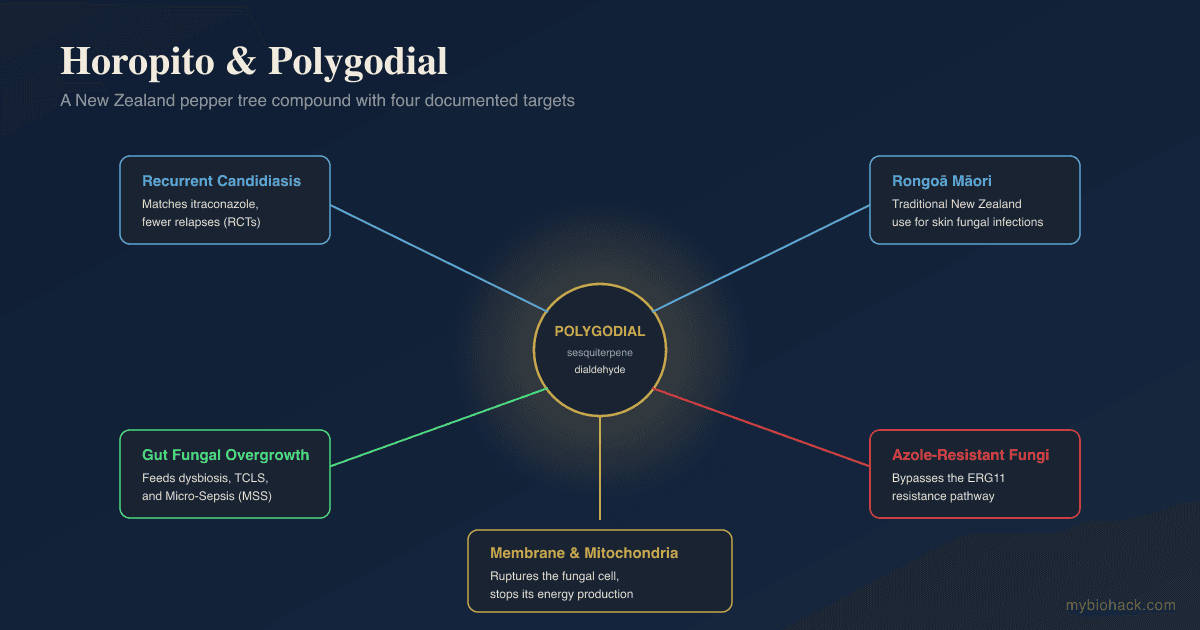
Horopito is a New Zealand pepper tree whose leaves carry polygodial, a sesquiterpene dialdehyde that kills Candida albicans through a mechanism most drug-resistant fungal strains have no defense against.
In this post, we will discuss what horopito and polygodial are, the evidence behind their antifungal and antimicrobial effects, where fungal overgrowth fits into the Junction Dysfunction framework, natural sources and dosing, the mechanisms of action, the genetics of clearing a reactive compound like this, and open questions in the research.

What Is Horopito
Horopito (Pseudowintera colorata) is a slow-growing sub-alpine shrub native to New Zealand, sometimes called the pepper tree for the burning, peppery bite of its mottled red-green leaves.
That heat is not a flavor accident, it is the plant's own chemical defense, and the compound responsible is polygodial, a sesquiterpene dialdehyde that the plant produces to deter browsing insects and fungal attack on its leaves. R
Rongoā Māori (traditional Māori medicine) has long used horopito leaves for toothache and skin infections, part of a broader ethnobotanical record of the plant being chewed, steeped, or applied as a poultice for skin, digestive, and mouth complaints. R
Modern lab work has confirmed the folk use was tracking something real: polygodial isolated from Pseudowintera colorata was first identified as an anti-Candida agent in 1982, and it has since been characterized as one of the more potent plant-derived antifungals in the pharmacology literature. R
That potency is unusual for a plant compound, and it is part of why polygodial has been developed into standardized clinical-trial extracts rather than staying a folk remedy, with one such extract standardized to 30 percent polygodial content by oleoresin weight. R
Benefits Of Horopito And Polygodial
1. Matches Itraconazole For Recurrent Vaginal Candidiasis, With Fewer Relapses Afterward
This is the strongest human evidence horopito has.
A 12-month randomized trial gave 82 women with a history of recurrent vulvovaginal candidiasis either oral itraconazole or an oral phytonutrient built around Pseudowintera colorata oleoresin standardized to polygodial. R
Mycological cure rates were comparable between the two groups during active treatment.
A follow-up 2-year trial in 122 women replicated the comparable cure rate, but the horopito group had significantly fewer relapses during the prophylactic follow-up period than the itraconazole group (22 versus 39 relapses). R
The horopito group also developed fewer azole-resistant and non-albicans Candida infections over the study period, which matters because non-albicans species and resistant strains are exactly what standard antifungal drugs struggle with most.
2. Targets The Fungal Overgrowth That Feeds Gut Dysbiosis And Systemic Inflammation
Candida albicans is a normal, low-level resident of the human gut, but it becomes a problem when antibiotics, immunosuppression, or an already-disrupted microbiome let it overgrow. R
Once it overgrows, Candida albicans can switch from its harmless budding yeast form into an invasive, tissue-penetrating hyphal form that drives virulence rather than just sitting quietly as a commensal. R
Gut bacterial dysbiosis directly promotes this Candida overgrowth, and once established, the overgrowth itself further disrupts the microbiome and drives systemic inflammation, a two-way loop rather than a one-time event. R
In the Junction Dysfunction (JD) framework, this is not a side issue, it is part of the same cascade that drives Transient Capillary Leak Syndrome (TCLS) and Micro-Sepsis (MSS).
Overgrown fungal populations add to the total microbial and toxin burden crossing a compromised gut epithelium, feeding the same portal-vein endotoxin looping that chronic bacterial dysbiosis causes.
Jacob's framework also treats microbial pleomorphism as clinically real, meaning Candida and other opportunists reversibly shift their form and behavior in response to a toxic, hypoxic, nutrient-poor terrain rather than simply being present or absent.
Candida albicans specifically switches between a budding yeast form and an invasive filamentous hyphal form depending on pH, oxygen, nutrient availability, and quorum signals in its environment, which is the biological basis for that pleomorphism framing. R
This is a distinct issue from mycotoxin-driven mold illness (CIRS), which involves inhaled biotoxins and needs binders, not an antifungal targeting a live gut organism, so do not treat horopito as a substitute for a CIRS protocol if biotoxin exposure is the actual driver.
3. Kills Candida Through A Mechanism Azole-Resistant Strains Can't Escape
Conventional antifungal drugs like fluconazole and itraconazole (the azoles) work by blocking an enzyme called lanosterol 14-alpha-demethylase (encoded by ERG11), which fungi need to convert lanosterol into ergosterol for their cell membranes. R
Resistant Candida strains survive azoles primarily two ways: point mutations in ERG11 that keep the enzyme working while blocking the drug from binding it, or overexpression of ABC and MFS efflux pumps (CDR1, CDR2, MDR1) that physically pump the drug back out of the cell before it can act. R
Polygodial does not touch that pathway.
Instead it physically deranges the fungal cell membrane and shuts down mitochondrial energy production directly, which is a target resistant strains have not evolved defenses against, since the resistance mutation that saves them from azoles does nothing to protect the membrane itself. R
This is the mechanistic reason the RVVC trials above saw fewer resistant and non-albicans infections emerge in the horopito arm.

4. Works As An Antifungal Potentiator That Lowers The Dose Needed From Other Antifungals
Polygodial does not just kill Candida on its own, it also makes other antifungal compounds work harder.
Combined with anethole, polygodial dropped the lethal concentration needed against Candida albicans from 3.13 micrograms per milliliter down to 0.098 micrograms per milliliter, roughly a 30-fold potentiation. R
Practically, this is why standardized horopito extracts are often formulated alongside other antimicrobial botanicals rather than used in isolation, and it is worth keeping in mind if you are already running an antifungal or biofilm-disrupting protocol.
5. Spares Healthy Human Cells While Killing Fungal Ones
A compound that ruptures cell membranes and shuts down mitochondria sounds like it should be indiscriminately toxic, but polygodial shows clear selectivity.
At concentrations that kill fungal cells, polygodial does not reduce viability in primary human hepatocytes, fibroblast co-cultures, or non-cancerous prostate epithelial cells. R
The likely explanation is a structural one: fungal membranes are built around ergosterol instead of the cholesterol mammalian membranes use, a structural difference antifungal drug classes already exploit for their own selectivity, and polygodial's nonionic surfactant action appears to preferentially disrupt the ergosterol-based version. R
This does not mean unlimited safety at any dose (see Dosage And Safety below), but it does explain why oral horopito extracts have not produced the kind of collateral tissue damage seen with some pharmaceutical antifungals.
6. Carries A Long History Of Traditional Use For Skin Infections And Digestive Complaints
Rongoā Māori used horopito leaves, bruised, steeped, or chewed directly, for toothache and skin infections going back generations before it was written down. R
None of this is controlled trial evidence, and it should be read as ethnobotanical precedent rather than proof, but it is notable that the two applications with the longest traditional track record, skin infections and mouth/digestive complaints, are the same two areas where modern pharmacology has since found a plausible antimicrobial mechanism.
Natural Sources
Horopito is endemic to New Zealand and does not grow wild elsewhere, so nearly all supply comes from cultivated or wild-harvested New Zealand plantations. R
Fresh or dried leaf is available as a culinary spice (it is sold in New Zealand as a bush pepper substitute) and as a loose-leaf tea, but polygodial content in raw leaf is variable and unstandardized.
Most of the research above used a standardized oleoresin extract rather than raw leaf, so if you want the studied dose, look for:
- Kolorex Advanced Candida Care (standardized Pseudowintera colorata oleoresin with defined polygodial content, the extract used in the clinical trials cited above)
- Horopito leaf tincture (unstandardized, better for topical or culinary use than for matching trial dosing)
Check the label for milligrams of polygodial specifically, not just milligrams of horopito extract, since concentration varies by harvest and extraction method.
Dosage And Safety
Standardized commercial softgels typically deliver around 2 to 3 mg of polygodial per capsule, taken once or twice daily with food, in the same range as the roughly 3 mg oleoresin dose used in the RVVC trials above. R
There is no documented history of serious toxicity from oral or topical horopito use, and the cell-selectivity data above (no reduced viability in healthy human hepatocyte, fibroblast, or epithelial cultures at fungicidal concentrations) is consistent with that track record. R
That said, this is manufacturer and traditional-use safety data, not formal long-term human toxicology, so treat it with the same caution you would any botanical without a large safety database.
Raw leaf and concentrated tinctures are genuinely hot, similar to cayenne, and can burn the mouth or esophagus if taken outside an enteric capsule.
Some people notice transient nausea or GI discomfort in the first days of use, which is more likely a die-off response to fungal load dropping quickly than a direct drug effect (Jacob's working explanation for die-off reactions in general is oxidative stress from Neutrophil Extracellular Traps (NETs) forming during pathogen kill, not just endotoxin release, though this is his hypothesis rather than an established mechanism).
Horopito is not recommended during pregnancy or breastfeeding, and has not been studied in children under 12.
No formal drug interaction studies exist, so if you are on a prescription antifungal, mention horopito to whoever is managing that treatment given the potentiation effect described above.
Mechanisms Of Action
Simple:
- Polygodial punches through the outer membrane of fungal cells, causing them to leak their contents and die.
- It also jams the fungal cell's internal power plants (mitochondria) so they cannot keep producing energy.
- Because it attacks the membrane and the power plant instead of the ergosterol pathway, it still works against Candida strains that have become resistant to standard antifungal drugs.
Advanced:
- Nonionic surfactant / membrane disruption: Polygodial acts as a nonionic surfactant at the fungal plasma membrane, disrupting the lipid-protein interface of integral membrane proteins and denaturing their conformation, which causes rapid leakage of intracellular contents and, under electron microscopy, visible vesiculation of the fragmented membrane within minutes of exposure. R
- Mitochondrial ATPase inhibition: Polygodial inhibits mitochondrial ATPase in a dose-dependent manner at concentrations that overlap with its fungicidal range, choking off ATP production from the inside. R
- Uncoupling of ATP synthesis: Beyond simple ATPase inhibition, polygodial uncouples mitochondrial ATP synthesis by altering the electrical properties of the inner membrane surface, collapsing the membrane potential and the transmembrane pH gradient the mitochondrion depends on to make ATP. R
- Vacuolar ATPase and TORC1 signaling: A genome-wide phenotypic screen in yeast found that genes controlling vacuolar acidification and TORC1 (Target Of Rapamycin Complex 1) signaling determine sensitivity to polygodial, with the drug triggering vacuolar alkalinization and disrupted calcium signaling, pointing to TORC1 and calcium homeostasis as additional downstream targets beyond the membrane itself. R
- Antifungal potentiation: Polygodial's surfactant action appears to increase membrane permeability to co-administered antifungal compounds, which is the likely explanation for the roughly 30-fold potency increase seen when it is paired with anethole against Candida albicans. R
Genetics
GSTM1 / GSTT1
Glutathione S-transferases (GSTs) are Phase II detoxification enzymes that neutralize reactive electrophilic compounds, including reactive aldehydes, by conjugating them to glutathione so they can be excreted. R
GSTM1 and GSTT1 each carry a common homozygous deletion (null) genotype that results in a complete loss of that specific enzyme's activity, and null genotypes are present in a large share of the population depending on ancestry. R
No human genetic studies have looked at polygodial clearance specifically, so this is extrapolation, not direct evidence.
But polygodial is structurally a reactive dialdehyde, the same broad class of electrophile GSTM1 and GSTT1 are known to help clear, so someone who is GSTM1 or GSTT1 null (findable on a standard 23andMe raw data upload or a dedicated toxin genetics panel) may have a slower clearance and lower practical tolerance for concentrated horopito extracts, and would be a reasonable candidate to start at the lower end of the dosing range.
More Research
Candida is not the only organism polygodial affects, the compound and its close relative 9-deoxymuzigadial also show antifeedant and insecticidal activity against clothes moths and carpet beetles in lab bioassays, consistent with the plant using the same chemical defense against multiple classes of attacker rather than fungi specifically. R
Polygodial has shown preliminary anticancer activity in taxane-resistant castration-resistant prostate cancer cell lines, inducing oxidative stress and apoptotic signaling while sparing non-cancerous prostate cells in the same experiments, but this is in vitro, mechanistically interesting, and a long way from any human application or recommendation. R
Formal human trials have so far focused entirely on recurrent vulvovaginal candidiasis, there is no published clinical data yet on oral horopito for gut-based Candida overgrowth specifically, even though the mechanistic case (membrane disruption plus mitochondrial ATPase inhibition, both independent of the azole resistance pathway) applies equally to gut colonization.
If you suspect gut fungal overgrowth is part of your picture, I use the Candida/IBS Panel (Vibrant Wellness) or the Organic Acids Test (Mosaic Diagnostics, via Fullscript) to check for elevated fungal metabolites like D-arabinitol, and the Gut Zoomer (Vibrant Wellness) to see whether Candida overgrowth is sitting on top of broader bacterial dysbiosis, since treating the fungus without addressing the dysbiosis that let it overgrow tends to just invite it back.
The Biohacking Bot can walk through how this fits your specific labs and history if you want to go deeper than this post covers, and Pro members get the full Micro-Sepsis chapter on how microbial and fungal burden feeds TCLS and MSS in the JD guide.
Jacob Gordon
INHC, FMT-C
Board Certified Health Coach
I spent years battling unexplained chronic illness before discovering biohacking, epigenetics, and functional medicine. Now I share that research at MyBioHack to help others find their own answers.
Book a ConsultationRelated Protocols & Supplements
Deep-dive chapters and recommended supplements for this topic
Spore-Based Probiotics
1 cap with food
L-Glutamine
5g 2x/day on empty stomach
Butyrate
300mg 2x/day with meals