TP53 Gene and Protein: What It Is And Its Role In The Body
By Jacob Gordon, INHC, FMT-CThis article contains affiliate links. As an Amazon Associate, MyBioHack earns from qualifying purchases at no extra cost to you. We only link products we research and stand behind.
In 1993, TP53 (or p53) was voted molecule of the year by Science magazine.
Woo! 🎉 R
Basics
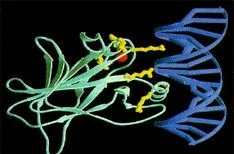
The p53 gene is also known as a tumor suppressor gene (stopping the formation of tumors). R
It is located in almost all normal tissues and is unstable, causing it to degrade very quickly.
This is the most commonly mutated gene in cancer. R
Mutation is usually what causes the problem, not the amount of protein.
P53 has been described as "the guardian of the genome" because of its role in conserving stability by preventing genome mutation. R
If the TP53 gene is damaged, tumor suppression is severely compromised.
People who inherit only one functional copy of the TP53 gene will most likely develop tumors in early adulthood, a disorder known as Li-Fraumeni syndrome. R
The TP53 gene can also be modified by mutagens (chemicals, radiation, or viruses), increasing the likelihood for uncontrolled cell division. R
More than 50 percent of human tumors contain a mutation or deletion of the TP53 gene. R
Roles In The Body
1. Regulates Cell Cycle and Helps in DNA Repair
TIGAR (TP53-inducible glycolysis and apoptosis regulator) can allow a cell to carry out DNA repair, and the degradation of its own organelles. R
It can protect a cell from death. R
TIGAR manufacture by the body is activated by the p53 tumour suppressor protein after a cell has experienced a low level of DNA damage or stress. R
2. Plays a Role in Cancer and Disease

Diseases associated with P53:
- Breast Cancer R
- Adenocarcinomas R
- Acute Myeloid Leukemia R
- B-Cell Lymphocytic Leukemia
- Melanoma R
- Squamous Cell Carcinoma R
- Ovarian Cancer R
- Esophageal Cancer R
- Brain Cancer R
- Oral Cancer R
- Li Fraumeni Syndrome R
- Huntington's Disease R
- Alzheimer's Disease R
P53 can regulate apoptosis. R
PUMA (p53 upregulated modulator of apoptosis) expression with or without chemotherapy or irradiation is high toxic to cancer cells:
PUMA adenovirus seems to induce apoptosis more so than p53 adenovirus. R R R
This is beneficial in combating cancers that inhibit p53 activation and therefore indirectly decrease PUMA expression levels. R
DYRK2 regulates p53 to induce apoptosis in response to DNA damage. R
Mechanism Of Action
P53 prevents the growth of abnormal tissue either by cell cycle arrest or by triggering apoptosis.
In The Cell Cycle

When there is DNA damage:
- A triggered expression of p53 gene
- Increases p53 levels (look below at WAF1)
- Prevents cell from entering S phase of cell cycle
- Arrest of cell cycle at G1 phase/stage
- Allows time for the DNA repair to take place
- P53 induces DNA repair genes:
- If DNA is repaired completely:
- P53 degrades
- Then cell cycle continues
- If DNA is not repaired:
- There is permanent damage leading to arrest/senescence
- Apoptosis
- If DNA is repaired completely:
P53 also regulates WAF1:
- Resulting in increased WAF proteins named p21
- P21 blocks CDK4/CyclinD complex
- Cell cycle is halted in G1 stage
Regulation of p53 Protein
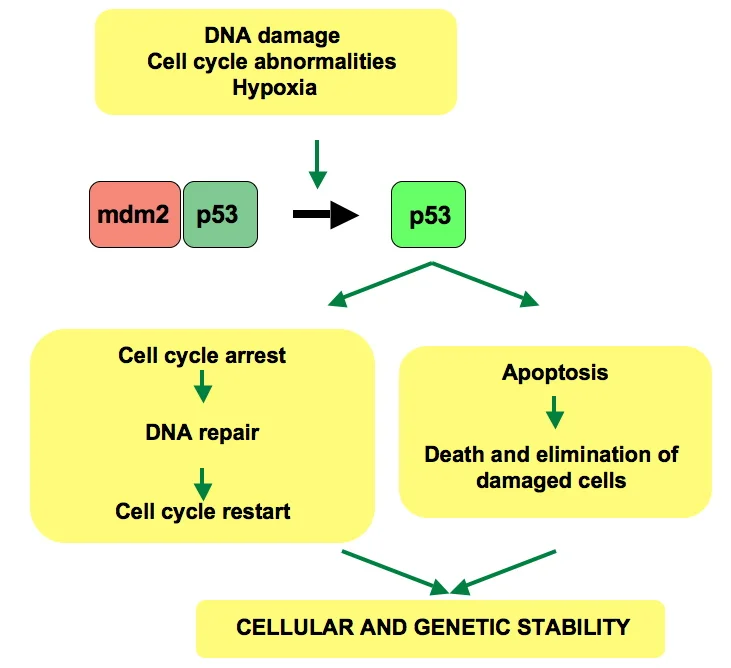
p53 is very unstable.
MDM2 and MDMX keep p53 in check. R
MDM2 gene in normal cells:
- Creates MDM2 protein
- MDM2 protein combines with p53 protein to create p53 mdm2 complex
- It degrades (via ubiquitin mediation) into degraded p53 + the release of mdm2 proteins
MDM2 gene in damaged DNA:
- Creats MDM2 protein
- P53 become phosphoralated, which prevents the formation of p53 mdm2 complex
- Thus no degradation = increased p53 levels
What happens when p53 is inactivated?
- DNA damage
- No p53/inactivated p53
- No cell cycle arrest
- Cell cycle progresses with damage DNA
- Neoplastic transformation (abnormal growth that can be cancerous)
How To Increase p53
Increasing the amount of p53 may seem a solution for treatment of tumors or prevention of their spreading.
This, however, is not a usable method of treatment, since it can cause premature aging. R
Pharmacological reactivation of p53 presents itself as a viable cancer treatment option. RR
- Astaxanthin/H. pluvialis R R
- Ginger/Zerumbone R R
- Increasing NQO1 expression/activity (such as mitosenes, indolequinones, aziridinylbenzoquinones and β-lapachone) R
- Pterostilbene R
- Resveratrol R
- BH3 mimetics R R R
- Capsaicin (decreases mutant p53 gene expression) R
What Decreases p53?
Genetics

The p53 protein is the product of the p53 gene. R
It is located on 17p13, first discovered in 1979. R
P stands for protein, 53 stands for its weight. R
p53 SNPs R
- rs1042522
- rs11540652
- rs11540654
- rs121912651
- rs121912652
- rs121912653
- rs121912654
- rs121912655
- rs121912656
- rs121912657
- rs121912658
- rs121912659
- rs121912660
- rs121912661
- rs121912662
- rs121912663
- rs121912664
- rs121912665
- rs121912666
- rs121912667
- rs121913343
- rs121913344
- rs12947788
- rs12951053
- rs148924904
- rs149633775
- rs1625895
- rs1642785
- rs17878362
- rs17882227
- rs17883323
- rs17884306
- rs17887200
- rs1800370
- rs1800371
- rs193920774
- rs193920789
- rs193920817
- rs201744589
- rs2078486
- rs2287497
- rs2287498
- rs2287499
- rs281865547
- rs28934271
- rs28934571
- rs28934572
- rs28934573
- rs28934574
- rs28934575
- rs28934576
- rs28934577
- rs28934578
- rs28934873
- rs28934874
- rs28934875
- rs35117667
- rs371409680
- rs375338359
- rs397516434
- rs397516435
- rs397516436
- rs397516438
- rs397516439
- rs483352695
- rs483352696
- rs55819519
- rs55832599
- rs55863639
- rs587776768
- rs587778720
- rs587780066
- rs587780067
- rs587780068
- rs587780070
- rs587780071
- rs587780073
- rs587780074
- rs587781288
- rs587781433
- rs587781504
- rs587781525
- rs587781564
- rs587781589
- rs587781664
- rs587781702
- rs587781987
- rs587781991
- rs587782144
- rs587782160
- rs587782272
- rs587782289
- rs587782393
- rs587782490
- rs587782529
- rs587782596
- rs587782609
- rs587782650
- rs587782664
- rs587782705
- rs587783062
- rs59758982
- rs730881999
- rs730882001
- rs730882004
- rs730882005
- rs730882006
- rs730882007
- rs730882008
- rs730882015
- rs730882016
- rs730882017
- rs730882018
- rs730882019
- rs730882025
- rs730882027
- rs730882029
- rs760043106
- rs763098116
- rs780442292
- rs78378222
- rs786201057
- rs786201059
- rs786201838
- rs786202055
- rs786202082
- rs786202222
- rs786202315
- rs786202514
- rs786202799
- rs786202962
- rs786203436
- rs786203589
- rs8064946
- rs8079544
- rs863223300
- rs863223301
- rs863224451
- rs863224499
- rs863224500
- rs864309495
- rs869312782
- rs876658144
- rs876658468
- rs876658483
- rs876658627
- rs876658982
- rs876659076
- rs876659098
- rs876659215
- rs876659260
- rs876659384
- rs876659802
- rs876660548
- rs876660726
- rs876660754
- rs876660807
- rs878854071
- rs878854073
- rs879253905
- rs879253942
- rs879254077
- rs879254212
- rs886039483
- rs886039484
- rs886039495
- rs886039855
Genes that p53 interacts with: R
- AIMP2
- ANKRD2
- APTX
- ATM
- ATR
- ATF3
- AURKA
- BAK1
- BARD1
- BLM
- BRCA1
- BRCA2
- BRCC3
- BRE
- CEBPZ
- CDC14A
- Cdk1
- CFLAR
- CHEK1
- CCNG1
- CREBBP
- CREB1
- Cyclin H
- CDK7
- DNA-PKcs
- E4F1
- EFEMP2
- EIF2AK2
- ELL
- EP300
- ERCC6
- GNL3
- GPS2
- GSK3B
- HSP90AA1
- HIF1A
- HIPK1
- HIPK2
- HMGB
- HSPA9
- Huntingtin
- ING1
- ING4
- ING5
- IκBα
- KPNB1
- LMO3
- Mdm2
- MDM4
- MED1
- MAPK9
- MNAT1
- NDN
- NCL
- NUMB
- NF-κB,
- P16
- PARC
- PARP1
- PIAS1
- CDC14B
- PIN1
- PLAGL1
- PLK3
- PRKRA
- PHB
- PML
- PSME3
- PTEN
- PTK2
- PTTG1
- RAD51
- RCHY1
- RELA
- Reprimo
- RPA1
- RPL11
- S100B
- SUMO1
- SMARCA4
- SMARCB1
- SMN1
- STAT3
- TBP
- TFAP2A
- TFDP1
- TIGAR
- TOP1
- TOP2A
- TP53BP1
- TP53BP2
- TOP2B
- TP53INP1
- TSG101
- UBE2A
- UBE2I
- UBC
- USP7
- WRN
- WWOX
- XPB
- YBX1
- YPEL3
- YWHAZ
- Zif268
- ZNF148
- SIRT1
More Research
- Yin Yang 1 is a negative regulator of p53. R
- EP300 acetylation of TP53 in response to DNA damage regulates its DNA-binding and transcription functions. R
- The gene TP53, encoding p53, has a common sequence polymorphism that results in either proline or arginine at amino-acid position 72. R
- The in vitro cytotoxicity of a novel cyclin-dependent kinase inhibitor, CYC202, was evaluated in 26 B-CLLs, 11 with mutations in either the ATM or TP53 genes, and compared with that induced by ionizing radiation and fludarabine. R
- Lysine methylation of p53 is important for its subsequent acetylation, resulting in stabilization of the p53 protein. R
- P53 has no role in muscle regeneration. R
Jacob Gordon
INHC, FMT-C
Integrative Nutrition Health Coach
I cover mold illness, post-viral recovery, methylation, and complex chronic disease, drawing on ten years of clinical research, work inside a functional medicine clinic, and my own recovery from all of it. Every claim here is cited.
Book a ConsultationRelated Protocols & Supplements
Deep-dive chapters and recommended supplements for this topic
Methylated B Complex
1 cap/day with food
SAMe
400mg on empty stomach
Resveratrol
250mg/day