The 12+ Benefits of Lion's Mane: Erinacines, Hericenones, and the NGF Story
By Jacob Gordon, INHC, FMT-CThis article contains affiliate links. As an Amazon Associate, MyBioHack earns from qualifying purchases at no extra cost to you. We only link products we research and stand behind.
Lion's Mane is the most hyped nootropic mushroom on the market, and almost none of the marketing distinguishes between its two completely different families of active compounds.
In this post, we will discuss what Lion's Mane is, the difference between hericenones and erinacines, how it drives nerve growth factor and neurotrophic signaling, its full range of brain, immune, metabolic, and digestive benefits, the human cognition and mood data, the fruiting-body-versus-mycelium quality debate, where to get it, dosing, side effects and safety, mechanisms, and genetics.

Basics
Recent evidence demonstrates that Lion's Mane may possibly be helpful for various diseases, such as Alzheimer's disease, immunoregulation, and many types of cancer, through mechanisms in the nervous system, digestive system, circulatory system, and immune system. R R
Lion's mane is an edible mushroom. R
It grows in cascading icicle-like spines on hardwood trees and has been eaten and used as a tonic in East Asia for centuries. R
It goes by many names:
- Deertail Mushroom
- Hedgehog Mushroom
- Hericium erinaceus
- Houtou
- Igelstachelbart
- Lion's Mane
- Monkey's Head (nấm đầu khỉ)
- Pom Pom Blanc
- Satyr's Beard
- Yamabushitake
It has been used in China, Japan, Korea, and India as medicine throughout history. R R R
Lion's Mane Contains:
- Erinacines A-K R R
- Hericenones A and C-H R R R
- Orcinol derivatives (Mycelium) R
- Sialic-acid binding lectin R
- Sterols, such as ergosterol and beta-sitosterol R
The reason it became a research target is that it produces two structurally distinct groups of small molecules that stimulate nerve growth factor (NGF) synthesis, and these two groups live in two different parts of the organism. R
This single fact is the most important thing to understand about Lion's Mane, and it is the thing almost every product label ignores.
Hericenones Vs Erinacines
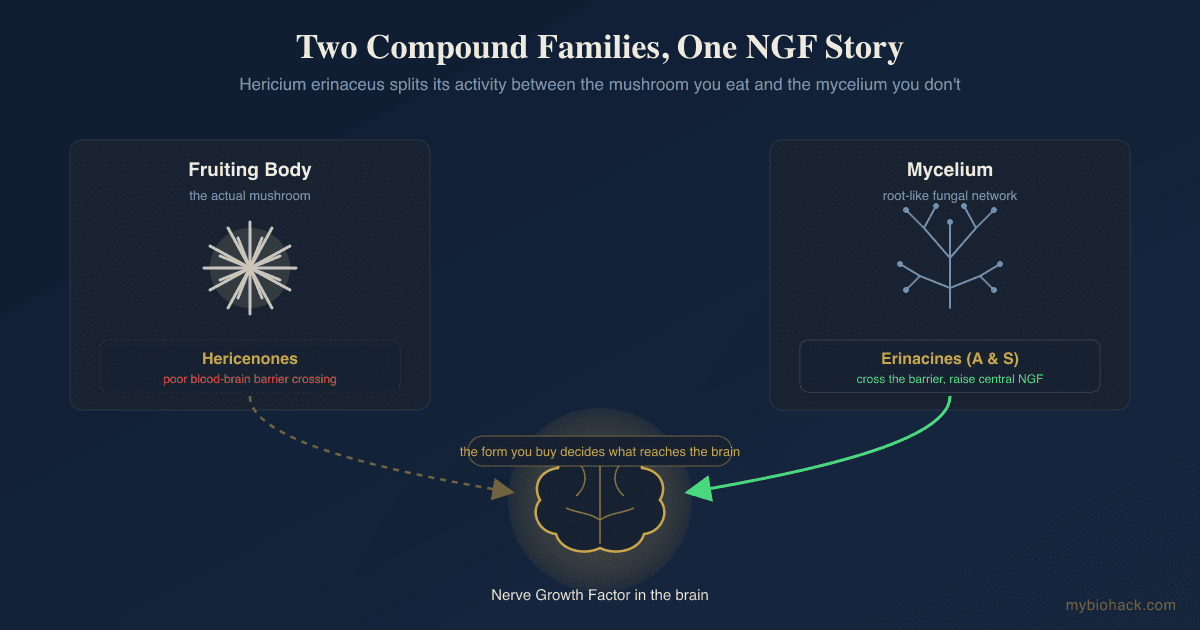
The fruiting body, which is the actual mushroom you would eat, contains a family of benzyl alcohol derivatives called hericenones. R
The mycelium, which is the root-like fungal network that grows before the mushroom forms, contains a separate family of cyathane diterpenoids called erinacines. R
Both families can induce NGF, but they are not equivalent.
Erinacines are the stronger NGF inducers, and crucially, only erinacines (erinacine A and erinacine S specifically) have been verified to cross the Blood-Brain Barrier (BBB) and raise NGF inside the brain. R
Hericenones C and D, despite showing neuroprotective effects in animals, have shown poor BBB penetration and in some assays failed to raise NGF gene expression in human astrocytoma cells. R

This is the central tension of Lion's Mane.
The part you eat (fruiting body) is rich in hericenones and beta-glucans but weak on the compounds that actually reach the brain, and the part with the brain-penetrant compounds (mycelium) is rarely sold in a form that retains them.
There is a big MAYBE running through the entire literature because of this, and most marketing collapses it into a single "NGF mushroom" claim that the chemistry does not support.
Benefits
1. Supports Brain Function and Regrows Nerve Cells
Lion's Mane contains polysaccharides known as hericenones and erinacines. R
They are both responsible for the neuroregenerative properties of Lion's Mane. R
The original discovery, by Kawagishi and colleagues, was that hericenones from the fruiting body and erinacines from the mycelium both stimulate NGF synthesis, with the erinacines being the most potent inducers identified. R R
Lion's Mane can enhance nerve growth factor (NGF) in the brain and body. R R
NGF was increased in the hippocampus (but not the cortex). R
Most of this NGF induction data is in vitro (cultured astrocytoma and glial cells) or in animal models, not in humans, which is an honest limitation worth stating up front. R
Rita Levi-Montalcini extracted NGF eye drops from Lion's Mane and said she felt more mentally acute in her 100's than in her 20s'. R
You can learn how to increase (or decrease) NGF here.
Dietary Lion's Mane increased mossy fiber-to-CA3 synaptic transmission in the hippocampus of healthy mice and improved novel object recognition memory. R
A 2023 study isolated hericene A and a related isoindoline compound and showed they drive axon outgrowth and neurite branching and enhance spatial memory in mice through ERK1/2 signaling. R
Notably, that pathway is distinct from, but converges on, the same downstream ERK1/2 cascade used by brain-derived neurotrophic factor (BDNF) and its TrkB receptor, which is why Lion's Mane gets discussed alongside BDNF even though it is primarily an NGF story. R

Lion's Mane regenerated peripheral and peroneal nerves following peripheral nerve injury. R R
Follow-up work implicated regeneration-associated signaling through Akt, MAPK, c-Jun, and c-Fos pathways. R
In vitro, it stimulated myelination. R
Stroke is the 4th leading cause of death worldwide. R
In rats, Lion's Mane mycelium inhibited neurological insults in ischemic stroke. R
Lion's Mane protected neuronal cells from endoplasmic reticulum stress-induced cell death. R
A double-blind, parallel-group, placebo-controlled trial showed improved cognitive ability in individuals with Mild Cognitive Impairment (MCI). R
In that trial (Mori 2009), Japanese adults aged 50 to 80 took 3 grams of dry fruiting body powder daily for 16 weeks and scored significantly higher on a cognitive scale than placebo at weeks 8, 12, and 16. R
The effect faded after they stopped, with scores declining by 4 weeks post-supplementation, which suggests the benefit depends on continued intake rather than a permanent structural change. R
It was a small trial (30 subjects), so treat it as promising rather than definitive. R
A 2020 pilot trial used erinacine A-enriched H. erinaceus mycelia (not fruiting body) at roughly 1 gram per day for 49 weeks in patients with mild Alzheimer's disease, and the treated group improved on the Mini-Mental State Examination and on daily-living and cognitive measures versus placebo. R
This is notable because the product was specifically standardized for erinacine A, the brain-penetrant compound, rather than generic fruiting-body powder. R
Docherty 2023 tested 1.8 grams per day in healthy adults aged 18 to 45, where a single dose improved speed on the Stroop task at 60 minutes and 28 days of intake showed a trend toward lower subjective stress. R
The authors were careful to note null and even mildly negative findings on some measures, and the sample was small, so this is a signal rather than a guarantee. R
2. Has Anti-inflammatory Properties
In a rat model induced with stroke, Lion's Mane reduced levels of acute inflammatory cytokines: IL-1β, IL-6, and TNF-alpha, while downregulating iNOS. R
3. Has Anti-Oxidant Properties
Consuming boiled Lion's Mane helped eliminate peroxides, remove harmful iron ions, and inhibit the degradation of fat. R
It enhanced skin anti-oxidant enzymes and collagen protein levels, making it helpful for anti-aging of the skin. R
4. Improves Glucose and Lipid Metabolism
Lion's Mane was able to reduce LDL by 45.5% and improve HDL-C by 31.1%. R
Some compounds in the mushroom, like threitol, D-arabinitol, and palmitic acid, may have antioxidant effects, regulate blood lipid levels, and reduce blood glucose levels. R
In mice fed a high-fat diet, hot water and ethanolic extracts of Lion's Mane helped improve lipid metabolism (via activation of PPARalpha). R
5. Regulates Blood Pressure
Lion's Mane appears to be an ACE inhibitor (helping reduce blood pressure). R
Hot water extracts tend to be more potent ACE inhibitors (compared to ethanolic or methanolic extracts). R R
6. Fights Pathogens
Lion's Mane inhibited the growth of H. Pylori within cells. R
It also protected mice from Salmonella Typhimurium-induced liver injury and death. R
It did this by stimulating immune cells. R
7. Fights Cancer
Lion's mane pills were used in the treatment of esophageal carcinoma. R
β-glucans from Lion's Mane were injected in tumors, and VEGF, COX-2, and 5-LOX were reduced. R
Lion's mane acts as an enhancer to sensitize doxorubicin (Dox)-mediated apoptotic signaling, which it does by reducing c-FLIP expression via JNK activation and enhancing intracellular Dox accumulation via the inhibition of NF-κB activity. R
NK activity, activation of macrophages, and inhibition of angiogenesis all contribute to the mechanism of reduction of tumor size. R
Hot water and microwaved ethanol extracts of Lion's Mane showed benefit in colon cancer by reducing expression of MMP-2 and MMP9 in cells. R
Lion's Mane is effective in cancer as it enhances natural killer cell function. R
8. Enhances the Immune System
Lion's Mane contains a number of polysaccharides, such as β-glucans. R
Polysaccharides stimulate macrophage activity and increase T-cell count and CD4+ cells within mice. R R
Lion's Mane suppresses LPS-induced macrophage activation (less activation of JNK and NF-kB). R
In mice spleens, Lion's Mane activated NK cells via induction of IL-12 and interferon-γ. R
9. Supports the Digestive System
Lion's mane was used in the treatment of gastric ulcers. R
Water extract protected against gastric mucosal injury (by inhibiting reduction of antioxidant enzymes). R
10. Helps Wound Healing
In rats that were given wounds in the posterior neck area, the wounds showed less scar width, fewer macrophages, and more collagen with angiogenesis, which means Lion's mane enhances the acceleration of wound healing. R
11. Supports the Liver
Lion's mane was able to reduce liver damage from acute alcohol exposure. R
12. Reduces Depression and Anxiety
Thirty females were given Lion's Mane for 4 weeks, and their anxiety and irritation were reduced. R
That study (Nagano 2010) gave Lion's Mane cookies to women with menopause-related complaints, and the treated group reported significantly lower depression and anxiety scores, along with reduced irritability and improved concentration, compared to placebo. R
The proposed mechanism is partly neurotrophic and partly a reduction in neuroinflammation, although a 4-week cookie study cannot separate those cleanly. R
If you are working on mood, the upstream drivers usually matter more than any single supplement, and a lot of that is covered in the BDNF and neuroinflammation posts.
13. Supports the Gut Microbiome and Intestinal Immunity
Separate from the neurotrophic compounds, the beta-glucan polysaccharides in Lion's Mane act as prebiotics and immune modulators.
In animal models, H. erinaceus polysaccharides increased beneficial taxa such as Lachnospiraceae and Akkermansia and helped restore immune function after chemical immunosuppression. R
Extracts have also relieved colitis and inflammatory bowel disease features by modulating both immunity and the gut microbiota. R R
Because the gut-brain axis is bidirectional, some of the cognitive and mood effects may partly run through the microbiome rather than purely through direct NGF induction.
Natural Sources
The only meaningful dietary source is the mushroom itself, eaten fresh or cooked, which provides hericenones and beta-glucans but not erinacines.
Like other mushrooms, the fruiting body is also a source of ergothioneine, a sulfur antioxidant that concentrates in tissues under oxidative stress.
For anything approaching the doses used in the human trials, you are realistically looking at a supplement, which brings up the quality debate below.
The Fruiting-Body-Versus-Mycelium Quality Debate
This is where most of the money is wasted, so it is worth being precise.
Fruiting body extracts are made from the actual mushroom, contain hericenones, and are typically standardized to beta-glucans, but they contain essentially no erinacines. R
Mycelium-on-grain products are grown by letting the fungus colonize a grain substrate (usually rice or oats), then drying and grinding the whole thing, grain included. R
Mycelium is the only part that produces erinacines, the brain-penetrant NGF inducers, so in principle mycelium is the more interesting fraction for cognition. R
The problem is that most mycelium-on-grain powders are heavily diluted with the leftover starch from the grain, and very few disclose their actual erinacine A content. R
The cleanest human evidence for the mycelium side comes from the Alzheimer's trial that used a product specifically standardized to 5 mg/g erinacine A, which is the kind of disclosure almost no consumer product provides. R
The honest takeaway is that "fruiting body" is not automatically superior and "mycelium" is not automatically a scam.
What matters is whether the product actually quantifies the compounds you care about (beta-glucans and hericenones for fruiting body, erinacine A for mycelium), and most do not.
My Experience
When I first used Lion's Mane, I took it as tablets from Mushroom Wisdom.
After a few weeks, when I closed my eyes, I was able to visualize and remember long memories clearly.
I noticed if I took this on an empty stomach, I would feel sick within a few hours.
I took up to 3g/day.
I then tried Lion's Mane from Real Mushrooms.
I would put it in water or almond milk with or without cocoa powder.
The powder tastes like chocolate already and cocoa enhances blood flow to grey matter in the brain. R
I took up to 3g/day, and I noticed better perception.
Colors were enhanced and I had an overall mood lift.
This was increased if I took ~10g/day and were to ride my bike around, looking at nature.
Also a good effect was that I had less gastric distress.
When traveling I tried Lion's Mane capsules from Brain Forza.
I had gone on a break from Lion's Mane for a bit, so it took over a week for me to notice the effects.
When I would take 3-6 capsules (1.5g-3g) on an empty stomach, I had better sociability and recall.
I also tried Four Sigmatic's Lion's Mane tea, with minimal benefits, although I did not take it long enough to really gather any effect.
I believe if I added this to my daily regimen it would have been better, I like star anise as it can inhibit mast cells, amongst other benefits. R
Now, I use Amyloban and notice significant cognitive boosts within a couple of days.
I have no problem taking this on an empty stomach.
I've also tried Lion's Mane from Powder City (closed) and from Mushroom Matrix (now called Om Organic).
Where To Get Lion's Mane
Mushrooms need to be extracted.
Fungi have chitin in their cell walls that cannot be broken down by humans, because we lack chitinase.
So to be bioavailable for humans, it must be extracted.
Eating raw mushrooms will not produce the beneficial effects because of this. R
- Amyloban (very powerful, I notice a cognitive boost within a couple days)
- Capsules (I'll use this while traveling)
- Powder (I'll use this with spirulina in smoothies)
- Tablets
- Tea
The problem with most supplements is that they are mostly starch.
Polysaccharides are starches, so looking for the beta-glucan count is more important. R
Dosage
There is no single validated dose, so the useful approach is to anchor to what the human trials actually used.
Mori 2009 used 3 grams per day of dry fruiting body powder. R
The Alzheimer's trial used roughly 1 gram per day of erinacine A-enriched mycelia. R
The healthy-adult cognition study used 1.8 grams per day. R
A practical range for a concentrated extract is 500 to 1000 mg once or twice daily, with the understanding that whole-powder doses run higher because they are less concentrated.
Side Effects And Safety
Some report itching which could be due to high histamine levels caused by mast cells in response to high NGF.
In one case, a 63 year old man suffered acute respiratory failure after using Lion's Mane daily for 4 months. R
In rats, toxicology studies showed up to 5g/kg day of bodyweight was safe (when combined with Panax Ginseng). R
Across human trials and a 2025 systematic review, Lion's Mane has a favorable safety profile, with adverse events that were mostly mild and gastrointestinal. R
Preclinical work put the no-observed-adverse-effect level at 2000 mg/kg/day, which is far above any human dose. R
The meaningful cautions are these (not an exhaustive list):
- Allergy and hypersensitivity, including rare skin reactions and isolated case reports of respiratory reactions, more relevant if you have a known mushroom or mold allergy R
- Anticoagulant interaction, because Lion's Mane may affect platelet aggregation, so use caution if you take warfarin, a direct oral anticoagulant, or high-dose aspirin R
- Gastrointestinal upset, which is the most common complaint and is usually mild and dose-related R
Mechanisms Of Action
Simple:
- Lion's Mane makes small molecules that tell your support cells to produce more nerve growth factor, which helps neurons survive, grow, and stay connected.
- The compounds in the mushroom you eat do not reach the brain well, while the ones in the root-like mycelium do, which is why the form you buy matters.
- It also feeds beneficial gut bacteria, and a calmer, better-fed gut can quiet the inflammation that drags down mood and thinking.
Advanced:
- Hericenones are benzyl alcohol derivatives found in the fruiting body that induce NGF transcription in glial and astrocytoma cells in vitro, but they show poor blood-brain barrier penetration, which caps their central effect. R
- Erinacines are cyathane diterpenoids found only in the mycelium, are the most potent NGF inducers identified in the genus, and erinacine A and erinacine S have been verified to cross the blood-brain barrier and raise central NGF. R
- NGF and TrkA signaling drives the downstream benefit, where secreted NGF binds the high-affinity TrkA receptor to activate survival and outgrowth cascades in cholinergic and sensory neurons. R
- Hericene A and N-de phenylethyl isohericerin (NDPIH) drive axon outgrowth and neurite branching independent of added neurotrophins by activating a pan-neurotrophic ERK1/2 pathway that converges on the same node as BDNF/TrkB signaling, which enhanced spatial memory in mice. R
- Beta-glucan polysaccharides act through innate immune and microbiome routes, shifting gut taxa toward Lachnospiraceae and Akkermansia and modulating NF-kB, MAPK, and PI3K/Akt signaling, which feeds back on systemic and neuro-inflammation. R R
- Peripheral nerve regeneration after crush injury proceeds through regeneration-associated Akt, MAPK, c-Jun, and c-Fos signaling in the injured segment. R
- NGF gene expression induced by H. erinaceus extracts was inhibited by the c-Jun N-terminal kinase (JNK) inhibitor SP600125, which places JNK signaling upstream of the neurotrophic effect. R
Genetics
NGF
NGF encodes the nerve growth factor protein, the neurotrophin that Lion's Mane compounds are designed to upregulate.
Variants in this gene alter how much NGF is produced and how the neurotrophin is processed, which can influence pain signaling and neuronal maintenance.
rs6330 (c.104C>T) is a coding variant in NGF that has been associated with differences in pain sensitivity and cardiovascular and psychiatric phenotypes, meaning baseline NGF biology is not identical across people. R
BDNF
BDNF encodes brain-derived neurotrophic factor, the neurotrophin most tied to learning, memory, and mood, and the one whose downstream pathway Lion's Mane compounds converge on.
The common functional variant changes activity-dependent secretion of the protein.
Val66Met (rs6265) reduces activity-dependent BDNF release and is associated with poorer episodic memory and altered stress and anxiety responses, which may shape how much benefit a person gets from neurotrophic interventions. R
NTRK1
NTRK1 encodes TrkA, the high-affinity receptor that NGF binds to trigger neuronal survival and growth, so it is the receptor side of the NGF story.
Severe loss-of-function mutations in NTRK1 cause congenital insensitivity to pain with anhidrosis, which demonstrates how central this receptor is to NGF-dependent sensory neuron development.
Because the entire benefit of raising NGF depends on intact TrkA signaling, NTRK1 function is the rate-limiting step that any NGF-boosting strategy ultimately runs through. R
More Research
For biomarker context I use the Neural Zoomer (Vibrant Wellness) to assess blood-brain barrier integrity and neural autoimmunity, since there is no reliable consumer-grade serum NGF assay and tracking NGF directly is not practical.
- Chemistry, Nutrition, and Health-Promoting Properties of Hericium erinaceus (Lion's Mane) Mushroom Fruiting Bodies and Mycelia and Their Bioactive Compounds R
- LM Experiences R R
- Much of the strongest mechanistic data (NGF induction, erinacine signaling, neurite outgrowth) is in vitro or in animals, and the human trials are small, short, and use different preparations, so the evidence base is promising but thin. R
- The mounting evidence from various research groups across the globe, regarding anti-tumor application of mushroom extracts, makes it a fast-track research area worth mass attention. R
- The Mori 2009 cognitive benefit faded within 4 weeks of stopping, which suggests Lion's Mane behaves like a maintenance compound rather than a one-time fix. R
- The single biggest unresolved practical problem is product standardization, because almost no commercial product discloses erinacine A content, and the one trial that clearly worked for the brain used a product that did. R
- The enhancement of NGF gene expression by H. erinaceus extracts was inhibited by the c-Jun N-terminal kinase (JNK) inhibitor SP600125. R
- Video
Jacob Gordon
INHC, FMT-C
Integrative Nutrition Health Coach
I cover mold illness, post-viral recovery, methylation, and complex chronic disease, drawing on ten years of clinical research, work inside a functional medicine clinic, and my own recovery from all of it. Every claim here is cited.
Book a ConsultationRelated Protocols & Supplements
Deep-dive chapters and recommended supplements for this topic
Electrolyte Complex
1 scoop/day
CoQ10
200mg/day
Magnesium Glycinate
400mg at bedtime