Grik4, The Amygdala, And The Glutamate Circuit Behind Anxiety
By Jacob Gordon, INHC, FMT-CThis article contains affiliate links. As an Amazon Associate, MyBioHack earns from qualifying purchases at no extra cost to you. We only link products we research and stand behind.
Anxiety and social withdrawal can be driven by a single overexcited node deep in the amygdala, and a 2025 study showed that quieting that one node was enough to reverse both in mice.
In this post, we will discuss the Grik4 gene and its GluK4 kainate receptor, how a tiny circuit between the basolateral and centrolateral amygdala flips anxiety on and off, why this matters for autism, depression, and post-viral illness, and what you can do to push your own excitatory and inhibitory balance back toward calm.

Basics Of The Grik4 Anxiety Circuit
Glutamate Receptor Ionotropic, Kainate 4 (GRIK4) is the gene that codes for the GluK4 protein, a high-affinity subunit of the brain's kainate receptors (KARs).
Kainate receptors are one of three families of ionotropic glutamate receptors, sitting alongside the better known NMDA and AMPA receptors.
Their job is not mainly to carry the loud, fast signal.
Kainate receptors act more like a volume knob, tuning how much glutamate gets released and how strongly inhibitory circuits fire back. R
GluK4 is concentrated in exactly the regions where mood and fear are set, including the hippocampus and the amygdala. R
The amygdala is the brain's threat detector, and it is not a single blob.
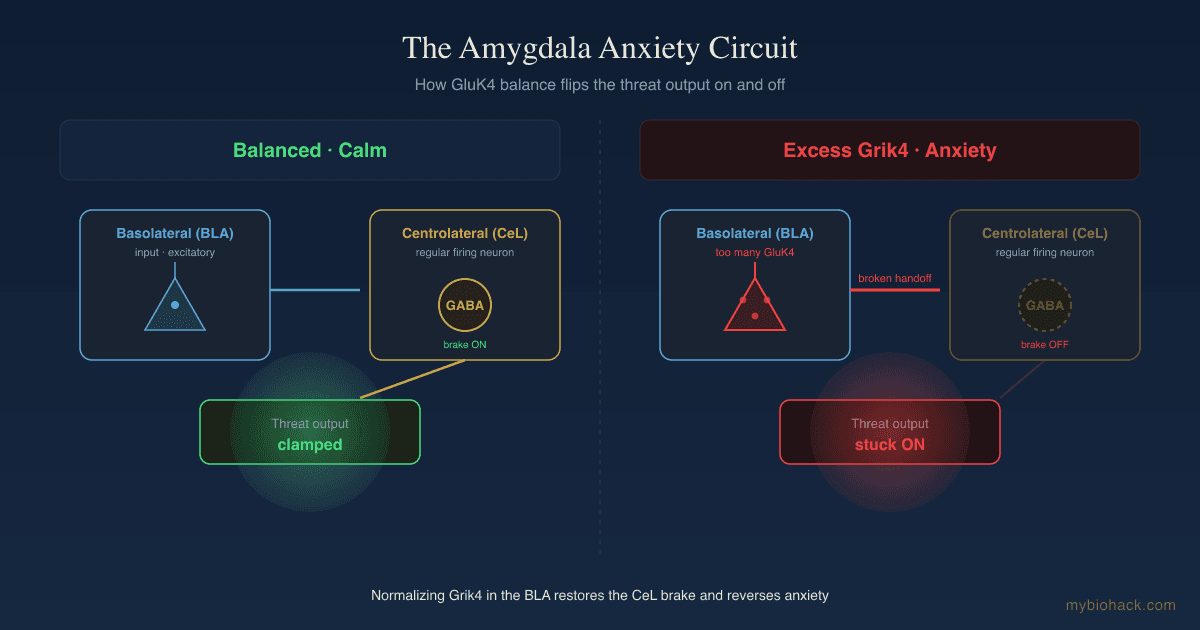
The basolateral amygdala (BLA) is the input hub, packed with excitatory pyramidal neurons that take in sensory and cortical information.
The centrolateral amygdala (CeL) is the output gatekeeper, packed with inhibitory neurons that decide whether the threat signal is allowed to spill outward into fear, avoidance, and a racing heart.
When this BLA to CeL handoff is balanced, you notice a threat and then let it go.
When it is unbalanced, the threat signal gets stuck on, and that stuck state is what anxiety feels like from the inside.
What The New Study Found
The work came out of Juan Lerma's Synaptic Physiology lab at the Institute for Neurosciences in Elche, Spain, and was published in iScience in 2025. R
The same lab had built a mouse a decade earlier that overproduces the Grik4 gene, which raises the number of GluK4 receptors and makes certain neurons more excitable than normal. R
Those mice behave anxious and socially withdrawn, traits that overlap with autism and schizophrenia.
In the new study, the team zeroed in on a specific inhibitory cell type in the centrolateral amygdala called regular firing neurons (RFNs).
They found that excess Grik4 in the basolateral amygdala broke the communication between the BLA pyramidal cells and these centrolateral regular firing neurons.
Using engineered viruses, they selectively normalized Grik4 expression back down in the basolateral amygdala.
That single adjustment restored the BLA to CeL signaling and reversed the anxiety-related and social deficit behaviors. R
The more striking part came next.
They applied the same intervention to ordinary wild-type mice that were naturally anxious, not genetically altered, and the treatment lowered their anxiety too. R
That is the finding that matters, because it suggests this circuit is not a quirk of one engineered mouse.
It points to a general control point for emotional regulation, where the inhibitory regular firing neurons of the centrolateral amygdala hold outsized power over how much anxiety the whole system produces.
One honest caveat sits inside the same paper.
Not every symptom improved, and object recognition memory deficits stayed behind, which tells you other regions like the hippocampus carry parts of the syndrome that fixing the amygdala alone does not touch. R
What Drives Amygdala Hyperexcitability
You almost certainly do not carry a forebrain Grik4 overexpression transgene.
What the mouse demonstrates is a principle, not a diagnosis: when excitatory glutamate tone in the amygdala outruns inhibitory tone, anxiety follows.
Many common exposures push that same balance in the same direction.
Drivers of amygdala excitatory and inhibitory imbalance: (not exclusive list)
- Chronic stress (chronic restraint stress downregulates the kainate receptors that keep amygdala inhibition switched on, releasing the brakes on principal neurons) R
- Early life stress (downregulates kainate receptor control of GABA release in the amygdala and produces lasting anxiety-like behavior in rodents) R
- Low magnesium status (removes the voltage-dependent block on NMDA receptors, letting glutamate overexcite neurons more easily) R
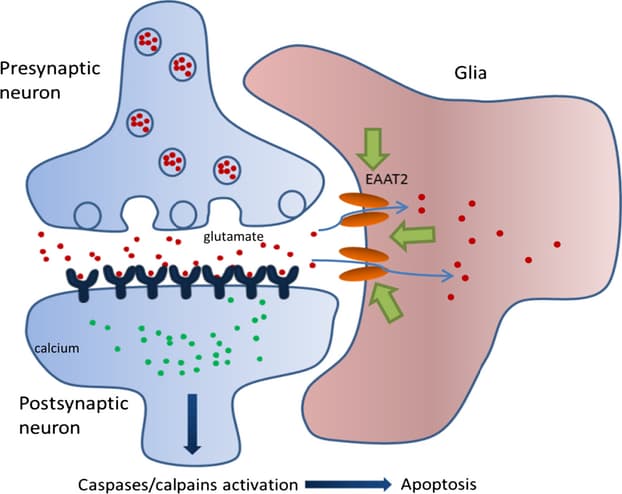
- Neuroinflammation (activated microglia and astrocytes raise extracellular glutamate and impair its clearance, the loop covered in glutamate dysregulation and neuroinflammation)
- Poor sleep and glymphatic failure (impaired overnight clearance lets excitatory metabolites and glutamate accumulate, see the glymphatic system)
- Weak GABAergic tone (insufficient inhibitory opposition to a normal excitatory signal, the theme of the GABA and glutamate balance work)
The unifying idea is mechanistic, not moralistic.
Anxiety here is an electrical state, an amygdala that cannot stop firing the threat signal because the inhibition that should silence it is too weak or too late.
How The Amygdala Manufactures Anxiety
Start with the normal sequence.
Sensory information arrives at the basolateral amygdala, the pyramidal neurons fire, and they recruit inhibitory neurons downstream in the centrolateral amygdala.
Those inhibitory regular firing neurons then clamp the output, so the threat response is proportional and self-limiting.
Kainate receptors sit on top of this as the tuning layer.
On inhibitory interneurons, kainate receptors keep GABA release high and maintain a tonic brake on the amygdala's principal output cells. R
Now add excess GluK4.
Too many high-affinity kainate receptors in the basolateral amygdala shift synaptic transmission, distort the timing of the BLA to CeL handoff, and break the recruitment of the inhibitory regular firing neurons. R
The gatekeeper neurons go quiet at the exact moment they are supposed to clamp down.
The output stays open, and the threat signal floods outward as anxiety, avoidance, and social withdrawal.
This is why the fix in the study was not a sedative that blankets the whole brain.
It was a precise correction at one node that let the inhibitory neurons do their job again.

Anxiety And Overlapping Conditions
The Grik4 mouse is interesting precisely because one gene produces a cluster, not a single symptom.
Overexpression yields anxiety, social withdrawal, and features that map onto autism spectrum disorders, while loss of GluK4 produces hyperactivity and impaired prepulse inhibition that mirror endophenotypes of schizophrenia and bipolar disorder. R R
Too much and too little of the same receptor both cause problems, which is the entire point: the target is balance, not suppression.
Human genetics back the mood link, with GRIK4 variants tied to depression, antidepressant response, bipolar disorder, and schizophrenia risk, all covered in the genetics section below.
The amygdala circuit also overlaps with conditions I write about constantly.
Anxiety that rides along with POTS and dysautonomia is partly a central problem, an amygdala and autonomic circuit stuck in threat mode, not only a blood volume or heart rate problem.
The same is true of the anxiety, sensory overwhelm, and social shutdown that show up in long COVID and other post-viral states, where systemic and long-term inflammation keeps central glutamate elevated.
My Biohack: In my Junction Dysfunction framework, the post-viral version of this circuit runs on Micro-Sepsis (MSS), my term for the smoldering immune activation that keeps central glutamate elevated long after an infection clears, and it is my hypothesis for why so many long haulers describe new anxiety with no psychological trigger. JD Chapter 24 walks through the tryptophan, excitotoxicity, and vagus nerve cascade that ties that inflammation to an overexcited brain, and Chapter 35 covers retraining the limbic system and amygdala once the underlying chemistry is addressed.
Mast cell driven anxiety belongs in the same conversation, because mast cell mediators and the gut to brain axis feed neuroinflammation that biases the amygdala toward excitation.
I am not claiming Grik4 causes these conditions.
I am pointing at a shared downstream node, an amygdala whose inhibitory gatekeeping has failed, that many different upstream problems converge on.
How To Calm The Circuit
You cannot edit your own Grik4 expression with a virus.
You can shift the same excitatory and inhibitory balance the study was correcting, by lowering excess glutamate tone and strengthening GABAergic inhibition.
None of this is a substitute for care in severe anxiety, and nothing here replaces a clinician.
1. Restore Magnesium
Magnesium sits inside the NMDA receptor as a voltage-dependent plug, and when it is low, glutamate overexcites neurons more easily. R
A systematic review found magnesium supplementation reduced subjective anxiety in vulnerable groups, although the trial quality was mixed and there is a real MAYBE on effect size. R
Magnesium Glycinate: the glycinate form is well tolerated, and the glycine carrier is itself an inhibitory amino acid.
Magnesium L-Threonate: this form is designed to raise brain magnesium specifically, which is the pool that matters for the NMDA block.
2. Add L-Theanine
L-theanine is the amino acid from tea that acts as a direct antagonist at AMPA and kainate receptors and a partial agonist at NMDA receptors, while raising GABA and glycine. R
It is one of the few widely available compounds that touches the exact receptor family in this study, the kainate receptor, even if weakly.
A randomized trial in healthy adults found L-theanine reduced stress-related symptoms over four weeks. R
L-Theanine: typical research doses run 200 to 400 mg, and it pairs well with magnesium at night.
3. Use N-Acetylcysteine To Tune Glutamate Release
N-Acetylcysteine (NAC) feeds the cystine and glutamate antiporter on astrocytes, which raises extracellular glutamate enough to trigger inhibitory metabotropic receptors that then dial down synaptic glutamate release. R
That counterintuitive loop is why NAC has the strongest data in glutamate-driven conditions like obsessive-compulsive disorder. R
N-Acetylcysteine: trial doses for neuropsychiatric use are usually 1,200 to 2,400 mg per day, and it doubles as a glutathione precursor for the neuroinflammatory side of the loop.
4. Calm Neuroinflammation With Omega-3s
Because microglial and astrocytic inflammation raises central glutamate, lowering neuroinflammation indirectly takes load off the amygdala.
A meta-analysis found omega-3 fatty acids, especially at higher EPA doses, reduced clinical anxiety symptoms. R
High-EPA Fish Oil: look for a product where EPA clearly exceeds DHA for the anxiety and mood signal.
5. Botanicals With Real Trial Data
Two plant compounds have held up in head-to-head trials against prescription drugs.
Saffron Extract: a meta-analysis of randomized trials found saffron comparable to SSRIs for depression and anxiety symptoms. R
Lavender Oil (Silexan): standardized oral lavender oil was as effective as low-dose lorazepam and paroxetine in generalized anxiety trials, without sedation or dependence. R
6. Train The Off Switch Directly
The circuit is gated by inhibition, and you can recruit inhibition behaviorally.
Slow nasal breathing with an extended exhale raises vagal tone and shifts the autonomic balance the amygdala feeds, which is the cheapest intervention in this entire post.
Protecting deep sleep matters for the same reason, since overnight glymphatic clearance removes the excitatory load that accumulates during the day, and melatonin supports that clearance window.
Even fasting earns a mention, because I have noticed acting on metabolic and excitatory tone through time-restricted eating is one of the more reliable ways I have personally lowered an overactive nervous system.
What To Stay Away From
Things that push the amygdala back toward excitation: (not exclusive list)
- Alcohol (it boosts GABA acutely, then triggers a glutamate rebound on the way down that spikes next-day anxiety)
- Chronic sleep deprivation (raises amygdala reactivity and starves glymphatic clearance of glutamate)
- Chronic unmanaged stress (downregulates the kainate receptor brake on amygdala inhibition over time) R
- Stimulant stacking (high-dose caffeine and other stimulants add excitatory drive to a circuit that is already stuck on)
One contested item belongs here with a caveat.
Dietary glutamate and MSG get blamed for anxiety constantly, and the honest read is that there is a big MAYBE, because the blood brain barrier limits how much dietary glutamate reaches the brain in most people, although a leaky barrier from inflammation may change that calculus for some.
Testing
There is no consumer test for amygdala GluK4 density, so testing here is about the upstream drivers you can actually measure and move.
Blood And Nutrient Markers
Red blood cell magnesium is more informative than serum magnesium, because serum is tightly buffered and can look normal while tissue is depleted. R
I use the Nutrient Zoomer (Vibrant Wellness) to assess magnesium, zinc, copper, B6, and the amino acid status that feeds GABA and glutamate balance.
Inflammation And Cellular Markers
Because neuroinflammation is a major upstream driver, I use the Cellular Zoomer (Vibrant Wellness) to assess organic acids, oxidative stress, and mitochondrial markers that track central inflammatory load.
For the post-viral and toxin-driven version of this picture, the Long COVID bundle (Vibrant Wellness) layers in the viral, cardio, and toxin panels that keep glutamate elevated.
Genetics
I use the Methylation Genetics panel (Vibrant Wellness) to assess COMT and the methylation variants that shape how fast you clear excitatory catecholamines, which sets your baseline reactivity.
Mechanisms Of Action
Simple:
- The amygdala has a gas pedal in the basolateral region and a brake in the centrolateral region, and anxiety is the brake failing while the gas stays down.
- Too much of the GluK4 receptor in the gas pedal region silences the brake cells, and turning GluK4 back down lets the brake work again.
- Magnesium, L-theanine, and NAC all nudge the same gas and brake balance from outside the brain.
Advanced:
- BLA to CeL microcircuit failure Excess GluK4-containing kainate receptors in basolateral amygdala pyramidal neurons distort synaptic transmission and disrupt recruitment of inhibitory regular firing neurons in the centrolateral amygdala, removing feedforward inhibition over the central amygdala output and producing sustained anxiety and social deficits, all reversible by normalizing Grik4 in the basolateral amygdala. R
- Kainate receptor control of tonic GABA Kainate receptors on parvalbumin and other amygdala interneurons sustain high GABA release and tonic GABA-B mediated inhibition of principal neurons, so downregulation of these receptors under chronic stress releases the inhibitory brake and increases principal neuron excitability. R R
- NMDA gating by magnesium Extracellular magnesium provides a voltage-dependent block of the NMDA receptor channel, so magnesium depletion lowers the threshold for glutamatergic excitation and calcium influx, biasing the network toward the excitotoxic and anxious state. R
- NAC and the cystine glutamate antiporter N-acetylcysteine supplies cystine for the astrocytic system xc minus antiporter, raising extrasynaptic glutamate that stimulates inhibitory mGluR2/3 autoreceptors on glutamatergic terminals and reduces synaptic glutamate release over time. R
Genetics
GRIK4
GRIK4 encodes the GluK4 high-affinity subunit of the kainate receptor family.
Variants change how much receptor is made and how the glutamatergic system is tuned, which is why the same gene keeps surfacing across mood and psychotic disorders.
rs1954787: carriers of the C allele and CC genotype respond better to antidepressants than T allele carriers across a meta-analysis of more than 2,000 patients, placing this variant inside the mechanism of antidepressant action. R R
rs1954787: this same variant showed interactive effects with HTR2A and FKBP5 in predicting remission to antidepressant treatment, so it does not act alone. R
A 2-SNP 3 prime UTR haplotype (rs2282586 and rs1944522): a deletion variant in the 3 prime untranslated region lowers GRIK4 transcript abundance and is protective against bipolar disorder. R
A separate 3-SNP haplotype between exons 3 and 7: predisposes carriers to schizophrenia, so different parts of the same gene push risk in opposite directions for different diagnoses. R
COMT
COMT encodes the enzyme that clears dopamine and norepinephrine from the synapse.
The slow-clearing variant leaves more excitatory catecholamine in circuits like the amygdala, which can raise baseline reactivity, and you can read the full dopamine and methylation picture in those posts.
Val158Met (rs4680): the Met allele slows catecholamine clearance and is associated with higher anxiety sensitivity in many cohorts, though the literature is mixed.
More Research
For biomarker and nutrient testing I use the Nutrient Zoomer and Cellular Zoomer (both Vibrant Wellness) to track the magnesium, amino acid, and inflammatory inputs to this circuit over time.
GluK3, a related kainate subunit, also shows up in anxiety, with knockout work pointing to a distinct contribution from a different receptor in the same family, which reinforces that the kainate system as a whole tunes anxiety rather than any single subunit. R
Lithium deserves a research-only flag here, because low-dose lithium dampens glutamatergic signaling and the GRIK4 protective haplotype overlaps with bipolar biology, but dosing and safety put it firmly in clinician territory rather than a self-experiment.
The translational gap is real and worth stating plainly: the study reversed anxiety with targeted viral gene therapy in the mouse amygdala, which no human will receive soon, so the practical value for now is the map it gives us of where to aim slower, safer levers.
The unanswered question I find most interesting is whether the centrolateral regular firing neurons are a final common pathway, the place where stress, inflammation, and genetics all cash out, which would make amygdala inhibition itself the thing worth protecting regardless of the upstream cause.
Jacob Gordon
INHC, FMT-C
Board Certified Health Coach
I spent years battling unexplained chronic illness before discovering biohacking, epigenetics, and functional medicine. Now I share that research at MyBioHack to help others find their own answers.
Book a ConsultationRelated Protocols & Supplements
Deep-dive chapters and recommended supplements for this topic
Lion's Mane
1000mg/day
Omega-3 (DHA)
2g/day
Phosphatidylserine
100mg 3x/day