Increasing Creativity and Memory with Genetics (Nogo-A)
By Jacob Gordon, INHC, FMT-CThis article contains affiliate links. As an Amazon Associate, MyBioHack earns from qualifying purchases at no extra cost to you. We only link products we research and stand behind.
I’ve always been creative, but this ability to be creative easily seems to have diminished with age.

When I was young, I spent the summers in southern Maine.
I was big into making movies and continuously made movies (music videos, shorts, commercials, how-to’s) with my friends during those summers.
It seemed like coming up with an idea for something was much easier back then and even easier to execute.
Now as I am older, there is less creativity in the air and trying to get anyone together for even a group photo costs $ and time, which no one wants to give away (this could be an exaggeration, but you know what I mean).
So, where did all this creativity go?
What makes my brain so different from the past when I was a child to how it is now as an adult?
Well, I guess this is what this post is about — creativity and memory changing as we age: why it can degrade and what you can do about it.
When we’re younger, novelty is so abundant and everything seems so new.
For example, I remember the warning notification sound of my parent’s car for when the car door left open (also called “a jar”) and hearing the beeps it would make to notify us it was open.
That sounded to me like a rhythm (like a song) which had me dancing and impromptu singing over it.
This changes as we settle into our life—everything becomes routine, routine becomes mundane, and mundane becomes your life and thoughts.
What what if there was an easy way to change that?
What if there was a gene that was essentially off most of your life childhood life, but get turned on into adulthood?
What if this gene interfered with the process of creating new memories and seeking for new novelties?
What if you could inhibit this gene and make your brain act similarly to how it was in childhood?
Hypothetical scenarios are fun and all, but let’s get real.
There’s no gene like that.
Or is there?
Well, yes there is and it is called Nogo-A (or Retiuclon 4).

There it is hanging out on the second chromosome!
In a medical setting, stopping this gene from doing its function (inhibiting it) helps with:
Brain and Spinal Cord Injuries
Parkinson’s Disease
Multiple Sclerosis
Amyotrophic Lateral Sclerosis (ALS)
Protecting The Eyes and Ears
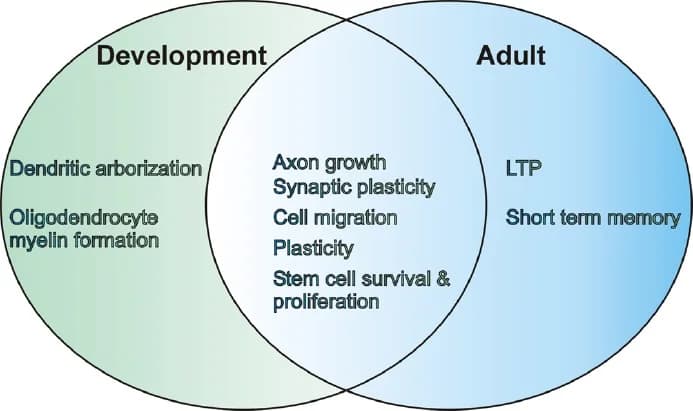
Now, this gene turns on for a reason in our adulthood life, because if it didn’t our brain would continue to grow (possibly leading to cancer or schizophrenia), so inhibiting it in small amounts seems to have benefits for memory and creativity without the downsides.
If you don’t have any problems with those conditions that I listed above, inhibiting Nogo-A can still benefit new memory formation.
Inhibition of Nogo-A in the hippocampus (part of the brain that forms memories) allows for new memories to form by (possibly) overwriting old memories.
By this process, everything may seem novel and new, which can help spark creativity (at least for me).
So, now you’re probably asking how to inhibit Nogo-A.
Well, it wasn’t known until recently on how to do this.
This information (like all the stuff I dig up for you) was buried in the scientific literature.
And I did the heavy lifting for you ;)
So here’s the moment you’ve all been waiting for.
Let’s inhibit Nogo-A.
There are a few different ways to inhibit Nogo-A — diet, supplements, and gear.
I’ve been using various ways (mainly supplements and gear) to inhibit Nogo-A, but in this post, I’ll talk about some diet changes you can make.
In my post here, you can see all the ways to inhibit Nogo-A (with supplements and references of course).
With diet, high amounts of Vitamin E can inhibit Nogo-A:
Also, polyphenols can inhibit Nogo-A:
Blackberries
Blueberries
Coffee (can be decaf as well)
Dark Chocolate
Red Onions
Red Wine
Spinach
TLDR: Inhibit Nogo-A with Vitamin E or Polyphenols to enhance new memory formation and/or creativity.
Stay beautiful!
-Jacob
Jacob Gordon
INHC, FMT-C
Integrative Nutrition Health Coach
I cover mold illness, post-viral recovery, methylation, and complex chronic disease, drawing on ten years of clinical research, work inside a functional medicine clinic, and my own recovery from all of it. Every claim here is cited.
Book a ConsultationRelated Protocols & Supplements
Deep-dive chapters and recommended supplements for this topic
Quercetin
500mg 2x/day
Vitamin D3 + K2
5000 IU + 200mcg/day
Magnesium Glycinate
400mg at bedtime