Taurine: The Conditionally Essential Amino Acid and the Deficiency-of-Aging Hypothesis
By Jacob Gordon, INHC, FMT-CThis article contains affiliate links. As an Amazon Associate, MyBioHack earns from qualifying purchases at no extra cost to you. We only link products we research and stand behind.
Taurine is the most abundant free amino acid in your heart, muscle, retina, and white blood cells, yet it is not used to build a single protein in your body.
In this post, we will discuss what taurine actually is, the headline-grabbing 2023 claim that its decline drives aging, the cardiovascular and metabolic evidence that is much stronger, the mechanisms behind its effects, where to get it, how to dose it, and the genetics that decide whether you can make your own.

What Is Taurine
Taurine (2-aminoethanesulfonic acid) is a sulfur-containing amino acid, but it carries a sulfonic acid group instead of the carboxylic acid group that protein-building amino acids use.
That single chemical difference is why taurine is never incorporated into proteins and instead floats free inside cells, where it reaches some of the highest intracellular concentrations of any small molecule in the body.
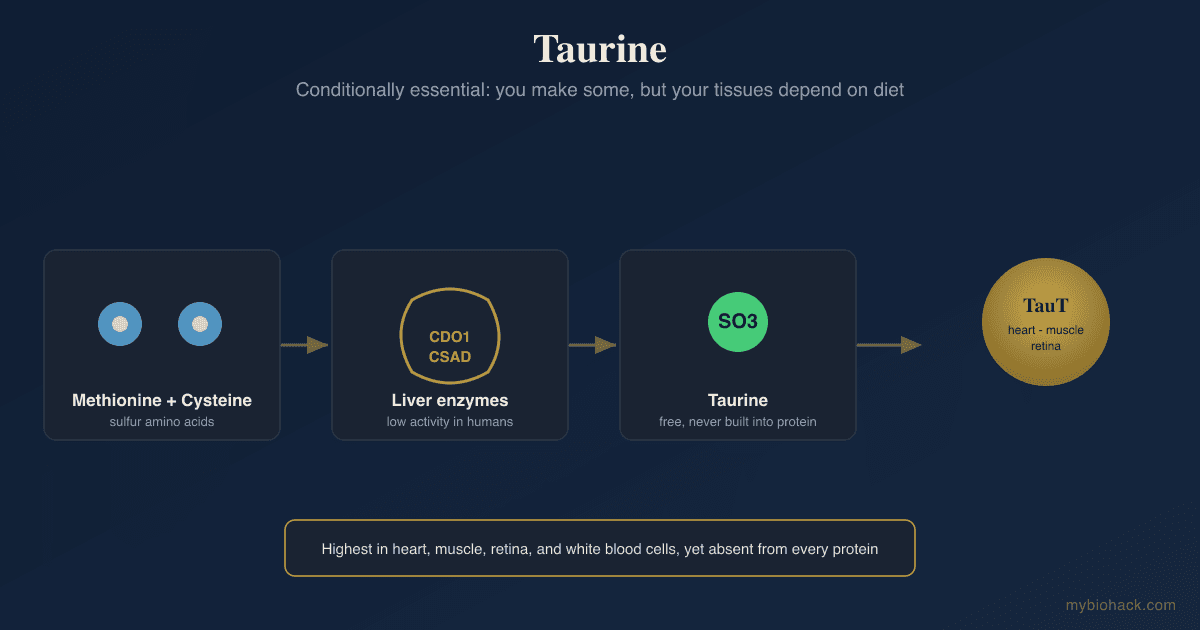
It is classified as conditionally essential, meaning you can synthesize it from cysteine and methionine under normal conditions, but synthesis can fall short during infancy, illness, pregnancy, and on a plant-only diet. R
Your body makes taurine through a short pathway that starts with the sulfur amino acids, so taurine status is downstream of cysteine and methionine metabolism. R
The enzymes that finish the job, cysteine dioxygenase (CDO1) and cysteine sulfinic acid decarboxylase (CSAD), are concentrated in the liver, and their relatively low activity in humans is the reason dietary taurine still matters. R
Once made or eaten, taurine is held inside cells by a dedicated taurine transporter (TauT), encoded by the gene SLC6A6, which pumps it against a steep concentration gradient into heart and muscle tissue that cannot make much of its own. R
Benefits Of Taurine
1. The Deficiency-Of-Aging Hypothesis
In 2023 a large multi-species paper in Science reported that circulating taurine declines with age in mice, monkeys, and humans, and that restoring it extended median lifespan in mice by roughly 10 to 12 percent and improved healthspan markers in middle-aged monkeys. R
In the same paper, taurine supplementation reduced cellular senescence, limited DNA damage, improved mitochondrial function, and lowered markers of inflammaging in animal tissue. R
There is a big MAYBE here, and it needs stating plainly.
The lifespan and causality data are almost entirely animal, and the human portion of that paper is associational, showing that lower taurine tracks with obesity, diabetes, and hypertension without proving that raising it reverses anything. R
A 2025 analysis in Aging Cell pushed back directly, finding that blood taurine did not reliably fall with age across several human cohorts and that earlier declines were partly explained by confounders, arguing against treating taurine as a clean aging biomarker. R
The honest summary is that the anti-aging case is mechanistically plausible and exciting in animals, but the human longevity claim is unproven and now actively contested.

2. Lower Blood Pressure And Cardiovascular Support
A 2024 systematic review and meta-analysis of randomized controlled trials found that taurine, at doses from 0.6 to 6 grams per day, lowered systolic blood pressure by about 4 mmHg and diastolic by about 1.5 mmHg. R
In a randomized, double-blind, placebo-controlled trial in prehypertensive adults, 1.6 grams of taurine daily for 12 weeks dropped clinic systolic pressure by 7.2 mmHg and improved both endothelium-dependent and endothelium-independent vasodilation. R
That vascular effect is relevant to anyone tracking nitric oxide and blood pressure regulation, and to the integrity of the endothelial glycocalyx that governs vascular permeability.
The blood-pressure benefit also lines up with one of the oldest observations in this field, the WHO-coordinated CARDIAC study, where higher 24-hour urinary taurine excretion across populations was inversely associated with ischemic heart disease mortality, with the highest-taurine Japanese populations showing the lowest heart-disease death rates. R
This is epidemiology and cannot prove cause, since high-taurine diets in those populations also came with more seafood and other protective factors. R
In congestive heart failure, taurine has small randomized trials behind it, including a double-blind crossover study where taurine improved NYHA functional class, and a later trial where it increased exercise capacity in patients already on standard therapy. R R
3. Mitochondrial Function And Exercise
Taurine is not just floating in muscle for storage, it chemically modifies specific mitochondrial transfer RNAs so that the mitochondria can correctly translate the proteins of the respiratory chain. R
When taurine runs low, that modification fails, certain respiratory complex subunits are built incorrectly, and oxygen consumption and ATP output drop, which is exactly what happens in some inherited mitochondrial diseases. R
Taurine also protects mitochondria from reactive oxygen species and stabilizes the inner membrane under stress. R
In exercise, supplementation around 1 to 3 grams taken before training has shown modest improvements in aerobic capacity, recovery, and some measures of strength and power across short trials. R
The effect sizes are real but small, and taurine is best understood as a supportive amino acid for the redox machinery and NAD+ system rather than a stimulant.
4. GABA And Glycine Receptor Modulation, Anxiety, And Sleep
Taurine is an inhibitory neuromodulator in the brain, acting as a weak agonist at GABA-A receptors and an activator of strychnine-sensitive glycine receptors. R
It specifically activates extrasynaptic GABA-A receptors in the thalamus, the same class of receptors that set the background tone of neural inhibition and influence sleep. R
This is the mechanistic basis for taurine's calming reputation, and it overlaps with how theanine and glycine quiet an overactive nervous system.
The caveat is that human data for taurine as an anxiety or sleep aid is thin, and most of the calming evidence is mechanistic or from animal models rather than clinical trials. R
5. Bile Acid Conjugation And Fat Digestion
In the liver, taurine is conjugated onto bile acids to form taurocholic acid and related taurine-conjugated bile salts, which emulsify dietary fat and make fat-soluble vitamins absorbable. R
Taurine-conjugated bile acids normally make up roughly a quarter to 40 percent of the bile acid pool, and in taurine depletion that fraction collapses while poorly emulsifying unconjugated bile acids rise. R
If you struggle with fat digestion, this is a relevant and underappreciated role, and it connects taurine to bile flow and the TUDCA family of bile-derived compounds.
6. Blood Sugar And Insulin Sensitivity
In a randomized, double-blind, placebo-controlled trial, 3 grams of taurine daily for 8 weeks significantly lowered fasting blood glucose, insulin, and HOMA-IR in people with type 2 diabetes. R
A separate randomized trial in type 2 diabetes found that taurine reduced markers of oxidative stress and inflammation, which are upstream drivers of insulin resistance. R
A 2024 meta-analysis pulled this together and concluded that taurine supplementation reduces several components of metabolic syndrome, including fasting glucose, triglycerides, and blood pressure. R
7. Eye And Retina Protection
Taurine is essential for the retina, and dietary taurine depletion causes progressive degeneration of cone photoreceptors and retinal ganglion cells, a finding first established decades ago in cats. R
In humans, the proof comes from rare genetic loss of the taurine transporter, where children develop early retinal degeneration alongside cardiomyopathy. R
Taurine and its bile-acid derivative taurocholic acid also show protective effects against features of age-related macular degeneration in laboratory models, which complements other retinal protectants like bilberry anthocyanins. R
8. Antioxidant And Immune Buffering
In white blood cells, taurine reacts with hypochlorous acid produced during the immune respiratory burst to form the more stable, less damaging molecule taurine chloramine, which dampens excess inflammation. R
This is part of why taurine is concentrated so heavily in neutrophils and why it is considered a cytoprotective buffer rather than a classical free-radical scavenger like glutathione. R
Natural Sources
Taurine is found almost exclusively in animal tissue, and is essentially absent from plants.
- Beef and red meat (moderate amounts, higher in dark muscle)
- Dairy (small amounts, one reason it is added to infant formula)
- Dark poultry meat (thigh and leg higher than breast)
- Octopus, mussels, clams, and scallops (among the richest sources)
- White fish and most seafood (consistently good sources)
The practical consequence is that strict vegans take in negligible taurine, and studies confirm vegans have lower plasma taurine and much lower urinary taurine excretion than omnivores. R
This does not automatically mean vegans are deficient, because endogenous synthesis compensates to a degree, but it does make taurine one of the more reasonable supplements to consider on a plant-only diet. R
Cooking method matters too, since taurine is water soluble and leaches into cooking liquid, so boiled meat loses more taurine than meat cooked in ways that retain its juices. R
Dosage And Safety
Most clinical trials use Taurine in the range of 1 to 6 grams per day, usually split into divided doses. R
A common practical starting point is 1 to 3 grams daily, with the higher end of the range reserved for cardiovascular or metabolic goals studied in trials. R
Taurine is consistently well tolerated, and the cardiovascular meta-analysis reported no significant increase in adverse effects versus placebo even at doses up to 6 grams per day. R
It is water soluble and not stored to toxic levels, with excess simply excreted in urine. R
A few caveats are worth keeping in mind despite the strong safety record.
Because taurine can lower blood pressure and blood glucose, anyone on antihypertensive or glucose-lowering medication should monitor for additive effects. R
Taurine in energy drinks is not the relevant model for therapeutic use, because the caffeine and sugar in those products drive most of their effects and most of their risks.
Mechanisms Of Action
Simple:
- Taurine keeps cells stable by balancing their water and mineral content and calming overexcited nerves.
- It helps the mitochondria read their own genetic code correctly so they can make energy efficiently.
- It gets attached to bile so you can digest fat, and it soaks up harsh immune chemicals so inflammation does not spiral.

Advanced:
- Osmoregulation and calcium handling Taurine is a primary organic osmolyte, and cells release or retain it to defend their volume, while in cardiomyocytes it modulates intracellular calcium flux and sarcoplasmic reticulum handling, which underlies its cardiac and antiarrhythmic effects. R
- Mitochondrial tRNA modification Taurine forms 5-taurinomethyluridine at the wobble position of specific mitochondrial tRNAs, and loss of this modification impairs translation of respiratory chain subunits such as ND6 in complex I, reducing oxidative phosphorylation and oxygen consumption. R
- Inhibitory neurotransmission Taurine activates extrasynaptic GABA-A receptors and strychnine-sensitive glycine receptors while inhibiting NMDA-mediated excitation, producing a net inhibitory and neuroprotective tone in the CNS. R
- Bile acid conjugation Taurine is conjugated to cholic and chenodeoxycholic acid via bile acid-CoA, generating taurine-conjugated bile salts that improve micelle formation and fat-soluble vitamin absorption. R
- Immune chloramine buffering Neutrophil taurine scavenges myeloperoxidase-derived hypochlorous acid to form taurine chloramine, a less reactive species that downregulates pro-inflammatory mediator production. R
Genetics
SLC6A6 (Highest Population Risk)
SLC6A6 encodes the taurine transporter TauT, which moves taurine into cells against a steep gradient, and is the rate-limiting step for taurine in tissues like heart and muscle that barely synthesize their own.
Biallelic loss-of-function mutations cause hypotaurinemic retinal degeneration and cardiomyopathy, with severely reduced taurine in plasma, muscle, and brain. R
This condition is treatable, and the same group argued taurine could be added to newborn screening because early supplementation may prevent the retinal and cardiac damage. R
Animal knockout of this transporter reproduces the human picture, producing cardiomyopathy with cardiac atrophy, reduced exercise capacity, and near-total taurine depletion in heart tissue. R
CSAD
CSAD encodes cysteine sulfinic acid decarboxylase, the enzyme that catalyzes the last committed step of taurine biosynthesis by converting cysteine sulfinic acid to hypotaurine.
Its activity is a major determinant of how much you depend on dietary taurine, and it is relatively low in humans compared with rodents.
Knockout of CSAD in mice drops tissue taurine dramatically and raises neonatal mortality unless taurine is supplied in the diet. R
CDO1
CDO1 encodes cysteine dioxygenase, the upstream enzyme that oxidizes cysteine to cysteine sulfinic acid and sits at the branch point between taurine synthesis and cysteine catabolism.
Its expression is tightly regulated by sulfur amino acid intake, so methionine and cysteine availability indirectly set the ceiling on how much taurine your liver can make. R
More Research
For biomarker context, plasma and urinary taurine can be measured, and amino acid status including taurine is captured on a comprehensive panel like the Nutrient Zoomer (Vibrant Wellness).
If your interest in taurine is metabolic, the Cardio Zoomer (Vibrant Wellness) covers fasting insulin, HOMA-IR, lipoproteins, and the metabolic markers that taurine trials moved, and a focused alternative is the Insulin Resistance Panel (Quest Diagnostics).
The aging hypothesis remains the most contested area, with the 2023 Science paper and the 2025 Aging Cell rebuttal disagreeing on whether human taurine even declines with age, so the honest position is to wait for the randomized human longevity trials now being designed. R R
The epidemiological signal from the CARDIAC study pairs taurine with magnesium as the two diet-derived factors most inversely associated with heart-disease mortality, which is suggestive but cannot separate taurine from the rest of a seafood-rich diet. R
The exercise literature is genuinely mixed, with some trials showing improved endurance and recovery and others showing nothing, so the realistic expectation is a small supportive effect rather than a meaningful ergogenic one. R
Jacob Gordon
INHC, FMT-C
Board Certified Health Coach
I spent years battling unexplained chronic illness before discovering biohacking, epigenetics, and functional medicine. Now I share that research at MyBioHack to help others find their own answers.
Book a ConsultationRelated Protocols & Supplements
Deep-dive chapters and recommended supplements for this topic
Electrolyte Complex
1 scoop/day
CoQ10
200mg/day
Magnesium Glycinate
400mg at bedtime