Medium-Chain Triglycerides: Why C8, C10, C12, And C6 Are Not The Same Fat
By Jacob Gordon, INHC, FMT-CThis article contains affiliate links. As an Amazon Associate, MyBioHack earns from qualifying purchases at no extra cost to you. We only link products we research and stand behind.
Not all medium-chain triglycerides (MCTs) do the same thing, and treating them interchangeably is one of the most common mistakes people make when using MCT oil for ketosis, antifungal support, or gut health.
In this post, we will discuss the structural differences between the four medium-chain fatty acids (MCFAs), why each one behaves differently in the body, the mechanisms behind C8 ketone production and antifungal activity, the role of Saccharomyces boulardii as an endogenous MCFA producer, the amphotericin B interaction caveat, the real story on Th2 skewing and allergic risk, and how to choose an MCT product that matches your goal.

What Makes A Fat "Medium-Chain"
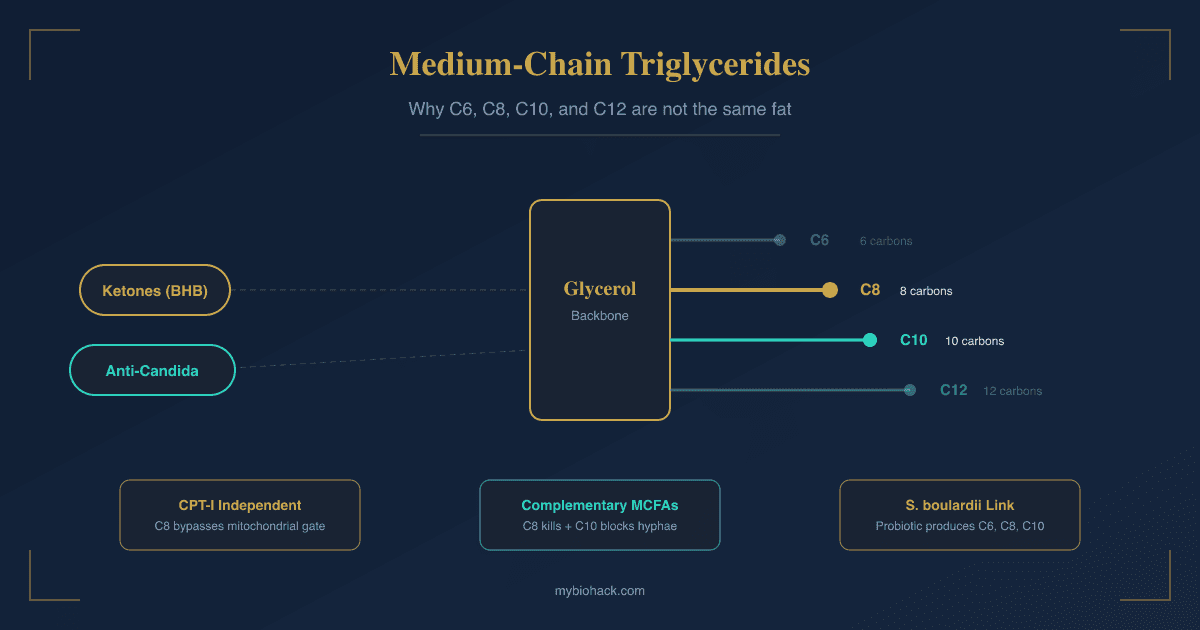
Triglycerides are the standard storage form of dietary fat: three fatty acid chains esterified to a glycerol backbone.
Fatty acids are classified by carbon chain length, and the medium-chain range spans 6 to 12 carbons. R
The four medium-chain fatty acids (MCFAs) are:
- Caproic acid (C6:0): 6 carbons, also called hexanoic acid
- Caprylic acid (C8:0): 8 carbons, also called octanoic acid
- Capric acid (C10:0): 10 carbons, also called decanoic acid
- Lauric acid (C12:0): 12 carbons, also called dodecanoic acid
The names caproic, caprylic, and capric all derive from the Latin word for goat (caper), because these fatty acids were first isolated from goat milk fat, where they produce the characteristic goat smell. R
Why MCFAs are absorbed differently than long-chain fatty acids (LCFAs):
Long-chain fats (C14 and above) require packaging into chylomicrons in the intestinal wall and travel through the lymphatic system before entering systemic circulation. R
C8 and C10, by contrast, are poorly incorporated into chylomicrons, are relatively water-soluble, and travel directly from the intestine through the portal vein to the liver bound to serum albumin. R
This portal-vein absorption route means C8 and C10 reach hepatic mitochondria rapidly, bypassing the lymphatic delay that slows long-chain fat oxidation. R
C12 (lauric acid) behaves differently: it has a higher propensity for lymphatic absorption, meaning its transit to the liver is delayed and it behaves more like a long-chain fat than a true capra-type MCFA. R
This absorption difference is not trivial: it is the structural basis for why C8 is dramatically more ketogenic than C12, and why grouping all four into a single "MCT" category obscures clinically relevant differences. R
Natural food sources:
Coconut oil contains roughly 46 to 54% lauric acid (C12), 5 to 10% caprylic acid (C8), and 5 to 8% capric acid (C10). R
This is why coconut oil is not a good ketogenic supplement: the dominant fatty acid is C12, which is the least ketogenic of the four. R
Commercial MCT oil is produced by fractionating coconut or palm kernel oil, extracting the C8 and C10 fractions, and re-esterifying them to glycerol. R
Goat and cow milk fat contains roughly 4 to 12% combined capra fatty acids (C6, C8, C10) and 3 to 5% lauric acid, making dairy a natural source of shorter-chain MCFAs in modest amounts. R
C6: Caproic Acid
Caproic acid (C6) is the shortest MCFA and is not included in most commercial MCT oil products. R
The reason is straightforward: it produces a distinctly unpleasant goat-like odor and causes significant gastrointestinal (GI) distress even at low doses. R
C6 is not meaningfully ketogenic at practical oral doses.
It is produced by Saccharomyces boulardii in the gut, where it contributes to antifungal activity in a context where GI tolerability is not the limiting factor. R
Practical takeaway: C6 has no role in a supplemental MCT protocol.
C8: Caprylic Acid
Caprylic acid (C8) is the most ketogenic of the MCFAs and the primary active compound in high-quality MCT oil. R
It is the only MCFA with a carbon chain length short enough to cross the inner mitochondrial membrane independent of carnitine palmitoyl transferase I (CPT-I). R
This is the mechanistic key to its superiority for ketogenesis.
Long-chain fats (C14 and above) require the CPT-I shuttle system to enter mitochondrial beta-oxidation, and CPT-I activity is rate-limited by malonyl-coenzyme A (malonyl-CoA) levels that rise under high-insulin and high-carbohydrate conditions. R
C8 bypasses CPT-I entirely, entering mitochondrial beta-oxidation unregulated regardless of the cell's malonyl-CoA or insulin status. R
C8 is also a potent antifungal: at concentrations as low as 10-5 M, caprylic acid achieves total killing of Candida albicans in as little as 10 minutes of contact time. R
C8 inhibits Candida virulence factors including morphogenesis (the yeast-to-hyphae transition), adhesion to epithelial surfaces, and biofilm formation. R
The mechanism of antifungal action involves direct penetration and perturbation of the fungal cell membrane: molecular dynamics simulations show C8 inserts into and disrupts lipid bilayers, while C12 self-clusters at the surface without bilayer penetration, explaining why shorter chain length confers more direct membrane disruption. R
C8 summary:
- Best for ketone production (CPT-I independent)
- Rapid fungicidal activity at very low concentrations
- Absorbed via portal vein, reaches liver rapidly
- GI tolerance acceptable at doses ramped slowly
C10: Capric Acid
Capric acid (C10) is the second most ketogenic MCFA, producing approximately one-third the ketone output of C8 at equivalent doses. R
C10 does not cross the inner mitochondrial membrane independently of CPT-I, which is the main reason for its lower ketogenic potency relative to C8. R
Where C10 arguably surpasses C8 is in antifungal filamentation inhibition.
C10 is a stronger inhibitor of Candida albicans hyphae formation than C8 at equivalent concentrations. R
In the study identifying the active components of S. boulardii extract, capric acid alone inhibited hyphae formation at a level comparable to the full S. boulardii extract, while caprylic acid had only a slight effect on filamentation and caproic acid had none. R
This makes the C8 plus C10 combination mechanistically complementary: C8 kills Candida rapidly via membrane disruption, while C10 specifically blocks the virulence-enabling yeast-to-hyphal transition that enables tissue invasion. R R
C10 also reduces Candida adhesion to epithelial cells and creates synergistic antifungal activity when paired with the azole drug fluconazole (FLC). R
Critical caveat: C10 and amphotericin B:
Capric acid stimulates ergosterol production in Candida albicans cell membranes. R
Amphotericin B (AMB) exerts its antifungal effect precisely by binding ergosterol and disrupting the fungal membrane.
When capric acid increases ergosterol content, it generates cross-resistance to AMB and blocks AMB's mechanism of action. R
Do not combine capric acid (C10) or S. boulardii with amphotericin B antifungal treatment, as the combination actively antagonizes the drug. R
The same caveat likely applies to dietary C10 sources (MCT oil blends containing capric acid) during AMB treatment courses.
C10 summary:
- Moderately ketogenic (one-third of C8's ketone output)
- Superior to C8 for blocking Candida filamentation and adhesion
- Synergistic with fluconazole
- Antagonistic with amphotericin B
- Best used in combination with C8 for complementary antifungal coverage
C12: Lauric Acid
Lauric acid (C12) occupies an ambiguous position in the MCFA literature.
It is technically classified as medium-chain (12 carbons), but its metabolic behavior is significantly closer to long-chain fats than to capra-type MCFAs. R
Rodent studies show lauric acid is preferentially absorbed via the lymphatic system rather than the portal vein, delaying its access to the liver and dramatically reducing the ketone spike it generates compared with C8 or C10. R
The practical consequence is that coconut oil (approximately 50% lauric acid) produces a lower and more sustained pattern of blood ketone elevation, with the peak being substantially lower and later than MCT oil. R
C12 does exhibit antimicrobial activity and is the most potent antibacterial of the MCFAs against Gram-positive bacteria.
It also has antifungal activity against Candida, though molecular dynamics data show C12 self-clusters at the bilayer surface rather than penetrating it, making its membrane disruption less direct than C8. R
Practical advantage of C12:
Because lauric acid behaves more like a long-chain fat, it has a significantly higher smoke point than C8/C10-based MCT oils, making it suitable for moderate-temperature cooking and pan-frying. R
C12 summary:
- Least ketogenic of the four; lymphatic absorption delays hepatic delivery
- Produces lower, more sustained ketone elevation
- Antimicrobial, particularly antibacterial against Gram-positive species
- Higher smoke point than C8/C10 oils; suitable for moderate-heat cooking
- Coconut oil is primarily C12, not a ketogenic supplement
Ketogenesis: Why C8 Wins
The ketogenic ranking of the MCFAs from highest to lowest output is: C8 > C10 > C12.
The ketogenic effect of C8 is approximately three times higher than C10 and six times higher than C12 at equivalent oral doses. R
The entire mechanistic difference traces back to CPT-I.
C8 crosses the inner mitochondrial membrane without CPT-I.
C10, C12, and all long-chain fats require CPT-I for mitochondrial entry.
CPT-I is rate-limited by malonyl-CoA, which accumulates under high-insulin and high-carbohydrate conditions.
C8 bypasses all of this regulation and enters beta-oxidation unconditionally. R
Once inside the mitochondria, C8 undergoes beta-oxidation to acetyl-coenzyme A (acetyl-CoA).
When acetyl-CoA exceeds the liver's capacity to oxidize it through the tricarboxylic acid (TCA) cycle (which is downregulated during carbohydrate restriction or fasting), excess acetyl-CoA is shunted into ketogenesis: HMG-CoA synthase produces hydroxymethylglutaryl-CoA (HMG-CoA), which is cleaved to beta-hydroxybutyrate (BHB) and acetoacetate. R
BHB enters circulation and crosses the blood-brain barrier (BBB), providing an alternative fuel source for neurons that ordinarily depend on glucose. R
Practical dose guidance:
Starting dose: 5 g of C8 alone or a C8 plus C10 combination. R
Target dose for ketogenesis: ramp progressively to 15 to 20 g of C8.
Consuming MCT oil in a fasted state (or with only fat and protein) maximizes BHB elevation; consuming it with a carbohydrate-containing meal blunts and delays the ketone peak. R
Caffeine co-ingestion may augment the ketogenic response, which is one reason MCT oil in coffee achieves higher ketone levels than MCT oil alone. R
Antifungal Activity: C8 And C10 Against Candida
C8 and C10 target Candida albicans through distinct but complementary mechanisms, attacking different aspects of fungal pathogenicity simultaneously.
C8 mechanisms against Candida:
- Direct membrane penetration and bilayer disruption, producing fungicidal activity at 10-5 M within 10 minutes. R
- Inhibition of morphogenesis: blocks the yeast-to-hyphae transition that enables Candida to invade tissue and evade phagocytosis. R
- Inhibition of adhesion: reduces Candida attachment to intestinal epithelial cell surfaces. R
- Inhibition of biofilm formation: disrupts established biofilm architecture, the structure that confers antifungal drug resistance. R
C10 mechanisms against Candida:
- Strong hyphae formation inhibition: capric acid alone matches the anti-filamentation potency of full S. boulardii extract. R
- Adhesion inhibition: reduces epithelial surface binding. R
- Fluconazole synergy: combined C10 and FLC causes the multidrug resistance (MDR) efflux pump Cdr1p to relocalize from the plasma membrane to the cell interior, reducing FLC efflux and restoring drug sensitivity in resistant strains. R
Resistance is unlikely with MCFAs:
Fungi are significantly less likely to develop resistance to fatty acids than to azole or polyene drugs, because fatty acids attack fundamental membrane lipid biophysics rather than specific enzymatic targets that can mutate. R
All four MCFAs inhibit both yeast-form and mycelial growth of Candida albicans in vitro, with C8 and C10 being consistently the most potent inhibitors of hyphal growth at clinically relevant concentrations. R
Saccharomyces Boulardii: The Probiotic That Makes MCFAs
One underappreciated mechanism of action of Saccharomyces boulardii (a probiotic yeast used for diarrhea, Clostridioides difficile infection, and dysbiosis) is that it produces MCFAs directly in the gut as metabolites.
S. boulardii secretes caproic acid (C6), caprylic acid (C8), and capric acid (C10) into the intestinal environment. R
When S. boulardii extract was analyzed by gas chromatography-mass spectrometry (GC-MS), the anti-filamentation fraction was identified as containing primarily C6, C8, and C10. R
C10 was confirmed as the dominant anti-filamentation compound, matching the full extract's potency against Candida germ tube formation at the concentrations produced. R
This is part of the mechanism by which S. boulardii competitively suppresses Candida overgrowth: it occupies the gut niche and simultaneously secretes the fatty acids that block Candida's pathogenic morphotype. R
Practical implication: combining exogenous MCT oil (C8/C10) with S. boulardii creates dual delivery of antifungal MCFAs, one from the supplement and one produced endogenously by the probiotic in the gut lumen.
Do not combine S. boulardii with amphotericin B for the ergosterol-related antagonism reason described in the C10 section above. R
The Th2 Caveat: MCFAs, Gut Permeability, And Allergy Risk
This is a nuanced area that is often misrepresented as a simple "MCT oil causes allergies" concern.
The actual picture is more mechanistically conditional and dose-dependent.
What The Research Actually Shows
MCFAs signal through G protein-coupled receptor 84 (GPR84), which is expressed on naive T cells and innate immune cells.
Diets rich in MCFAs including C6, C8, and C10 were shown to polarize naive T cells toward Th17 and Th1 phenotypes via GPR84 signaling. R
This is a Th1/Th17 polarization, not Th2 polarization.
The Th2 skewing that raises allergy concern is a separate downstream problem that occurs through a different mechanism.
The Actual Th2 Mechanism: Leaky Gut As The Mediator
When the intestinal epithelial barrier is disrupted or made more permeable (by dysbiosis, inflammatory diet, candidal overgrowth itself, or potentially by MCFAs at high doses before gut tolerance is established), food antigens and microbial products translocate across the epithelium more freely. R
This barrier breach triggers release of alarmin cytokines from stressed epithelial cells: interleukin-25 (IL-25), interleukin-33 (IL-33), and thymic stromal lymphopoietin (TSLP). R
These three cytokines promote naive T cell differentiation into Th2 cells, drive immunoglobulin E (IgE) class-switching in B cells, and recruit mast cells and eosinophils to the mucosa, producing the classic allergic immune architecture. R
The concern with MCFAs is not that they directly drive Th2 polarization.
The concern is that at high doses in a gut that is already permeable or inflamed, they could transiently worsen barrier function, enabling antigen translocation that then activates the IL-25/IL-33/TSLP alarmin cascade and the downstream Th2/IgE response. R
Who This Matters For
This concern is most relevant for:
- People with pre-existing intestinal permeability, inflammatory bowel disease (IBD), or severe gut dysbiosis
- People who start at high MCT doses without gradual titration
- People with existing IgE-mediated food allergies or eosinophilic gastrointestinal disorders
Context: MCFAs Also Support Barrier Integrity
The picture is genuinely mixed.
Early evidence suggests caprylic acid at appropriate concentrations can support intestinal barrier function under inflammatory stress and reduce interleukin-8 (IL-8) signaling in intestinal epithelial cells exposed to inflammatory challenge. R
The antifungal activity of C8 and C10 against Candida directly reduces one of the established drivers of gut permeability (candidal hyphal invasion of the epithelium), which would reduce alarmin release and Th2 risk over time in people with candidal overgrowth. R
This is a dose-dependent and gut-state-dependent concern, not a categorical contraindication.
The practical guidance: start low, titrate slowly, and do not use high-dose MCT oil as a first intervention in a severely inflamed or permeable gut without addressing the underlying dysbiosis first.
GI Tolerance And Dosing
GI distress (loose stools, nausea, cramping) is the primary dose-limiting side effect of MCT oil, caused by rapid delivery of free fatty acids to the intestinal lumen. R
GI distress severity by chain length (worst to best tolerated):
- C6: Most disruptive, excluded from commercial MCT products for this reason. R
- C8: Significant GI distress at doses above tolerance without titration.
- C10: Better tolerated than C8 at equivalent doses.
- C12: Least GI-disruptive; lymphatic absorption reduces luminal free fatty acid concentration. R
Dosing protocol:
Start at 5 g per serving (approximately 1 teaspoon of MCT oil). R
Increase by 5 g every 3 to 5 days as tolerated.
Target dose for ketogenesis: 15 to 20 g of C8 per dose.
Take with food initially if GI-sensitive; shift to fasted use once tolerance is established to maximize ketone output.
Do not use C8/C10 MCT oil for cooking at high heat: its low smoke point produces degradation compounds at frying temperatures.
How To Choose
For ketone production and brain energy:
Use a pure C8 (caprylic acid) oil or C8-dominant blend.
C8-only products produce the highest and fastest BHB elevation. R
C8 MCT oil is the appropriate product here.
For antifungal gut support:
Use a C8 plus C10 blend.
C8 handles rapid membrane disruption and killing; C10 handles filamentation blockade and adhesion inhibition. R R
Stack with Saccharomyces boulardii for complementary endogenous MCFA production in the gut lumen.
Do not use C10 or S. boulardii concurrently with amphotericin B. R
For cooking:
Coconut oil (C12-dominant) or ghee is appropriate for moderate-temperature pan-frying.
C8/C10 MCT oil should not be heated to cooking temperatures.
For both ketosis and antifungal goals:
A 60/40 or 70/30 C8/C10 blend covers both objectives: the C8 fraction drives ketones and both fractions contribute antifungal activity.
C8/C10 MCT oil products of this composition are widely available.
Mechanisms Of Action
Simple:
- C8 bypasses the CPT-I mitochondrial shuttle that limits long-chain fat oxidation, entering beta-oxidation directly and producing an acetyl-CoA overflow that drives ketone production.
- C10 is moderately ketogenic and specifically blocks Candida's yeast-to-hyphae transition, removing the morphotype that enables tissue invasion and drug resistance.
- C8 kills Candida rapidly at very low concentrations by penetrating and disrupting fungal cell membranes, achieving complete killing in 10 minutes at 10-5 M.
- C10 combined with fluconazole forces the Candida efflux pump Cdr1p away from the plasma membrane, restoring fluconazole sensitivity in drug-resistant strains.
- C10 combined with amphotericin B stimulates ergosterol production in Candida, generating cross-resistance that blocks amphotericin B's membrane disruption mechanism: do not combine them.
- S. boulardii produces C6, C8, and C10 in the gut lumen as metabolites, with C10 being the dominant anti-filamentation compound and a key part of how the probiotic suppresses Candida overgrowth.
- The Th2 allergy concern is not direct MCT-driven Th2 polarization: MCFAs actually polarize T cells toward Th1/Th17 via GPR84. The Th2 risk arises when a permeable gut allows antigen translocation that triggers the IL-25/IL-33/TSLP alarmin cascade, which then drives Th2/IgE responses. Slow titration and addressing underlying gut permeability mitigates this.
Advanced:
- CPT-I bypass and ketogenesis: Only fatty acids with carbon chain lengths of 8 carbons or fewer cross the inner mitochondrial membrane independently of CPT-I. R CPT-I is allosterically inhibited by malonyl-CoA, which accumulates under high-insulin conditions via ACC1 (acetyl-CoA carboxylase 1) activity. By bypassing CPT-I, C8 enters beta-oxidation in the hepatocyte mitochondrial matrix regardless of the cell's malonyl-CoA status. R The resulting acetyl-CoA flood drives the ketogenesis pathway: acetyl-CoA condenses to form HMG-CoA via HMG-CoA synthase, then HMG-CoA lyase cleaves HMG-CoA to produce acetoacetate and acetyl-CoA. R Acetoacetate is reduced to BHB by beta-hydroxybutyrate dehydrogenase (BHBD) using NADH as cofactor. BHB crosses the BBB via monocarboxylate transporter 1 (MCT1) and MCT2, and is reconverted to acetyl-CoA in neuronal and cardiac mitochondria by succinyl-CoA:3-oxoacid-CoA transferase (SCOT) for local energy use. R
- C8 antifungal membrane mechanism: Molecular dynamics simulation using a Martini coarse-grain lipid bilayer model shows that caprylic acid inserts into the bilayer interior and disrupts lateral membrane pressure profiles, while lauric acid (C12) forms surface-level self-clusters without bilayer penetration. R C8 bilayer insertion destabilizes lipid packing required for fungal plasma membrane integrity and normal transmembrane protein function, producing the rapid fungicidal kinetics at low concentration that distinguish it from azoles (which are fungistatic at standard doses). R R
- C10 and Cdr1p relocalization: In Candida albicans, the Cdr1p (Candida drug resistance protein 1) ATP-binding cassette (ABC) transporter is the primary mechanism of azole efflux resistance. R Cdr1p requires ergosterol-rich lipid raft microdomains in the plasma membrane for correct localization and function. The FLC plus capric acid combination suppresses ergosterol biosynthesis by inhibiting ERG11 (lanosterol 14-alpha-demethylase) expression, collapsing membrane ergosterol concentration. R Deprived of its ergosterol raft environment, Cdr1p relocalizes to intracellular compartments, losing its ability to pump FLC out of the cell and restoring Candida's FLC sensitivity. R Capric acid alone, by contrast, upregulates ERG11 expression 5.4-fold, increasing membrane ergosterol, which normally provides the substrate AMB binds and disrupts. The elevated ergosterol combined with altered membrane lipid composition created by capric acid reduces the net membrane-permeabilizing and cytoplasm-leakage effect that AMB relies on, producing net antagonism. R
- GPR84-mediated immune signaling: GPR84 is a G protein-coupled receptor (GPCR) that functions as a pattern-recognition sensor for MCFAs in immune cells. R GPR84 activation by C6, C8, and C10 on naive T cells skews differentiation toward the Th17 and Th1 lineages, which are the antimicrobial and tissue-protective phenotypes, not the Th2 allergic phenotype. R The Th2/IgE risk arises separately when gut barrier compromise allows food antigens and microbial products to reach the lamina propria, where dendritic cells polarize naive T cells in a Th2 direction under the influence of the epithelial alarmins IL-25, IL-33, and TSLP. R IL-25 is produced by tuft cells in response to barrier disruption; IL-33 is released from stressed epithelial nuclei; TSLP is secreted by epithelial cells exposed to allergens and irritants. Together they activate type 2 innate lymphoid cells (ILC2s) and dendritic cells that drive Th2 differentiation, IgE class-switching, mast cell recruitment, and eosinophilia. R This two-step pathway (MCFA contributing to barrier disruption, barrier disruption driving antigen translocation, antigen translocation activating the alarmin cascade) is conditionally relevant and dose-dependent.
More Research
- A study using an MCT oil with a C8:C10 ratio of 30:70 demonstrated enhanced cognitive performance and attenuation of cognitive decline associated with prolonged exercise in healthy young adults, suggesting C10 may contribute to neurological benefits beyond ketone production alone. R
- MCT oil provides slightly fewer calories than long-chain triglycerides (LCTs) at 8.4 kcal/g versus 9.2 kcal/g for LCTs, because the metabolic cost of partial oxidation to ketone bodies versus full oxidation to carbon dioxide and water reduces net caloric yield. R
- Murine oral candidiasis models show capric acid applied topically to the oral cavity at concentrations above 48.8 micromolar three times daily significantly improves candidal lesion scores and reduces mycelial growth histologically, supporting topical as well as systemic applications of C10. R
- The capric acid plus fluconazole combination has been proposed as a strategy to restore fluconazole sensitivity in resistant Candida strains by targeting Cdr1p localization rather than genetic resistance mechanisms, making it relevant against azole-resistant Candida auris and multi-drug resistant C. albicans. R
- There is a mechanistic rationale for combining MCT oil with coffee: caffeine activates cyclic AMP (cAMP) signaling in hepatocytes via adenosine receptor blockade, activating protein kinase A (PKA) and promoting lipolysis and fatty acid oxidation, potentially amplifying the acetyl-CoA overflow that drives C8-induced ketogenesis. The supporting data remain limited but mechanistically plausible. R
- The GI side effect profile of C8 is dose-related and largely resolves with titration: at chronic doses of 15 to 20 g per day reached by ramping over several weeks, most individuals tolerate C8 well; starting doses above 10 g without prior titration produce loose stools in the majority of new users. R
Jacob Gordon
INHC, FMT-C
Board Certified Health Coach
I spent years battling unexplained chronic illness before discovering biohacking, epigenetics, and functional medicine. Now I share that research at MyBioHack to help others find their own answers.
Book a ConsultationRelated Protocols & Supplements
Deep-dive chapters and recommended supplements for this topic
Spore-Based Probiotics
1 cap with food
L-Glutamine
5g 2x/day on empty stomach
Butyrate
300mg 2x/day with meals