Twin Codependency: The Biology Of Enmeshment And Why Separation Feels Like Injury
By Jacob Gordon, INHC, FMT-CThis article contains affiliate links. As an Amazon Associate, MyBioHack earns from qualifying purchases at no extra cost to you. We only link products we research and stand behind.
Twin codependency is what happens when two nervous systems that calibrated against each other before birth never learn to regulate alone.
In this post, we will discuss what twin enmeshment actually is, why the research on it is thinner than the popular writing suggests, what shared regulation does to the stress axis over decades, how to rebuild autonomous regulation without severing the bond, and what is worth testing.

Basics Of Twin Codependency
The clearest definition comes from Joan Friedman, a psychotherapist and identical twin who has written more carefully about this than anyone: healthy twins experience the relationship as a choice, and codependent twins experience it as a necessity.
She frames the distinction as soul mates or cell mates.
That is a clinical observation, not a research finding, and the distinction matters for everything that follows.
I want to be direct about the evidence base before building anything on top of it.
Codependency is not a diagnosis.
It has no entry in the DSM or the ICD, no consensus operational definition, and a 2026 integrative review of 30 studies described the construct as conceptually fragmented and contested, recommending it be reframed as a relational process rather than a trait or a disorder. R
A critique published in 1990 argued the concept was never empirically grounded in the first place, having been imported wholesale from an outdated disturbed-personality model. R
The measurement literature is thin enough to be embarrassing: the most-cited psychometric work rests on 95 undergraduates. R
So when you read "twin codependency," including in this post, understand that you are reading a clinically useful folk concept, not a validated syndrome with an established physiology.
The twin research literature does not use the word.
It uses co-twin dependence and inter-twin closeness, which are narrower and better behaved.
What the research does establish is that the twin bond is categorically different from other sibling bonds.
Twins are more likely than non-twin siblings to use a sibling as an attachment figure, and identical twins are more likely than fraternal twins to be attached to one another. R R
Twins report the highest intimacy with their co-twin of any relationship they have, above friends and above parents. R
Here is the finding that complicates the popular narrative, and it is worth sitting with.
Twins score *higher* on self-differentiation than non-twins, not lower. R
Growing up beside someone who is constantly compared to you appears to force the question of who you are earlier and harder than most people ever face it.
The same study found twins under 18 scored higher on identity diffusion, which suggests the process is slower and more turbulent before it resolves.
Enmeshment is therefore not the default outcome of twinship.
It is one outcome, and the interesting question is what separates it from the other one.
The signature of the pathological version is not closeness.
It is asymmetry.
In 419 twins, psychological submissiveness within the pair correlated with increased depression and psychosomatic symptoms, and the effect was strongest in males with a female co-twin. R
Notably, 81% of adult twins in that sample eventually reported feeling equal to their co-twin in dominance, so the asymmetry is usually developmental rather than permanent.
Conflict and reduced warmth in the twin relationship predicted hyperactivity and conduct problems by first grade, but did not predict emotional difficulties or peer problems, and there was no difference between identical and fraternal pairs. R
The twin relationship is a risk factor for something specific, not a general one for everything.
What Causes Twin Codependency
Contributing factors (not an exclusive list, and none of these are deterministic):
- Being raised as a unit (matching clothes, a shared name, a shared bedroom, and a shared social identity that no one ever questioned)
- Coregulation from before birth (the mechanism section below, and the reason this is not simply ordinary sibling closeness)
- Parental role assignment (the shy one and the bold one, the smart one and the athletic one, roles that harden because they are useful to the adults doing the labeling)
- Shared prenatal environment (gene expression differences are already present at birth in identical twins and vary somewhat by placentation, though a discordant-twin study in the UK Biobank found within-pair birth weight differences did *not* predict most adult cardiometabolic markers, so do not overstate the womb) R R
- Social comparison orientation (identical twins score significantly higher than fraternal twins on comparing themselves to their co-twin, which is a plausible engine for both individuation and fusion depending on how it is handled) R
- Zygosity (identical twins are more attached to one another than fraternal twins, who are in turn more attached than non-twin siblings) R
There is a big MAYBE on the zygosity point.
Identical twins are also dressed alike more often, kept in the same classroom more often, and told they are a matched set more often.
No study I can find cleanly separates the genetic similarity from the differential rearing, and anyone who tells you the bond is "genetic" is reading past that confound.
The clinical literature adds a set of causes that no one has measured properly, described well by The Peaceful PLC in its writing on twin trauma: guilt and obligation when one twin feels responsible for the other's wellbeing, power imbalances that go unreported because the culture has no script for a twin being harmed by a twin, and the cultural mythology of twinship itself, which makes separation look like betrayal.
The Gibbons sisters, the "Silent Twins," are the extreme case that gets cited to make this point, and they are an extreme case, not a model.
How Coregulation Creates The Problem
This is the part that belongs on a health site rather than a psychology one.
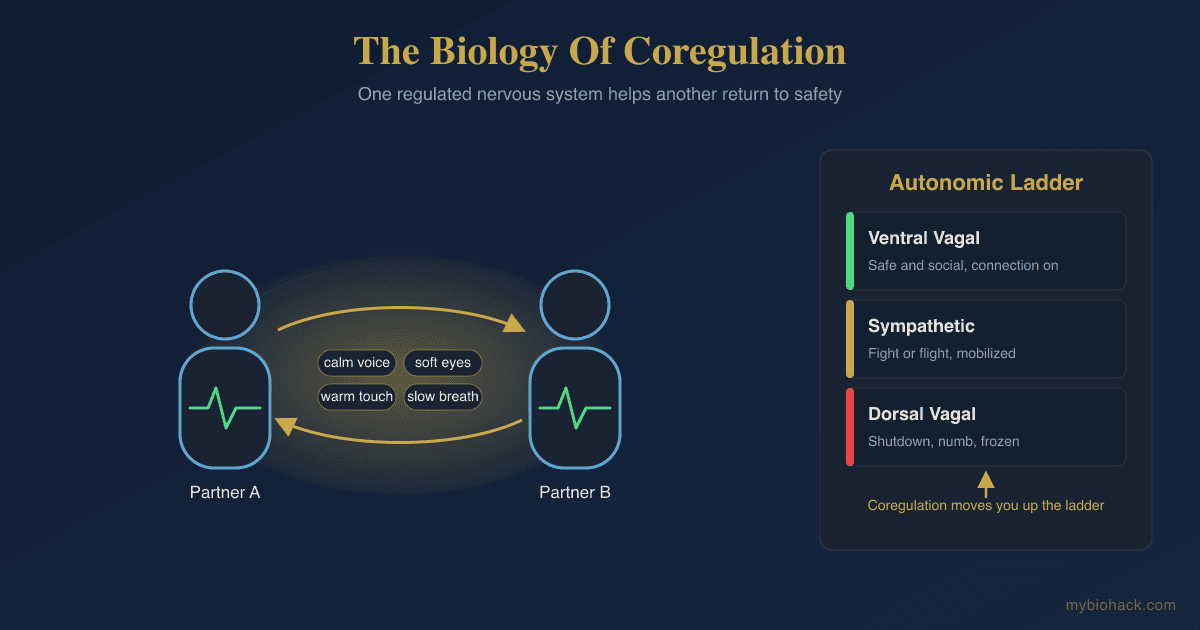
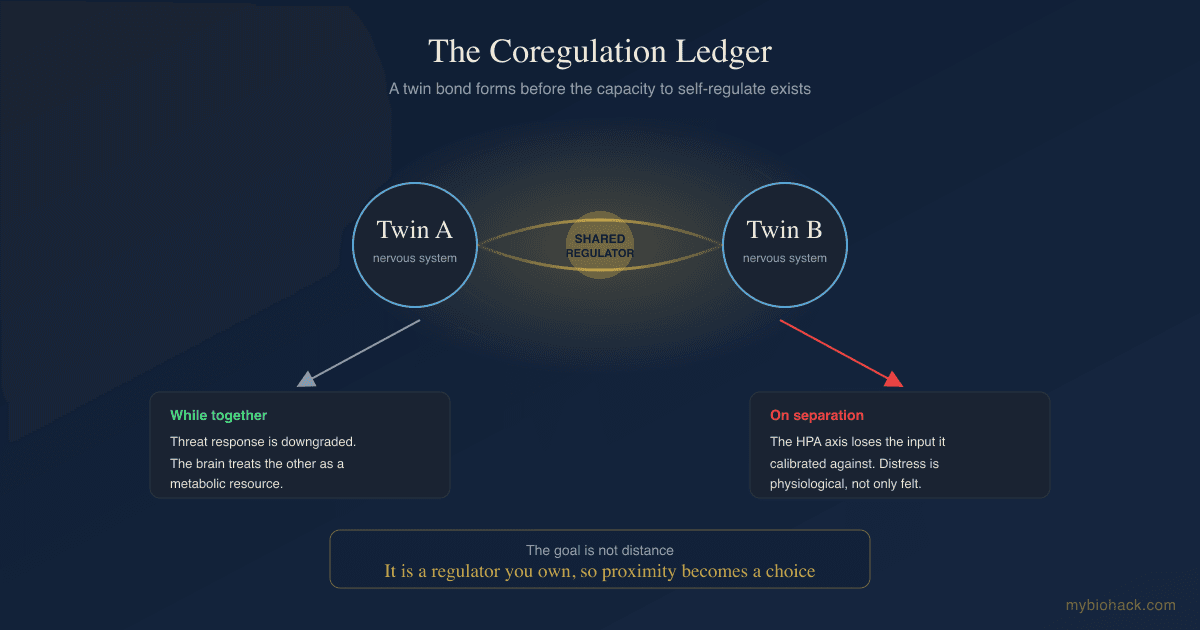
Start with social baseline theory, which holds that the brain treats a proximate, reliable social partner as a metabolic resource and quietly downgrades its own threat response accordingly. R
Your nervous system runs a cost accounting on the world, and another person's presence changes the numbers.
The demonstration everyone cites is an fMRI study in which married women under threat of electric shock showed attenuated activation in the right anterior insula, superior frontal gyrus, and hypothalamus while holding their spouse's hand, more than while holding a stranger's hand, with the size of the effect tracking marital quality. R
It is an elegant study of sixteen women.
Treat it as illustrative rather than as proof, because that is what an n of 16 in a single sex buys you.
The regulation is bidirectional and continuous.
In 30 married couples sampling saliva four times a day for three days, each spouse's cortisol tracked the other's. R
Mother-adolescent cortisol synchrony shows the same pattern and amplifies specifically during episodes of negative affect. R
Romantic partners' respiration and heart rate show measurable coupled-oscillator dynamics. R
I am going to say the obvious thing plainly, because the rest of this section depends on it.
Nobody has measured cortisol synchrony, vagal coupling, or inflammatory signaling in enmeshed adult twins.
Every physiological citation in this section comes from marital, parent-child, attachment, or loneliness research.
Applying it to twins is an inference I am making, not a finding I am reporting, and if someone runs the study it may not hold.
What makes the inference reasonable is timing.
A spouse becomes a coregulator in adulthood, on top of a nervous system that already learned to self-regulate.
A twin is there from before the capacity to self-regulate exists.
If coregulation is the process by which one nervous system borrows another's regulatory capacity until it can build its own, the twin case is the only one in human biology where the borrowing precedes the building.
That is the mechanistic claim of this post, and it is a hypothesis.

The Cost Of Outsourced Regulation
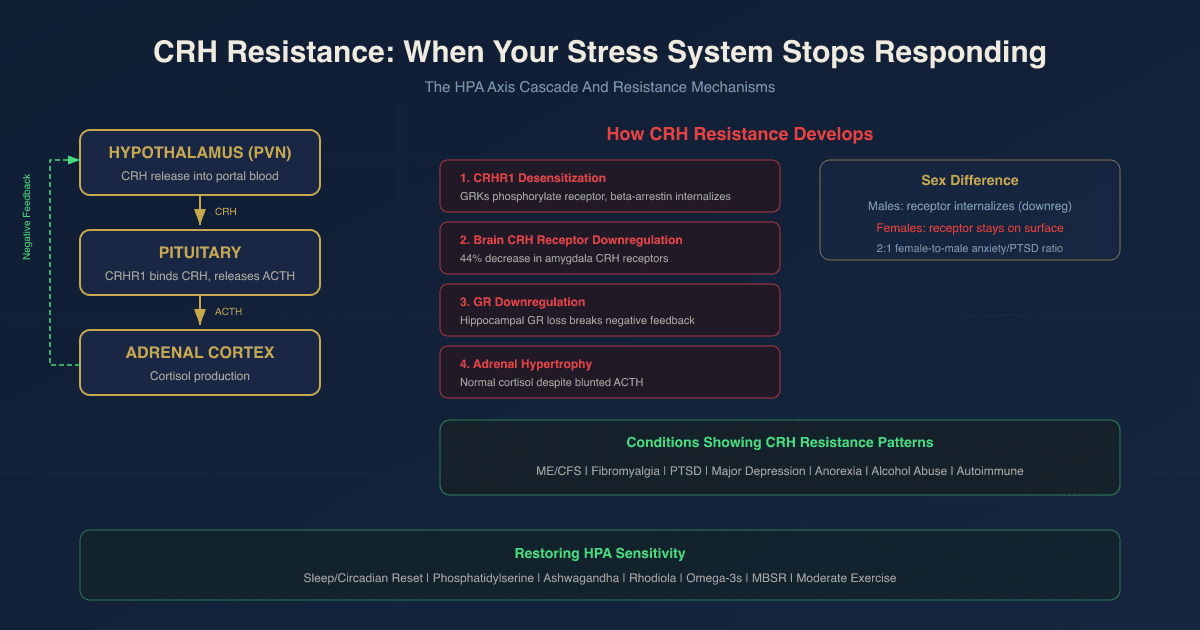
When regulation is chronically outsourced, the hypothalamic-pituitary-adrenal (HPA) axis calibrates to a world in which the other person is always there.
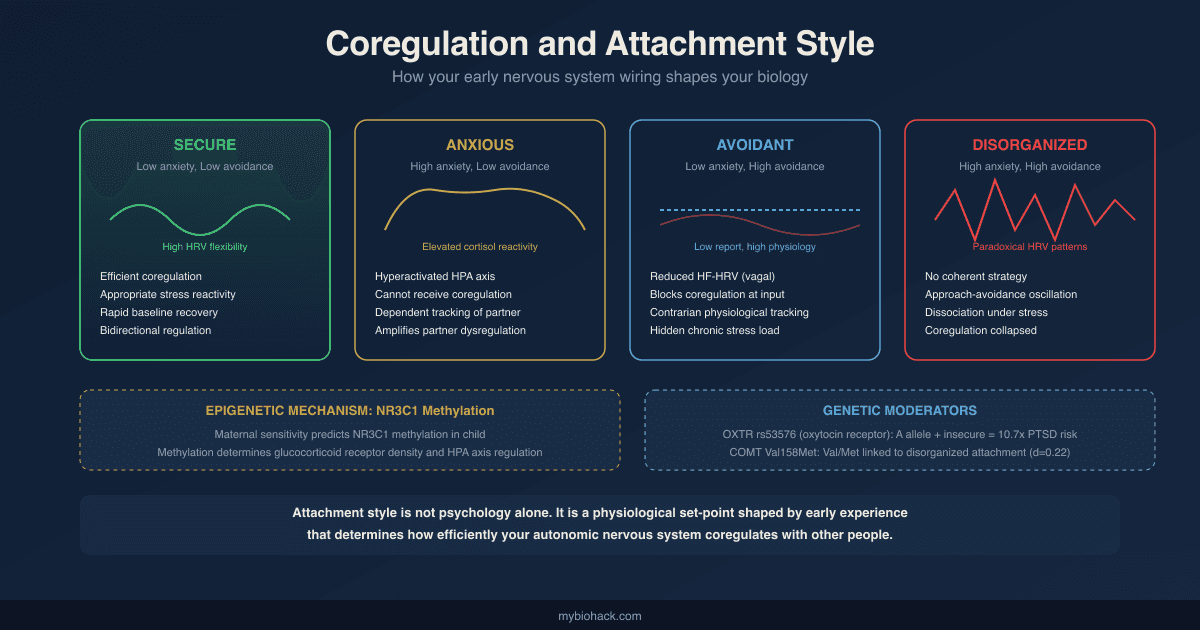
Attachment anxiety in adults associates with heightened cortisol reactivity to stress alongside a *blunted* cortisol awakening response (CAR), which is the signature of a system that is simultaneously hair-triggered and depleted. R
Insecure attachment predicts greater cortisol reactivity during relationship conflict, with measurable spillover between partners. R
Both studies are small and neither used long-term enmeshed relationships, let alone twins.
The blunted-CAR pattern is the same shape seen in CRH resistance, where the axis stops responding rather than over-responding, and it is worth understanding that low cortisol is not the opposite of stress.
Chronic relational strain has consequences that show up in tissue, not just in questionnaires.
In 42 married couples given standardized blister wounds, high-hostility couples healed at roughly 60% of the rate of low-hostility couples, showing *reduced* local cytokine production at the wound site alongside an *amplified* systemic inflammatory response. R
That dissociation is the important part and it is usually reported sloppily: inflammation went up where it does no good and down where it was needed.
A review of 64 studies found marital dysfunction produces cardiovascular, endocrine, and immune effects independent of depression and health behaviors. R
Chronically lonely adults show a genome-wide leukocyte transcriptional signature of upregulated proinflammatory genes and downregulated antiviral genes, known as the conserved transcriptional response to adversity (CTRA). R
Here the honest caveat is inconvenient for the story I am telling.
In a later study of 108 older adults, the loneliness-to-CTRA association was fully absorbed once eudaimonic wellbeing, meaning a sense of purpose, was entered into the model. R
Loneliness may be a marker of purposelessness rather than an independent inflammatory driver, and the CTRA gene-set methodology has drawn statistical criticism.
I still think the signal is real, but the causal arrow is not established, and the vagal brake on inflammation described in the cholinergic anti-inflammatory pathway is the more mechanistically defensible route from relational stress to cytokines.
Why Separation Registers As Injury
The claim that social pain uses physical pain circuitry originates in an fMRI study of social exclusion showing dorsal anterior cingulate cortex (dACC) activation that tracked self-reported distress. R
Reviews have extended this into an opioid-mediated shared-substrate model. R R
There is a big MAYBE here.
Later meta-analytic work argued dACC activation during exclusion is not pain-specific and may index salience or conflict monitoring instead, and the physiological mechanism in those reviews is largely extrapolated from animal literature.
Cite it as an influential hypothesis, not as settled biology, and be suspicious of anyone who tells you rejection and a broken arm are the same thing in the brain.
The twin-specific evidence for separation cost is better than the neuroimaging, and almost nobody quotes it.
Among surviving co-twins, grief intensity for the deceased twin was significantly higher in identical than fraternal pairs, and exceeded the grief reported for parents or any other relative. R R
Most importantly, pre-loss closeness correlated *positively* with grief intensity. R
The closer the bond, the worse the separation.
This is the cost side of the ledger that the celebration of twin closeness never mentions, and it is the strongest empirical support for taking individuation seriously as a health intervention rather than a psychological nicety.
The bereavement literature here is old, small, and traces largely to a single research program, so hold it loosely.
The Finding That Reframes Everything
In the FinnTwin16 cohort, co-twin dependence modified the *heritability* of drinking behavior.
Among interdependent twins, shared environment dominated the variance.
Among independent twins, genetics dominated. R
Read that again, because it is doing more work than any other citation in this post.

Enmeshment measurably suppressed the expression of individual genetic predisposition.
The twins who were fused did not behave according to who they were built to be.
They behaved according to the environment they shared.
"You cannot become yourself while fused to someone else" turns out not to be a metaphor about feelings.
It is a statement about variance components, and it was published in 2005.
I am not aware of anyone who has extended this design to other traits, and I would like to be.
Twin Codependency And Overlapping Conditions
Associated conditions and states (not an exclusive list):
- Depression and psychosomatic symptoms (specifically in the submissive member of an asymmetric pair) R
- Identity diffusion (elevated in twins under 18, and the state that individuation resolves) R
- Insecure attachment (twins use each other as attachment figures at higher rates than any other sibling relationship, which means attachment insecurity has an unusual place to land) R
- Low self-esteem (in a population-based study of 3,793 twin pairs, women raised with a male co-twin had lower self-esteem than those with a female co-twin) R
- Prolonged grief (the closer the pre-loss bond, the more intense the grief response) R
- Separation anxiety carried into adulthood (in panic disorder patients treated with cognitive behavioral therapy, lower adult separation anxiety predicted response, meaning patients with adult separation anxiety disorder were less likely to improve) R
That last citation deserves a note, because it is easy to misread and I want to use it correctly.
It is not evidence that therapy fixes adult separation anxiety.
No dedicated trial of that exists.
It is evidence that unaddressed separation anxiety makes standard anxiety treatment work considerably less well, which is an argument for treating the attachment pattern first, not for treating it instead.
If any of this maps onto a broader trauma pattern for you, the mechanism of how the limbic system encodes and generalizes that pattern is covered in increasing variables to overcome trauma, and the nervous system side is in coregulation and PTSD.
How To Improve Twin Codependency
The goal is not distance.
The goal is a nervous system that can regulate itself, so that proximity becomes a choice.
Friedman's formulation is the entire protocol in one line: move from "I *need* my twin" to "I *want* to be with my twin."
Everything below is a way of making that physiologically true rather than merely asserted.
1. Build Autonomous Regulation Before Changing Anything Relational
This comes first because attempting boundary work with an unregulated nervous system produces panic, and panic produces reversal.
Heart rate variability biofeedback is the best-evidenced intervention in this entire post.
A meta-analysis of 24 studies (n=484) found large reductions in self-reported stress and anxiety, with a within-group effect of Hedges' g = 0.81 and g = 0.83 against control. R
Slow-paced breathing below 10 breaths per minute raises heart rate variability (HRV) and respiratory sinus arrhythmia, and associates with reduced anxiety, depression, and anger. R R
Practically: six breaths per minute, five seconds in and five seconds out, ten to twenty minutes daily, ideally with a device that shows you the coherence signal so you are training against feedback rather than vibes.
The mechanistic rationale is neurovisceral integration, in which vagally-mediated HRV indexes the prefrontal-limbic circuitry that does emotion regulation. R
You are building the internal regulator that was outsourced.
2. Protect Sleep Before Attempting Any Of This
A single night of sleep deprivation markedly amplified amygdala reactivity to negative emotional stimuli and severed the functional connectivity between the amygdala and the medial prefrontal cortex that normally restrains it. R
An enmeshed twin attempting individuation on poor sleep is attempting it with the brake line cut.
My approach to deep sleep specifically is in how I get 3-4 hours of deep sleep every night.
3. Establish Consistent Boundaries Around Time
This is Friedman's recommendation and it has no trial behind it, which I would rather say than dress up.
The reason to do it anyway is that it is the only way to generate the exposure that everything else depends on.
Consistency matters more than magnitude: a reliably protected two hours beats an erratic weekend.
Recognize enabling behavior, which is help that maintains the other person's dependence, and distinguish it from help that resolves a real need.
4. Tolerate The Discomfort Without Fixing It
Both source clinicians converge here, and it is the hardest instruction in the protocol.
When one twin individuates, both twins suffer.
The one who moves feels guilt for "replacing" the other.
The one who stays feels abandoned and resentful about losing priority status.
The reflex is for either twin to end the discomfort by collapsing the distance.
The instruction is to let the discomfort exist and not resolve it, on the reasoning that the distress is extinction of a conditioned response rather than evidence of harm.
Friedman compares the adjustment period to a post-divorce family transition, measured in years and not weeks.
The mechanism you are relying on is fear extinction, and the epigenetics of why extinction sometimes fails to consolidate is covered in HDAC inhibition and fear extinction.
5. Get Therapy That Targets Differentiation, Not Communication
Differentiation of self, the Bowen family systems construct, acted as a moderator between anxiety and family triangling patterns in two analyses and not in others, and higher psychological symptoms tracked with being caught in triangling patterns. R
That is a mixed result, it was measured in adolescents, and it was about triangling rather than adult enmeshment, so the extrapolation to a twin dyad is mine and not the authors'.
Emotionally focused therapy shows sustained improvements in relationship satisfaction and attachment-related outcomes across follow-up in a systematic review spanning 19 years. R
It was developed for couples, and applying it to a twin dyad is off-label.
A therapist who understands that the twin relationship is an attachment relationship and not merely a sibling one is worth searching for, and most do not.
6. Move, But Do Not Expect Cortisol To Be The Reason
Physical activity associates with a steeper diurnal cortisol slope, with a small effect (r = -0.043, 95% CI -0.080 to -0.004) and no relationship with the cortisol awakening response. R
Exercise is worth doing.
The cortisol-lowering story most people tell about it is considerably weaker than they think.
7. Somatic Discharge For Stored Activation
Neurogenic tremor work is unproven in trials and I use it anyway, with the reasoning and the honest evidence assessment laid out in TRE, tension and trauma releasing exercises.
If separation distress presents somatically, as internal tremors or a buzzing that will not resolve, this is where I would start rather than with another supplement.
8. Supplements, With Appropriately Low Expectations
Nothing here treats enmeshment.
These blunt the autonomic load while you do the actual work, and the evidence for all of them is weaker than the supplement industry implies.
200 mg daily for four weeks reduced depression, trait anxiety, and sleep disturbance scores versus placebo in a crossover trial of 30 healthy adults. R
The full mechanism is in my post on theanine.
A 60-day randomized placebo-controlled trial found significantly reduced serum cortisol (P=0.0006) and reduced scores on all stress scales. R
That is a single-site trial of 64 people in India, and the ashwagandha field is dominated by small, short, often industry-funded studies of proprietary extracts, so treat the cortisol claim as promising rather than established.
A systematic review of 18 studies found the evidence suggestive of a benefit on subjective anxiety in anxiety-vulnerable samples, while stating plainly that "the quality of the existing evidence is poor," with effects clustering in people who were already deficient or already anxious. R
I still take it, and I will not pretend the data says more than it does.
On meditation, the popular claim that mindfulness meaningfully lowers inflammatory biomarkers does not survive a preregistered three-level meta-analysis, which found pooled effects of g = -0.15 within-group and g = -0.11 against control across cortisol and inflammatory cytokines. R
Meditate for the subjective benefit.
Do not meditate expecting your CRP to move.
What To Stay Away From
Approaches that do harm or nothing (not an exclusive list):
- Abrupt total estrangement (the grief literature suggests the cost of severance scales with the closeness of the bond, and cutting off a twin trades enmeshment for bereavement) R
- Commercial "bonding gene" genetic testing (the variants marketed for this do not do what the marketing says, as detailed in the Genetics section below) R
- Forced classroom separation as a corrective (in 1,505 twins, classroom placement had no significant effect on reading development once pre-existing behavior and preliteracy differences were controlled, and in 560 pairs followed from ages 5 to 12, staying in the same classroom was associated with modestly *better* social behavior) R R
- Framing the co-twin as the problem (the dysregulation belongs to your nervous system, and the reasoning is in coregulation and healthy relationships)
- Using the twin as the sole emotional regulator (this is the mechanism itself, and every use deepens the calibration)
The classroom point deserves emphasis because it is where well-meaning institutions do the most damage.
The popular belief that separating twins at school builds independence is not supported once you control for confounds.
Separation imposed by an adult on a schedule is not individuation.
Individuation is chosen.
Testing
No laboratory test diagnoses twin codependency, and any practitioner who offers one is selling something.
What testing does is characterize the downstream autonomic and inflammatory load, and give you an objective baseline to measure the protocol against.
Autonomic Function
Heart rate variability is measured, not ordered.
A chest-strap or ring-based morning HRV reading, trended over weeks rather than read day to day, is the most relevant objective marker in this entire post, because it indexes the regulatory capacity you are trying to rebuild. R
Look at the trend across a month of daily readings, and specifically at whether HRV recovers after contact-heavy or conflict-heavy days.
Blood And Urine Markers
Diurnal cortisol rhythm and cortisol awakening response are the markers that map most directly onto the mechanism, because attachment anxiety associates with a blunted awakening response alongside heightened reactivity. R
A single random serum cortisol is close to useless here, since the entire signal is in the shape of the curve.
I use the DUTCH Complete (Precision Analytical) to assess the diurnal cortisol curve, the awakening response, cortisol metabolites, and DHEA, which is the most complete picture of HPA axis function available outside a research setting.
The Hormone Zoomer (Vibrant Wellness) covers the cortisol rhythm and DHEA alongside sex hormones if you want a broader panel.
High-sensitivity CRP and IL-6 are the inflammatory markers implicated by the relational-stress literature. R
The Cardio IQ Advanced Lipid Panel with Inflammation (Quest Diagnostics) includes hs-CRP, and the Cardio Zoomer (Vibrant Wellness) covers inflammatory and endothelial markers more broadly.
Expect these to be normal in most people reading this.
Chronic relational stress moves them over years, not weeks, and a normal hs-CRP does not mean the mechanism is absent.
Baseline And Functional
The Foundation Zoomer (Vibrant Wellness) covers CBC, comprehensive metabolic panel, thyroid, and fasting glucose, which is worth having before attributing any symptom to a relational pattern.
Thyroid dysfunction and anemia produce fatigue, irritability, and emotional lability that look exactly like separation distress and respond to none of the interventions above.
Rule out the boring things first.
Genetics
The Methylation Genetics panel (Vibrant Wellness) covers COMT alongside the methylation cycle variants, which is the only genotype in the Genetics section below with a defensible, if modest, association to stress physiology.
Order it for the methylation information, described in my complete guide to methylation, and treat the COMT result as interesting rather than actionable.
If you want a broader read on how relational and environmental stress accumulates biologically, epigenetic clocks are the honest version of that question, including what they cannot tell you.
Mechanisms Of Action
Simple:
- Your brain saves energy by letting a trusted person absorb part of the work of staying calm, and a twin has been doing that job since before you were born.
- Because the job was never yours, the internal machinery for doing it alone was never fully built.
- Separation does not feel like sadness, it feels like a system losing a component it depends on, which is why it registers in the body and not only in the mood.
- Rebuilding that machinery, through breathing, sleep, and tolerated distance, is what turns needing your twin into wanting your twin.
Advanced:
- Social baseline regulation of the threat response. The brain computes environmental demand relative to available social resources, and the presence of a reliable attachment figure reduces the metabolic cost assigned to a stressor, attenuating activation in the right anterior insula, superior frontal gyrus, and hypothalamus. R R When the resource has been continuously present since gestation, the baseline against which demand is computed was never established in its absence.
- HPA axis calibration and the blunted awakening response. Chronic attachment anxiety associates with elevated cortisol reactivity to acute stressors alongside a suppressed cortisol awakening response, a dissociation consistent with a hypersensitive axis operating on depleted reserve rather than a simply overactive one. R R This is the same pattern as CRH resistance, where downstream receptor sensitivity, not upstream signal, is the lesion.
- Interpersonal cortisol coupling as a shared regulatory circuit. Cortisol covaries between spouses across the day and between mothers and adolescents, with coupling strength amplified during negative affect, implying that the effective unit of HPA regulation in a bonded dyad is the dyad rather than the individual. R R R No such measurement has been made in twins.
- Vagal withdrawal and the loss of the cholinergic brake. Vagally-mediated HRV indexes prefrontal inhibitory control over limbic threat circuitry, and reduced vagal tone removes the cholinergic anti-inflammatory brake on macrophage cytokine release, providing a route from unbuffered relational stress to systemic inflammation. R R
- Dissociated local and systemic inflammatory signaling under relational strain. Hostile marital interaction reduced cytokine production at the wound site while amplifying the systemic inflammatory response, and slowed standardized wound healing to roughly 60% of control rates, demonstrating that relational stress does not raise inflammation uniformly but misallocates it. R R
- CTRA transcriptional shift. Perceived social isolation associates with upregulated proinflammatory and downregulated type I interferon and antibody-synthesis gene programs in circulating leukocytes, mediated by beta-adrenergic signaling to myeloid lineage cells. R The association did not survive adjustment for eudaimonic wellbeing in a later cohort, so the causal status is unresolved. R
- Variance-component suppression by interdependence. Co-twin dependence modified the heritability of alcohol use in the FinnTwin16 cohort, with shared environmental variance dominating among interdependent pairs and additive genetic variance dominating among independent pairs, meaning the degree of enmeshment governs whether individual genotype is expressed behaviorally at all. R This is the strongest available biological argument that individuation is a prerequisite for the expression of an individual phenotype, and it has not been replicated across other traits.
- Grief intensity scales with pre-loss closeness. Bereavement response magnitude in surviving co-twins correlates positively with pre-loss social closeness and is greater in monozygotic than dizygotic pairs, indicating that the regulatory dependency established by the bond is itself the substrate of the separation response. R R R
Genetics
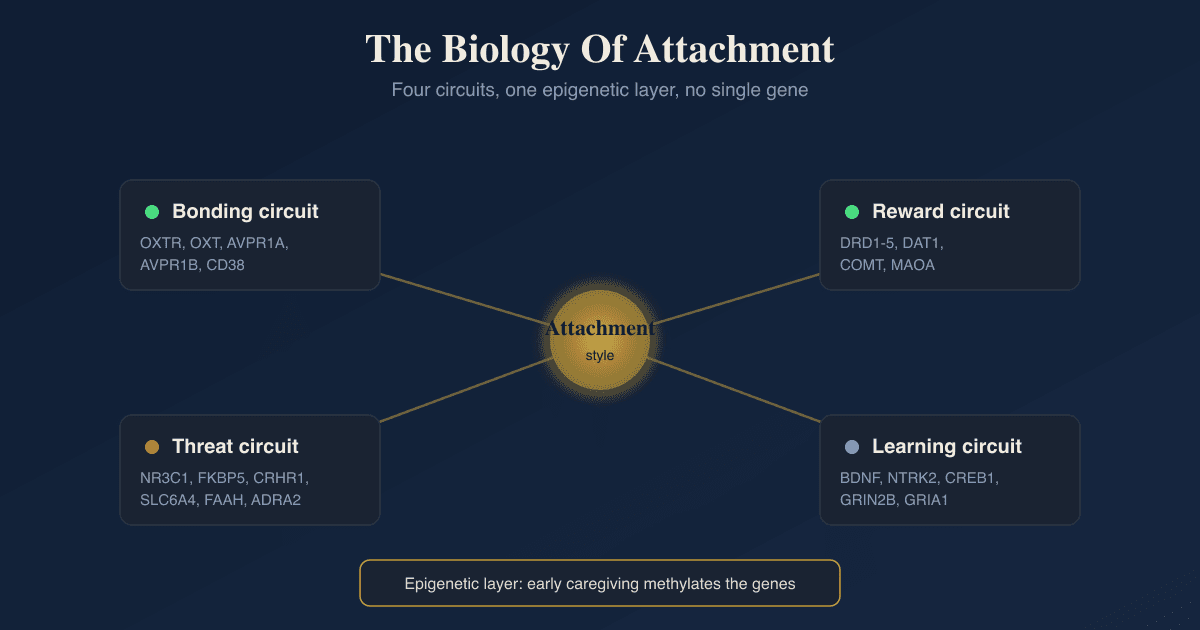
Read this section as a cautionary tale about candidate genes rather than as a list of things to test.
Across samples ranging from 62,138 to 443,264 people, none of the 18 historical candidate genes for depression, nor any candidate-gene-by-stress interaction, showed a significant association, and the authors concluded that the large number of published associations in that literature are likely false positives. R
That paper is about depression, but its logic generalizes to every gene below.
All of them were characterized in small, underpowered studies from the 2000s and 2010s.
Treat the whole section with skepticism, and treat anyone marketing these variants as a readout of your capacity to bond with more skepticism still.
What the twin literature does support is that the *traits* are heritable, which is a different claim than any specific variant being responsible.
Attachment-related anxiety was 45% heritable and avoidance 36% heritable in 677 twins, with a latent attachment security factor at 62%. R
A Minnesota Twin Registry analysis put general attachment at roughly 36% heritable with 64% attributable to nonshared environment. R
Loneliness was 48% heritable in 8,387 Dutch adult twins, with no shared environmental contribution. R R
No heritability estimate exists for codependency, because it is not a measurable construct.
The gene-by-gene breakdown for attachment specifically is in the epigenetics of attachment style.
AVPR1A
Encodes the vasopressin 1a receptor, which mediates central vasopressin signaling involved in social recognition and pair bonding, and which has broader physiological roles described in my post on vasopressin.
The RS3 repeat polymorphism in the promoter region alters receptor expression.
RS3 334-bp homozygous men were less likely to be married and reported marital crisis at 34% versus 15% for non-carriers, in 552 Swedish male twins. R
This single cohort has never been robustly replicated, and it is cited far past what one unreplicated candidate-gene study can support.
BDNF
Encodes brain-derived neurotrophic factor, the primary neurotrophin governing activity-dependent synaptic plasticity.
The Val66Met substitution impairs activity-dependent secretion of the mature protein.
rs6265 is the Met allele, which significantly moderated the relationship between stress and depression across 22 studies (n=14,233), though the effect held for recent stressful life events (p=.01) and not for childhood adversity (p=.051). R
An effect that appears for one stressor type and vanishes for another is the signature of an underpowered literature, not of a robust biological mechanism.
COMT
Encodes catechol-O-methyltransferase, the enzyme that degrades synaptic dopamine, norepinephrine, and epinephrine, particularly in the prefrontal cortex.
The Val158Met substitution produces a roughly threefold to fourfold difference in enzyme activity between homozygotes.
Val158Met (rs4680) is the variant in question, and in a meta-analysis of 27 studies (N=15,979), Val/Val white males showed higher neuroticism (effect size 0.13, 95% CI 0.02 to 0.25) and Val/Val Asian males higher harm avoidance (effect size 0.43, 95% CI 0.14 to 0.72), with no significant effect in women. R
Effects that appear only in specific sex and ancestry subgroups are exactly what overfitting looks like.
The relationship between COMT, catecholamine clearance, and attachment is covered in more depth in COMT genetics and attachment style.
FKBP5
Encodes FK506 binding protein 51, a co-chaperone that reduces glucocorticoid receptor affinity for cortisol and impairs receptor translocation to the nucleus.
Risk variants slow the negative feedback termination of the stress response.
rs1360780 showed no main effect on PTSD but interacted significantly with childhood abuse severity (minimum p=.0004) and altered cortisol suppression, with a later meta-analysis of 14 studies (n=15,109) supporting the T-allele-by-early-life-trauma interaction. R R
This has the most consistent support of anything in this section, and it is still candidate-gene-era work without genome-wide correction, so call it moderate rather than established.
OXTR
Encodes the oxytocin receptor, a G protein-coupled receptor mediating oxytocin's effects on social salience and affiliative behavior.
This is the variant sold as "the bonding gene," and it is the clearest case in this post of a plausible story that shrinks under scrutiny.
rs53576 showed a small association with general sociality in a meta-analysis (Cohen's d = 0.11, 95% CI 0.02 to 0.21) and a flat null for close-relationship quality (d = 0.01, 95% CI -0.04 to 0.07, n=5,262). R
A separate meta-analysis of 13 samples (n=6,631) did find modestly better empathic ability in G-allele carriers. R
A well-powered study of 611 adults using 13 days of ecological momentary assessment found no association between rs53576 and positive or negative affect, depressive symptoms, optimism, self-esteem, or engagement. R
An effect size of 0.01 on close-relationship quality is not a bonding gene.
It is noise with a marketing budget.
SLC6A4
Encodes the serotonin transporter, the target of SSRIs, with the 5-HTTLPR promoter repeat polymorphism producing short and long alleles that differ in transcriptional efficiency.
The short allele was the most-studied gene-by-environment interaction in all of psychiatry.
It did not replicate at scale. R
Include it here only so you recognize it when someone tries to sell it to you.
More Research
- Epigenetic divergence is the biological argument for individuation, on a long enough timeline. Identical twins are epigenetically near-indistinguishable in early childhood, and by age 50 show roughly four times more differentially expressed genes and 2.5 times more DNA methylation differences in CpG islands than three-year-old pairs. R Two identical genomes become two different people through divergent experience, which is precisely what enmeshment prevents.
- Lifestyle divergence within a twin pair produces measurable epigenetic age differences, but the effect depends on which clock you use. In 143 monozygotic pairs discordant for lifestyle, the healthier co-twin showed lower intrinsic epigenetic age acceleration on the Li clock, with no significant effect on the Horvath clock. R Clock-dependent results are a reason for caution about the whole field, covered in epigenetic clocks and biological age.
- No one has measured the physiology of twin enmeshment directly, and it is a conspicuous gap. Every mechanistic claim in this post is bridged from marital, parent-child, attachment, or loneliness research onto a population that differs from all of them in the one variable that matters most, which is when the bond formed. A cortisol-synchrony study in adult twin pairs stratified by co-twin dependence would settle a great deal, and it would not be expensive.
- The FinnTwin16 variance-component finding has never been extended beyond alcohol use. R Whether enmeshment suppresses the genetic expression of other traits, including the very attachment traits that are 36% to 62% heritable, is unanswered and directly testable in existing cohorts.
- The twin relationship's health effects appear to be specific rather than general. Inter-twin conflict predicted hyperactivity and conduct problems but not emotional or peer difficulties. R Resist the temptation, which the wellness internet never does, to attribute every symptom you have to your closest relationship.
- Twins are more differentiated than non-twins, not less. R The individuation pressure of growing up beside a same-age double appears, on average, to produce a stronger sense of self rather than a weaker one. Codependent twins are the failure mode of a process that usually works, and telling those two populations apart is the clinical skill that the research literature has not yet caught up to.
For personalized guidance on any of this, including how to sequence the autonomic work before the relational work, you can book a consultation.
Jacob Gordon
INHC, FMT-C
Board Certified Health Coach
I spent years battling unexplained chronic illness before discovering biohacking, epigenetics, and functional medicine. Now I share that research at MyBioHack to help others find their own answers.
Book a ConsultationRelated Protocols & Supplements
Deep-dive chapters and recommended supplements for this topic
Lion's Mane
1000mg/day
Omega-3 (DHA)
2g/day
Phosphatidylserine
100mg 3x/day