Coregulation And Healthy Relationships: Why Your Partner Is Not The Problem, Your Nervous System Is
By Jacob Gordon, INHC, FMT-CThis article contains affiliate links. As an Amazon Associate, MyBioHack earns from qualifying purchases at no extra cost to you. We only link products we research and stand behind.
Most relationship conflict is not a communication problem or a compatibility problem, it is two nervous systems dropping out of safety and into defense at the same moment.
In this post, we will discuss what coregulation actually is, how it develops, why some people never build it, how to recognize the deficit, how attachment styles and trauma shape it, the difference between codependence, interdependence, and hyperindependence, and the nervous system techniques two people can use to build safety together.

What Coregulation Actually Is
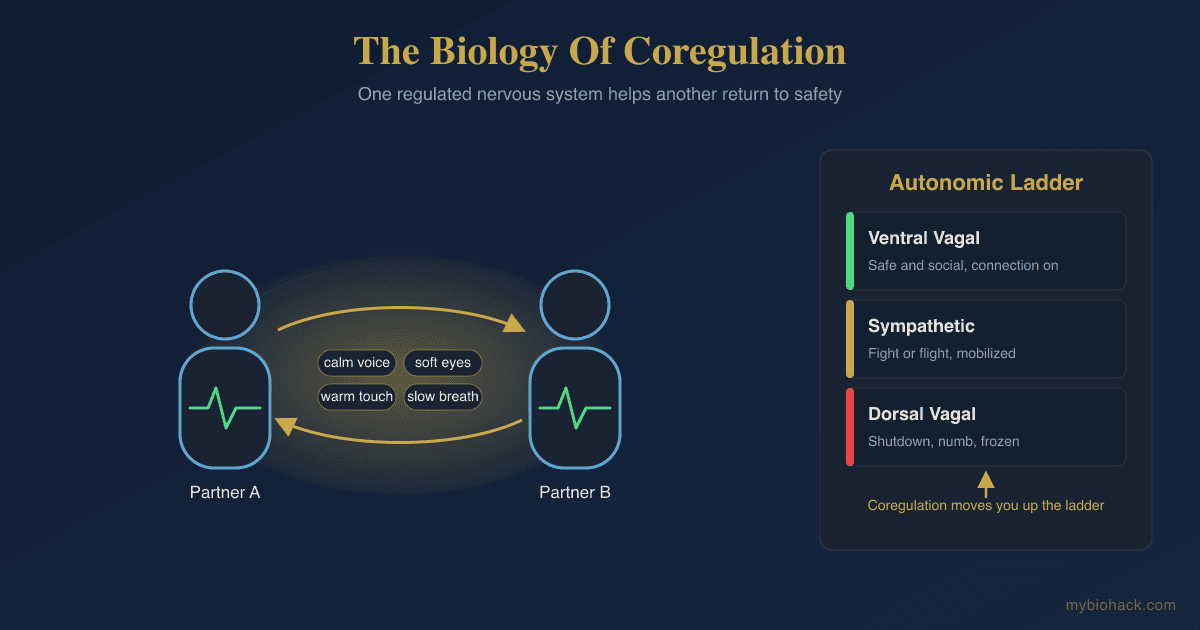
Coregulation is the process by which one nervous system helps another return to a calm, safe state through cues like tone of voice, facial expression, eye contact, touch, breathing rhythm, and physical proximity.
It is not a vague psychological metaphor.
It operates simultaneously at behavioral and biological levels, including hormones, the autonomic nervous system, central nervous system activity, and even measurable brain-to-brain synchrony between two interacting people. R
Your nervous system is constantly and unconsciously scanning the people around you and your environment for signals of safety or threat.
Stephen Porges named this scanning neuroception, the subcortical detection of safety, danger, or life threat that happens below conscious awareness, as part of Polyvagal Theory. R
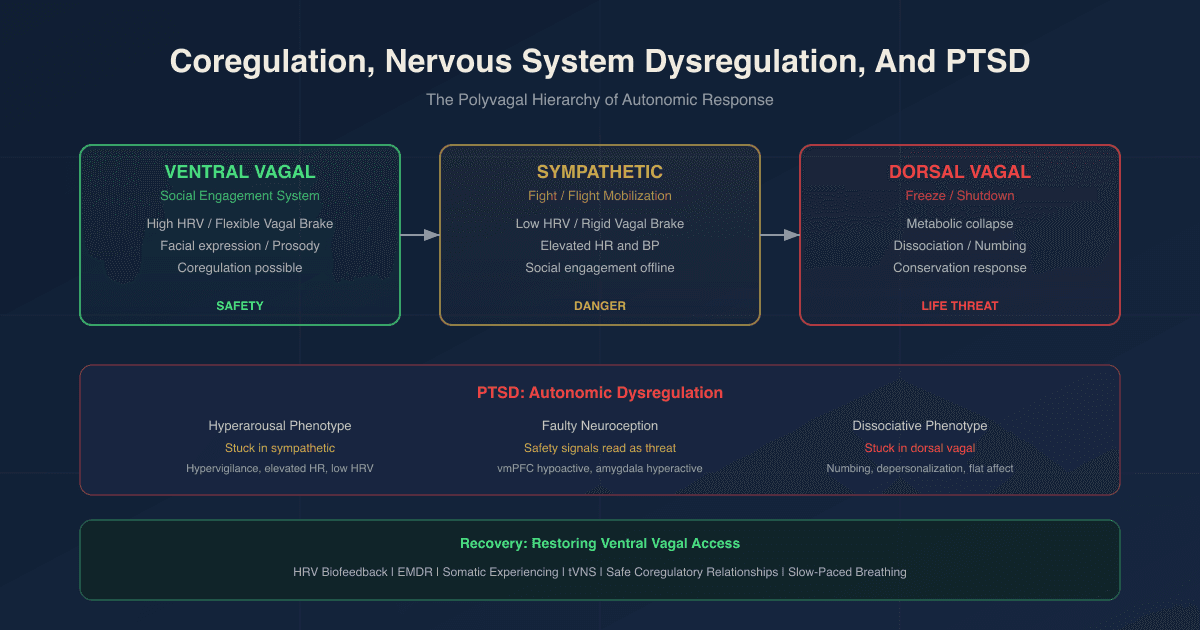
Polyvagal Theory describes a hierarchy of autonomic states.
When you feel safe, you are in the ventral vagal state, which is the only state from which genuine social connection is possible.
When neuroception detects threat, you drop into sympathetic fight-or-flight, and if the threat feels inescapable, into dorsal vagal shutdown (numbness, collapse, dissociation). R
Here is the part that matters for relationships.
You cannot access curiosity, empathy, or logic when your nervous system is in defense, because the circuitry that runs those functions goes offline when the circuitry that keeps you alive takes over.
So even if you know the perfect thing to say, you will not be able to use it unless your body feels safe enough to stay present.
Coregulation is the reciprocal sending and receiving of safety cues that lets two people pull each other back into that ventral, connected state.
It is not coddling and it is not codependence.
It is the same biology that lets an infant settle in a caregiver's arms, carried forward into adulthood, where warm and attuned connection measurably lowers cortisol, supports immune function, and increases emotional resilience.
In other words, healthy relationships regulate us, which means learning to coregulate is not only relationship work, it is mental and physical health work.
How Coregulation Develops
Humans are altricial, meaning we are born neurologically unfinished and physically helpless, unlike a foal or a calf that walks within hours.
We are born with most of the neurons we will ever have, but the connections between them are built through experience, and the single biggest sculptor of that wiring is coregulation with a caregiver.
The sequence looks like this.
An infant becomes distressed, a caregiver attunes and soothes through voice, face, and touch, and the infant's nervous system settles.
Repeated thousands of times, this teaches the developing brain a foundational expectation: when things get hard, connection can bring me back to safety.
Coregulation is the critical precursor to self-regulation, because the capacity to calm yourself is internalized from being calmed by someone else first. R
This attunement is physiologically real and measurable.
Caregiver and infant show synchrony in oxytocin, in salivary cortisol, in the sympathetic enzyme alpha-amylase, and in cardiac vagal tone, and these biological rhythms become linked through repeated interaction. R
Higher caregiver oxytocin predicts more sensitive, synchronous parenting, and parent-infant synchrony in the first months predicts the child's later capacity for emotion regulation and even moral development. R
The fragility of this system is easy to demonstrate.
In the still-face paradigm, a caregiver is asked to suddenly hold a blank, unresponsive expression, and within seconds the infant becomes distressed, looks away, and struggles to self-soothe, because the coregulating signal has been withdrawn. R
The same skill is trainable in adulthood, which is the entire premise of teaching parents coregulation.
The first step is always that the adult regulates their own state before trying to help, because emotions are contagious, and a dysregulated adult cannot down-regulate a dysregulated child.
A caregiver pauses and takes a breath, validates the feeling, observes the response, and only then chooses how to respond, verbally and nonverbally.
The point is that coregulation is a muscle, not a fixed trait, and that is true whether you are five or fifty.
Why Some People Never Develop It
If no one reliably coregulated with you, your nervous system never got the repetitions it needed to learn that connection equals safety.
This happens when caregivers are emotionally unavailable, inconsistent, frightening, intrusive, or simply too overwhelmed to attune.
When a child reaches for comfort and is met with indifference, criticism, or unpredictability, the nervous system receives that as a threat to survival, and it adapts by replacing patterns of connection with patterns of protection.
This is not a character flaw and it is not a memory you can necessarily recall, it is an adaptation that made complete sense given what was available.
Adverse childhood experiences are dose-dependently linked to many of the leading causes of death in adulthood, which is one of the clearest demonstrations that early relational environment becomes adult biology. R
A common version of this is parentification, where a child had to raise themselves or emotionally parent their own caregiver, and learned that needs are something you meet alone or not at all.
Another version comes from a caregiver who was themselves the source of fear, which leaves the child with an unsolvable problem: the person they are wired to run to for safety is also the person they need to run from.
When safety in connection was never modeled, coregulation as an adult can feel foreign, awkward, or even threatening, because the nervous system has no template for it.
The good news is that templates can be built later, which is the subject of the rest of this post.
Anxious, Avoidant, And Fearful Attachment Through The Lens Of Coregulation
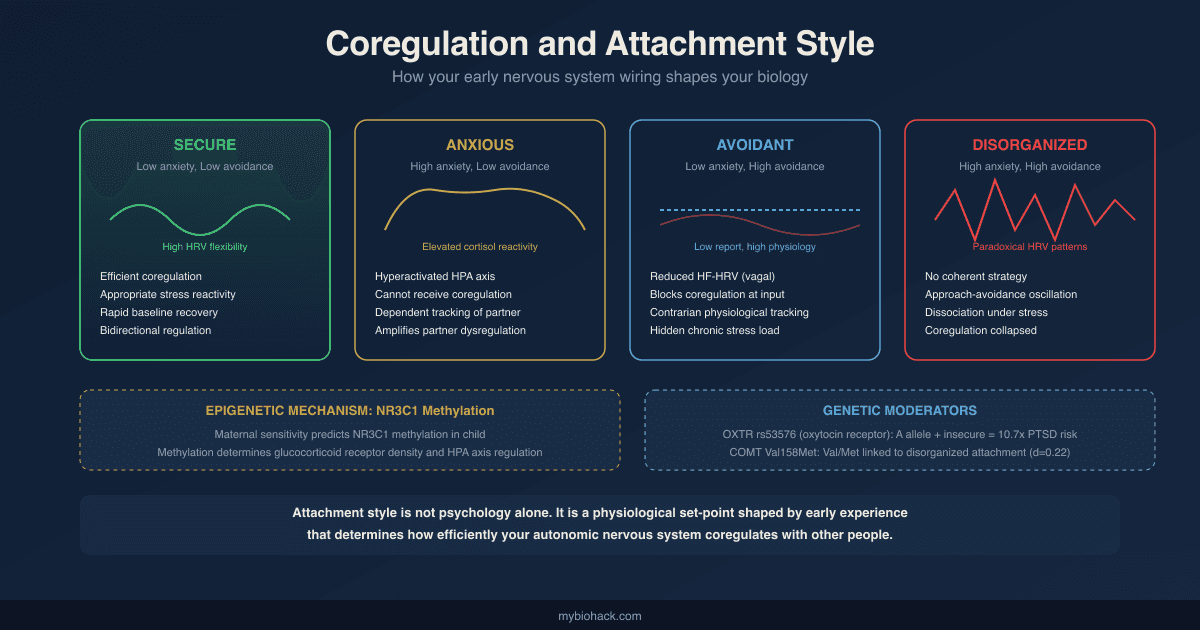
Attachment style is best understood not as a personality label but as the strategy your nervous system learned for getting safety from other people, and each style coregulates differently.
I have written a full gene-by-gene breakdown in The Epigenetics Of Attachment Style and a physiology deep-dive in Coregulation And Attachment Style, so this section focuses on the relational pattern.
Secure attachment means you can both give and receive coregulation.
You can reach for support without shame, accept it without suspicion, and return to baseline relatively efficiently after a conflict.
Anxious (preoccupied) attachment runs a hyperactivating strategy, where the nervous system amplifies distress to try to pull a caregiver or partner closer.
In dating couples, women higher in attachment anxiety showed greater cortisol reactivity and slower recovery in response to a relationship conflict, which is the physiological signature of a system that cannot settle until the connection feels secure again. R
Avoidant (dismissing) attachment runs the opposite, deactivating strategy, where the nervous system suppresses the outward bid for connection entirely.
The critical finding is that this is a mask, not an absence of distress.
Avoidant adults often report feeling fine while their bodies tell a different story, showing elevated skin conductance and autonomic arousal during attachment-relevant stress and separation. R R
This is the attachment root of hyperindependence, which we will return to.
Fearful (disorganized) attachment is the push-pull pattern, where both the approach and the avoidance systems fire at once.
The person wants closeness and fears it in the same breath, often because the original caregiver was simultaneously the source of comfort and the source of threat.
None of these are life sentences.
Earned secure attachment is a documented outcome, where adults who did not get security in childhood build it later through consistent, corrective relational experiences, including therapy and safe relationships.
How To Recognize You Did Not Get It
When you never learned coregulation, the deficit shows up as a recognizable cluster of patterns.
Signs of a coregulation deficit (not an exclusive list):
- Chronic emotional numbness or a sense of being detached from your own body
- Difficulty returning to a calm baseline after conflict, often cycling between intense anxiety and shutdown
- Hyperindependence and a reflexive refusal to ask for or accept help
- Intimacy, comfort, or someone genuinely showing up for you triggers anxiety or suspicion rather than relief
- Perfectionism and people-pleasing that function as constant scanning to keep others happy and ward off threat
- Physical signs of dysregulation with no clear medical cause, such as a racing heart, shallow breathing, or feeling frozen
- Self-regulation that feels like suppression, where you force yourself calm through willpower, harsh self-talk, overworking, scrolling, or substances rather than arriving at genuine ease
That last point is the one most people miss.
There is a difference between a nervous system that has actually settled and one that has been white-knuckled into silence, and only the first one is regulation.
If your version of calming down is really just clamping down, that is a sign the early coregulation was missing and the system never learned what real safety feels like.
Walking On Eggshells, Not Feeling Safe, And Compartmentalization
Three of the most common lived experiences of a dysregulated nervous system are walking on eggshells, not feeling safe even when you objectively are, and compartmentalizing.
Walking on eggshells is chronic hypervigilance.
It is neuroception stuck in the on position, where you are continuously reading a partner's tone, face, and body for the first hint of danger, and adjusting yourself to prevent it.
This is exhausting because it keeps the sympathetic system perpetually primed, and it is often mistaken for being "attentive" or "a good partner" when it is actually a survival adaptation.
Not feeling safe in objectively safe situations is the same mechanism viewed from the inside.
Because neuroception is calibrated by past experience, a nervous system shaped by an unsafe childhood will flag safe people and safe rooms as dangerous, which is why reassurance alone rarely works.
The body has to accumulate new experiences of safety before the alarm recalibrates, and that is a slow, repetition-based process, not a decision.
Compartmentalization is the third pattern, and it sits in direct relationship to coregulation.
Compartmentalization is a cognitive strategy where you seal off conflicting feelings, thoughts, or memories so you can keep functioning without being flooded.
It is genuinely useful in the short term, like setting grief aside to get through a workday, and pathological in the long term, where chronic walling-off produces emotional numbness, disconnection, and outright dissociation.
This is not just psychological language.
In post-traumatic stress, there is a recognized dissociative subtype defined by emotional over-modulation and detachment, with its own neurobiological signature of over-regulation by the prefrontal cortex shutting down emotional processing, which maps onto the dorsal vagal shutdown end of the polyvagal hierarchy. R
The key relational insight is that when someone lacks reliable coregulation, compartmentalization and avoidance become the default tools for managing distress, because sealing off is the only regulation strategy that does not require another person.
This is where compartmentalization gets confused with healthy space, and the two need to be distinguished.

If your partner pulls inward, the single most useful question to ask is: are you creating space or a wall?
Space is regulation: it is transparent, it is time-limited, and it comes with a return ("I am overwhelmed, I need twenty minutes, and then I want to come back to this").
A wall is defense: it is stonewalling, it is open-ended, it offers no reentry, and it leaves the other person's nervous system stranded in threat with no resolution.
Space protects the connection while one nervous system settles.
A wall protects one person by severing the connection.
Naming the difference out loud, and agreeing that space is welcome but walls are not, is one of the most practical coregulation tools a couple has.
The Spectrum: Hyperindependence, Interdependence, And Codependence

The clearest way to locate yourself is on a spectrum of how your nervous system handles needing other people.
On one end is hyperindependence.
On the other end is codependence.
In the healthy middle is interdependence.
Hyperindependence is extreme self-reliance, the belief that "I cannot rely on anyone, I have to do it all myself."
It typically grows out of early neglect, inconsistency, or parentification, and it masquerades as confidence, competence, and being the strong one.
Underneath the competence, it tends to produce chronic burnout, loneliness, and a quiet sense that receiving care is uncomfortable or even unsafe.
This is the avoidant nervous system playing out across an entire life, and Western culture rewards it heavily, which is exactly why it is so easy to mistake for health.
Codependence is the opposite collapse, captured by the phrase "I am not okay if you are not okay."
Here, your stability and self-worth are fused to another person's emotional state, you over-function as a caretaker, you struggle to set boundaries without guilt, and connection feels like walking on eggshells.
Both extremes are insecurity wearing different costumes, and both are nervous systems that never learned safe, mutual regulation.
Interdependence is the regulated middle.
It is two whole people who can each stand on their own, who can give and receive support, and who stay rooted in themselves while staying connected to each other.
The cultural script that independence is the mark of a healthy adult gets the biology backwards.
We do not outgrow our need for coregulation, we simply move from needing it for literal survival as infants to needing it for resilience and health as adults, and the goal is not independence, it is the capacity to depend on the right people in a balanced way.
Coregulation Is Not Codependence
This is the most important distinction in the entire post, because fear of codependence drives a lot of people to reject connection that would actually heal them.
Coregulation and codependence are not similar, they are opposites.
The cleanest framework here comes from the Psychobiological Approach to Couple Therapy, which integrates attachment, neuroscience, and arousal regulation.
Its central ideas are secure functioning, the couple bubble, and differentiation.
Secure functioning means both partners agree to put fairness, sensitivity, and mutual protection at the center of the relationship, and the couple bubble is the shared, high-responsibility space where they commit to protecting each other, refusing to lie, threaten, neglect, or abuse, and repairing quickly after a rupture.
Differentiation is the ability to hold onto yourself while staying connected to the other, and it is precisely what makes coregulation possible rather than fusion.
Here is the contrast that resolves the confusion.
Codependence is characterized by secrecy, enabling, eroded boundaries, walking on eggshells, silencing your own needs, and a collapse of responsibility where dysfunction gets covered for rather than confronted.
Coregulation is characterized by transparency, rapid repair, clear boundaries, mutual accountability, and two people who stay whole while supporting each other.
Codependence says "if you are not okay, I cannot be okay," and coregulation says "I can stay grounded while I am here with you."
One blurs the line between two people's emotions, and the other honors both.
This is why coregulation is most accurately described as the antidote to codependence, not a synonym for it.
There is a hard line embedded in all of this.
None of it applies to abusive relationships, where the answer is never to coregulate your way through harm, because abuse disqualifies a relationship from being a safe place to regulate at all.
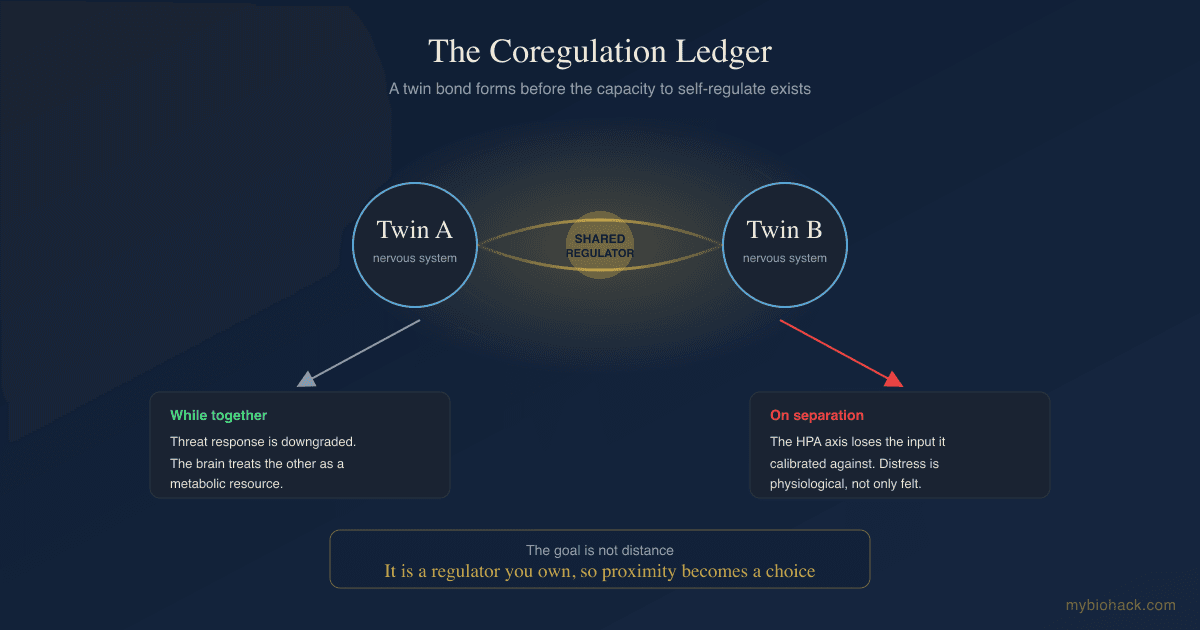
Finally, this framework explains one of the most painful experiences people describe after a breakup or a no-contact cutoff, even from someone who treated them badly.
You often are not missing the person, you are missing the coregulation, because your nervous system had outsourced part of its regulation to that relationship, and when it ends, your system is left without its external thermostat and crashes into dysregulation.
The research on adult attachment frames separation and loss as fundamentally a problem of losing a coregulating partner and being thrown back on under-developed self-regulation. R
Understanding that what you miss is the regulation, not the person, is often what makes it possible to grieve the loss without going back, and to rebuild that regulation with safe people and with yourself.
The Biology Of Being Regulated By Another Person
Coregulation is not a feeling, it is a measurable physiological event, and the research on adult couples is striking.
In a landmark neuroimaging study, married women anticipating an electric shock showed reduced threat-related activation in the brain when simply holding their husband's hand, and the calming effect was strongest in the women with the highest marital quality. R
A stranger's hand helped less, and a high-quality partner's hand helped most, which means the brain is doing relationship-specific math about who is safe.
This is the basis of Social Baseline Theory, the idea that the human brain treats proximity to trusted others as its expected baseline, and that facing the world alone is registered as more effortful and more threatening. R
In other words, your brain runs its threat-and-effort calculations assuming a regulating other is nearby, so isolation is not neutral, it is a cost.
Oxytocin is one of the molecular messengers that does this work.
In a classic stress experiment, oxytocin combined with social support produced the lowest cortisol response and the lowest subjective anxiety, more than either alone, demonstrating that the hormone and the relationship act synergistically. R
In couples specifically, intranasal oxytocin increased positive communication behavior and lowered cortisol during a standardized conflict discussion. R
Warm physical contact does the same thing endogenously.
Partners who received more warm contact, including a hug, showed higher oxytocin alongside lower blood pressure and lower norepinephrine. R
The linkage runs deep enough that it shows up in daily life, not just the lab.
Cohabiting couples show day-to-day covariation in their cortisol levels, meaning two people's stress hormone rhythms literally track each other over time, which is coregulation made visible in the bloodstream. R
The throughline under all of this is vagal tone, the parasympathetic capacity indexed by heart rate variability, which determines how flexibly a nervous system can move in and out of calm. R
This is why a regulated partner can drop your heart rate with a calm voice and a steady presence, and why a cold tone or a withdrawn glance can spike it before you have consciously registered why.
Why This Matters For Chronic Illness
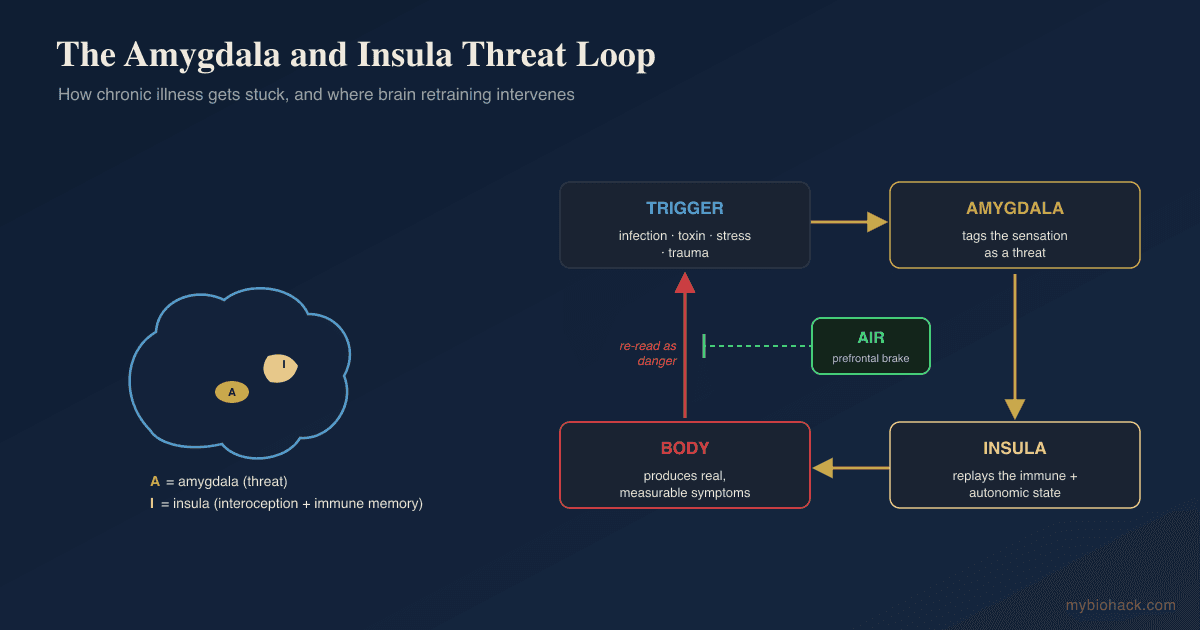
For my audience this is not a soft topic, because a nervous system stuck in chronic defense is upstream of inflammation, poor sleep, and autonomic dysfunction.
When neuroception is chronically set to threat, you sustain sympathetic activation and HPA-axis output, and the cumulative wear of that load on the body is what Bruce McEwen called allostatic load. R
The vagus nerve is the direct mechanical link between regulation and inflammation.
Through the inflammatory reflex, vagal (cholinergic) signaling actively restrains pro-inflammatory cytokine production, which means low vagal tone removes a brake on inflammation. R
A nervous system that cannot reach the ventral vagal safe state is therefore a nervous system with less anti-inflammatory capacity, which I cover from the cellular angle in Cell Danger Response.
The relational version of this is just as physical.
Hostile, escalating conflict between spouses slowed wound healing and raised circulating IL-6, a direct demonstration that how two nervous systems treat each other changes immune function. R
At the population level, the absence of regulating connection is a mortality-grade risk factor.
Stronger social relationships are associated with a 50 percent greater likelihood of survival across hundreds of thousands of people, an effect size comparable to established risks like smoking. R
Loneliness and social isolation independently raise mortality risk in their own right. R
This connects directly to the dysautonomia and post-viral populations I work with.
Chronic sympathetic dominance and low vagal tone are a shared thread between relational dysregulation and the autonomic dysfunction seen in conditions like POTS, which I reframe as a vaso-adaptive disorder and break down in Root Causes Of POTS.
I am not claiming your attachment history caused your dysautonomia.
I am saying that a nervous system locked in defense makes every autonomic and inflammatory problem harder to resolve, and that restoring the capacity to reach a safe, regulated state is foundational rather than optional.
This is also why chronic stress signaling shows up in symptoms like body buzzing and internal tremors, why it degrades the stress system itself over time, and why CRH from a chronically activated axis can drive mast cell and histamine symptoms.
How To Build Coregulation
Coregulation is a trainable capacity, and the work is mostly about giving the nervous system repeated experiences of safety until it updates.
1. Practice when things are calm, not only when they are on fire
You do not build coregulation in the middle of a fight, you build it beforehand, so the system already knows what safety feels like when stress hits.
Sit together in silence, share unhurried eye contact, breathe together, and let your bodies learn that this person plus this stillness equals safe.
2. Learn your own early dysregulation signals
Before you can regulate with someone, you have to notice you are leaving the safe state.
Watch for shallow breathing, racing thoughts, a clipped or harsh tone, emotional flooding, and the urge to attack, flee, or shut down, and learn to name them out loud early.
3. Use a pause and a signal
When you feel yourself flooding, say so and ask for a brief, defined break, for example "I am getting triggered, can we take twenty minutes and come back to this?"
Agree on a reset code word in advance that means "let us pause and protect the connection," so that pausing reads as care rather than abandonment.
This is the practical implementation of the space-not-a-wall distinction from earlier.
4. Nervous system techniques to practice together
These are concrete, two-person tools that use the body to send safety signals directly to both nervous systems.
Slow, paced breathing together, aiming for roughly five to six breaths per minute with a longer exhale than inhale, shifts both partners toward parasympathetic dominance. R
The physiological sigh, a double inhale through the nose followed by a long, slow exhale, repeated a few times in sync, is one of the fastest ways to down-regulate arousal and improve mood, and it works well done side by side. R
A long hug, held for around twenty seconds or until you both feel yourselves settle, leverages warm contact to raise oxytocin and lower blood pressure. R
Hand-holding, or placing a hand on each other's chest, gives the nervous system the same safe-contact signal that quiets the brain's threat response. R
Soft, unforced eye contact, the kind that says "I am here," cues the ventral vagal social engagement system that another safe human is present.
Humming, gentle singing, or a low "voo" tone done together stimulates the vagus through the muscles of the throat and the slow exhale, and is an easy way to nudge the system toward calm.
Rhythmic movement such as swaying, slow rocking, or simply walking side by side uses repetitive, predictable motion, which is inherently regulating, the same way carrying soothes an infant.
Orienting together, slowly looking around the room and naming that you are safe here, helps a threat-primed nervous system gather present-moment evidence that there is no danger.
5. Repair quickly after rupture
Conflict is not the problem, an unrepaired rupture is.
Coming back after a disconnection, owning your part, and re-establishing safety is what builds the deep trust that "we always find our way back," which is the heart of secure functioning.
6. Build earned security through consistent safe relationships
The nervous system updates through accumulated experience, so the most powerful intervention is sustained exposure to safe, attuned people, whether that is a partner, friends, or a skilled therapist.
Somatic and attachment-based modalities are particularly suited to this, and I cover the trauma-specific approaches, including EMDR, somatic experiencing, and HRV biofeedback, in Coregulation, Nervous System Dysregulation, And PTSD.
7. Support the parasympathetic shift biochemically
These are adjuncts, not the actual work, but they can lower the activation threshold so the nervous system can practice safety more easily.
Theanine promotes a calm-but-alert state and supports alpha brain wave activity, and I cover it in depth in my theanine post.
Magnesium Glycinate supports parasympathetic tone and dampens excitatory signaling.
Glycine is an inhibitory neurotransmitter that supports a calmer baseline, especially before sleep.
8. Widen the circle beyond one person
Outsourcing your entire regulatory system to a single partner is fragile and tips toward codependence.
A regulated life draws on multiple sources of safety, including friends, community, animals, and time in nature, so that no single relationship carries the full load.
What To Stay Away From
What to avoid (not an exclusive list):
- Abusive or unsafe partners, because you cannot coregulate your way out of harm, and safety is the non-negotiable prerequisite for any of this work
- Forcing touch, eye contact, or closeness before the body actually feels safe, which re-teaches the nervous system that connection is threatening
- Mistaking trauma bonding and intermittent reinforcement for love, where the highs of relief after distress get confused with genuine safety
- Outsourcing all of your regulation to one person, which collapses interdependence into codependence
- Pseudo-regulation through overwork, endless scrolling, alcohol, or other substances, which suppress arousal without ever delivering real safety
- Treating hyperindependence as the cure, because doubling down on "I will just do it alone" is the wound, not the healing
Testing
There is no single lab that measures coregulation, but you can objectively track the physiology underneath it.
Heart Rate Variability
Heart rate variability is the most accessible at-home window into vagal tone and your capacity to regulate, and it is best tracked as a trend over weeks using a wearable rather than as a single reading. R
A rising HRV baseline is one of the clearest signs that nervous system work is actually changing your physiology.
Cortisol Rhythm
A chronically defended nervous system shows up as a disrupted cortisol curve, and a single morning serum cortisol will miss it.
I use the Hormone Zoomer (Vibrant Wellness) or the DUTCH Complete (Precision Analytical) to assess the full diurnal cortisol rhythm along with DHEA and downstream hormones.
Inflammatory Markers
Because low vagal tone removes a brake on inflammation, chronic dysregulation often shows up in inflammatory markers like hsCRP and IL-6, which I assess with the Cardio Zoomer (Vibrant Wellness).
A note on oxytocin: peripheral blood oxytocin is not a reliable or actionable clinical test despite its central role here, so I do not recommend chasing it.
If you want this interpreted in the context of your full picture, that is the kind of thing I work through in a consultation.
Mechanisms Of Action
Simple:
- A calm person's voice, face, and touch tell your brain there is no threat here, which lets your body climb out of fight-or-flight.
- Babies only learn to calm themselves after being calmed by someone else thousands of times first.
- When you lose a person you regulated with, your body loses its thermostat, which is a real physiological reason a breakup can feel physically unbearable.
Advanced:
- Polyvagal hierarchy and the social engagement system The myelinated ventral vagal complex links the heart to the muscles of the face, voice, and middle ear, so cues of safety apply a vagal brake to the heart and open social engagement, while loss of those cues shifts the system to sympathetic mobilization and then to dorsal vagal shutdown. R
- Neurovisceral integration and vagal tone A prefrontal-amygdala-vagal network governs emotion regulation, and heart rate variability indexes the flexibility of that network, such that higher vagal tone corresponds to a greater capacity to regulate and recover. R
- Oxytocin and HPA crosstalk Oxytocin released through warm contact and attuned connection dampens HPA-axis cortisol output and reduces amygdala threat reactivity, and it does so synergistically with perceived social support. R R
- Interpersonal physiological linkage Two connected nervous systems synchronize at multiple levels, from day-to-day cortisol covariation in couples to brain-to-brain neural synchrony during interaction, which is the literal substrate of coregulation. R R
- Social Baseline Theory The brain treats proximity to trusted others as its metabolic baseline and offloads part of its threat-and-effort computation onto relationships, so isolation increases the predicted cost of facing the world and connection lowers it. R
- Allostatic load and the inflammatory reflex Chronic threat neuroception sustains sympathetic and HPA activation, accumulating allostatic load, while the loss of cholinergic vagal signaling removes a key anti-inflammatory brake. R R
Genetics
This is a brief overview, and I cover the full gene-by-gene map in The Epigenetics Of Attachment Style and COMT Genetics, Catecholamine Metabolism, And Attachment Style.
OXTR
OXTR encodes the oxytocin receptor, the docking site for the primary coregulation hormone.
Variants in this gene modulate social sensitivity and how strongly early caregiving shapes later prefrontal responses to social cues.
rs53576 is the most studied variant, where genotype interacts with early caregiving to influence social responsiveness and stress buffering. R
NR3C1
NR3C1 encodes the glucocorticoid receptor, which sets the sensitivity of the HPA stress axis.
Early caregiving environment shapes the methylation of this gene, which is one of the mechanisms by which coregulation in childhood becomes a biological stress set-point in adulthood.
COMT
COMT encodes the enzyme that clears catecholamines like dopamine and norepinephrine from the synapse.
Variants such as Val158Met (rs4680) influence how quickly you clear stress chemistry and therefore how fast your system recovers after activation, which interacts with attachment-related regulation.
More Research
- Cortisol covariation between partners increases with relationship involvement and shared time, suggesting coregulation deepens physiologically as a bond develops, though the direction of effect is hard to fully untangle from shared environment. R
- Hyperscanning studies measuring two brains at once show that the quality and emotional tone of an interaction, not merely its occurrence, shape the degree of neural synchrony between people, which hints that attuned interaction matters more than proximity alone. R
- Oxytocin is context-dependent rather than uniformly prosocial, and the same molecule that supports bonding can sharpen in-group versus out-group responses, so framing it as a simple "love hormone" oversimplifies the biology. R
- The avoidant strategy decouples self-report from physiology, which is why people who insist they are unaffected by closeness or separation can still show full autonomic arousal, and why hyperindependence is so easily mistaken for genuine resilience. R
- For biomarker tracking I use the Hormone Zoomer for cortisol rhythm and the Cardio Zoomer for inflammatory markers, interpreted alongside HRV trends rather than in isolation.
Jacob Gordon
INHC, FMT-C
Board Certified Health Coach
I spent years battling unexplained chronic illness before discovering biohacking, epigenetics, and functional medicine. Now I share that research at MyBioHack to help others find their own answers.
Book a ConsultationRelated Protocols & Supplements
Deep-dive chapters and recommended supplements for this topic
Lion's Mane
1000mg/day
Omega-3 (DHA)
2g/day
Phosphatidylserine
100mg 3x/day