Alpha-MSH And The Melanocortin System: Your Body's Built-In Anti-Inflammatory Switch
By Jacob Gordon, INHC, FMT-CThis article contains affiliate links. As an Amazon Associate, MyBioHack earns from qualifying purchases at no extra cost to you. We only link products we research and stand behind.
Your body makes a hormone that calms inflammation, induces immune tolerance, protects your DNA from the sun, and guards the hair follicle and the eye from immune attack, all at once.
In this post, we will discuss the melanocortin system, how alpha-MSH shuts down inflammation, the tiny tripeptide fragment that may matter most, and why losing this signal sits underneath nearly every condition in this series.

The Body's Built-In Anti-Inflammatory
Most anti-inflammatory drugs come from a pharmacy.
Your body already makes one of the most elegant anti-inflammatory molecules known.
Alpha-melanocyte-stimulating hormone (alpha-MSH) is a small peptide that suppresses inflammation, induces immune tolerance, protects against oxidative and UV damage, and does it potently even at very low concentrations. R
It belongs to a family of signals called the melanocortins, and the whole system is one of the body's master controls for keeping inflammation in check.
This is not a fringe molecule.
The melanocortin system is being actively developed as a drug target precisely because alpha-MSH does naturally what anti-inflammatory drugs try to do artificially. R
It has already appeared in every post in this series, as the guardian of hair follicle immune privilege, the anti-inflammatory melanocortin in sebocytes, and the protector of pigment cells in vitiligo.
This post is about the system itself.
The Melanocortin Family

The melanocortins all come from one parent protein.
Proopiomelanocortin (POMC) is a large precursor that gets cleaved into several bioactive peptides: adrenocorticotropic hormone (ACTH), the melanocyte-stimulating hormones (alpha, beta, and gamma-MSH), and beta-endorphin. R
These peptides act on five receptors, the melanocortin receptors MC1R through MC5R, each with a different job.
The roles break down roughly as follows (not an exclusive list):
- MC1R controls pigmentation and is the main anti-inflammatory receptor, expressed on virtually all cells that respond to melanocortins
- MC2R is the ACTH receptor that drives adrenal cortisol production
- MC3R and MC4R mainly regulate energy balance and metabolism in the brain
- MC5R regulates exocrine glands, including sebum production in the skin
MC1R is the star for skin and immunity, because it has the highest affinity for alpha-MSH and is expressed on the immune and resident cells that need calming. R
This is the same MC1R that, when mutated, gives red hair and fair skin.
How Alpha-MSH Shuts Down Inflammation
The mechanism is clean and powerful.
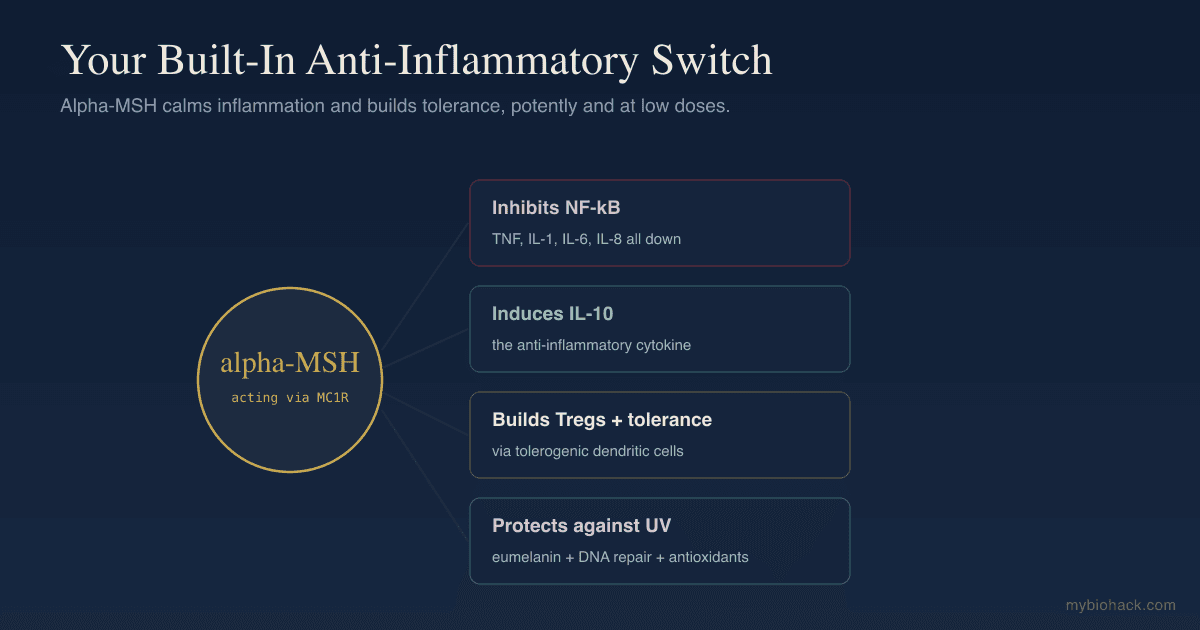
Alpha-MSH suppresses the production of pro-inflammatory cytokines including TNF-alpha, IFN-gamma, IL-1, IL-6, and IL-8, while inducing the anti-inflammatory cytokine IL-10. R
It does this largely by inhibiting nuclear factor kappa B (NF-kB), the master switch that turns on most inflammatory genes.
Alpha-MSH abolishes TNF-induced NF-kB activation in a dose-dependent way, which shuts down the downstream production of cytokines, chemokines, and adhesion molecules. R
It also suppresses inducible nitric oxide synthase, reduces the adhesion molecules that recruit immune cells, and dampens immune cell migration. R
The remarkable part is the potency.
Alpha-MSH works at low, physiological concentrations, which is exactly what you want from a built-in regulator rather than a sledgehammer.
It turns inflammation down without shutting the immune system off.
KPV And The Melanocortin Tripeptides
One of the most interesting discoveries is that you do not need the whole alpha-MSH molecule.
The anti-inflammatory activity is concentrated in the last three amino acids of alpha-MSH, a tripeptide called KPV (lysine-proline-valine). R
KPV is fascinating because it works through a different door.
Rather than going through the melanocortin receptors, KPV is taken into immune and intestinal cells by the peptide transporter PepT1, and once inside, nanomolar concentrations inhibit NF-kB and MAP kinase inflammatory signaling. R
This makes it orally active and gut-directed.
Oral KPV reduces the severity of chemically induced colitis in animal models and even prevents colitis-associated cancer through PepT1. R
This is why KPV has become a peptide of interest for gut inflammation, though human clinical evidence is still limited.
It is the anti-inflammatory essence of alpha-MSH, shrunk to three amino acids.
Alpha-MSH Builds Immune Tolerance
Beyond just suppressing inflammation, alpha-MSH actively builds tolerance.
Acting through MC1R, alpha-MSH induces tolerogenic dendritic cells, the kind of antigen-presenting cell that calms the immune system rather than activating it. R
Those tolerogenic dendritic cells then expand regulatory T cells (Tregs), the CD4+CD25+Foxp3+ cells that hold autoimmune and allergic responses in check. R
And these are functional, not just present on paper.
Alpha-MSH-induced Tregs inhibit contact allergy and calm ongoing psoriasis-like skin inflammation in mice, and alpha-MSH generates the same tolerogenic dendritic cells in human blood. R
This tolerance-building role is exactly why alpha-MSH is one of the immune privilege guardians that protect the hair follicle and the eye from autoimmune attack. R
So the melanocortin system does two things at once.
It turns down active inflammation, and it builds the regulatory cells that prevent future attacks.
The Pigment And UV Protection Role
The melanocortin system is also your primary sunlight defense.
When UV hits the skin, it drives POMC and alpha-MSH production, which acts on MC1R to stimulate the production of dark, protective eumelanin. R
But MC1R does far more than make pigment.
MC1R signaling enhances DNA repair, activates antioxidant defenses, and protects melanocytes from UV-induced damage to their chromosomes, independent of the pigment itself. R
This is why MC1R genotype is such a strong determinant of UV damage and melanoma risk.
People with the red-hair MC1R variants have a receptor that signals poorly, so they get less pigment, weaker DNA repair, and a weaker antioxidant response to UV. R
The full practical breakdown of getting these benefits, including how to support alpha-MSH and pigmentation, is in the dedicated alpha-MSH post.
The melanocortin system protects you from the sun by making pigment and by hardening the cell against damage.
The Thread Through The Whole Series
Step back and alpha-MSH is the quiet protagonist of this entire series.
It is the immune privilege guardian whose loss helps trigger alopecia areata.
It is the anti-inflammatory melanocortin in the sebocyte that opposes acne inflammation.
It is the pigment-cell protector whose failure contributes to vitiligo.
It induces the Tregs that calm psoriasis and contact allergy, and it modulates IgE and mast cell activity relevant to eczema. R
In every one of these conditions, the brain-skin axis is tilting toward neurogenic inflammation, and the melanocortin system is the counterweight that should be pushing back.
When inflammation is chronic, that counterweight gets depleted or overwhelmed.
Restoring it, rather than only suppressing the inflammation, is the underused half of the strategy.
The Junction Dysfunction And CIRS Connection
This is also where the melanocortin system meets Jacob's Junction Dysfunction framework.
Low alpha-MSH has long been noted in chronic inflammatory states, including the mold and biotoxin illness picture often labeled CIRS.
Jacob's framing differs from the conventional CIRS model here.
Rather than treating low MSH as the primary lesion to be replaced, he views it as a downstream marker of the chronic inflammation, glycocalyx damage, and stuck wound healing that define Junction Dysfunction, meaning the goal is to remove the drivers depleting the melanocortin system, not just to dose the hormone.
The melanocortin system is the body's anti-inflammatory and tolerance-building counter to the neurogenic, mast-cell-driven inflammation described throughout this series.
Support the system and reduce what depletes it, and you are working with the body's own brake rather than overriding it.
How To Support The Melanocortin System
The practical playbook is to stimulate the system safely and stop depleting it.
1. Use sunlight intelligently
UV is the natural stimulus for cutaneous POMC and alpha-MSH, so sensible, non-burning sun exposure supports the system, covered in the how to use the sun post.
The full alpha-MSH support protocol is in the dedicated alpha-MSH post.
2. Reduce the inflammation that depletes it
Chronic NF-kB-driven inflammation works against the melanocortin system, so the anti-inflammatory and gut strategies throughout this series (reducing endotoxin, calming mast cells, fixing the gut) protect it.
3. Support cAMP signaling downstream of MC1R
Because MC1R works through cyclic AMP, compounds that support that second messenger, like forskolin, are sometimes used to support melanocortin-type signaling.
4. Consider the melanocortin peptides
KPV and related melanocortin peptides are investigational tools for gut and skin inflammation, available as peptides rather than supplements, and worth discussing with a knowledgeable practitioner. R
5. Address the stress axis
Since POMC sits at the heart of the stress response, a dysregulated stress axis affects melanocortin output, making nervous-system work relevant here too.
Testing
You can measure parts of this system.
Blood And Urine Markers
Alpha-MSH can be measured in serum (through LabCorp), and it is one of the markers used in chronic inflammatory illness workups, though it should be interpreted as a downstream signal rather than a root cause.
The downstream inflammatory cytokines that alpha-MSH normally suppresses (TNF-alpha, IL-6, IL-1 beta) give a picture of the inflammatory load the system is fighting.
Functional Lab Panels
I use the Immune Zoomer (Vibrant Wellness) for the broader inflammatory and autoimmune picture, and the Hormone Zoomer (Vibrant Wellness) for the POMC-related stress hormone axis.
For the toxin and mold drivers often associated with low MSH, I use the Toxin Zoomer (Vibrant Wellness).
Mechanisms Of Action
Simple:
- Your body makes a hormone called alpha-MSH that turns down inflammation and teaches the immune system to tolerate rather than attack, and it also protects your skin from the sun.
- When inflammation is chronic, this natural brake gets worn down, which is part of why so many skin conditions persist.
Advanced:
- NF-kB inhibition. Alpha-MSH, primarily via MC1R, blocks TNF-induced NF-kB activation dose-dependently, suppressing TNF-alpha, IFN-gamma, IL-1, IL-6, IL-8, and iNOS while inducing IL-10. R
- PepT1-mediated tripeptide action. The C-terminal tripeptide KPV is transported into immune and epithelial cells by PepT1 and inhibits NF-kB and MAPK signaling at nanomolar concentrations, independent of melanocortin receptors, making it orally active for gut inflammation. R
- Tolerance induction. MC1R activation by alpha-MSH generates tolerogenic dendritic cells that expand functional Foxp3+ Tregs, suppressing contact allergy and psoriasiform inflammation. R
- UV cytoprotection. MC1R signaling, beyond stimulating eumelanin synthesis, enhances nucleotide excision repair and antioxidant defenses and preserves chromosomal stability after UV, with loss-of-function (red-hair) variants impairing all three. R
Genetics
Several genes set melanocortin tone.
MC1R
MC1R is the key anti-inflammatory and pigmentation receptor.
The loss-of-function red-hair-color variants R151C (rs1805007), R160W (rs1805008), and D294H (rs1805009) reduce cAMP signaling, weakening both UV protection and the anti-inflammatory melanocortin tone.
POMC
POMC encodes the precursor for all the melanocortins; rare loss-of-function variants cause red hair, early obesity, and adrenal insufficiency, reflecting the breadth of the system.
MC5R
MC5R regulates exocrine gland function including sebum, linking the melanocortin system to acne biology.
ASIP
ASIP encodes agouti signaling protein, the natural antagonist that blocks MC1R, opposing alpha-MSH at the receptor.
More Research
A few additional threads are worth following.
Alpha-MSH and melanocortin analogs are protective across a wide range of animal models including uveitis, colitis, arthritis, and experimental autoimmune encephalomyelitis, which is why the melanocortin receptors are an active drug target beyond dermatology. R
The discovery that the tripeptide KPV retains anti-inflammatory activity through PepT1 rather than melanocortin receptors opens a separate, orally available therapeutic route that does not affect pigmentation. R
MC1R's role in DNA repair and antioxidant defense means it is a cancer-relevant gene as much as a pigmentation gene, which reframes red-hair variants as a DNA-repair issue, not just a cosmetic one. R
For the practical how-to-increase protocol see the alpha-MSH post, and for the broader framework, the brain-skin axis pillar.
For biomarker testing I use the Immune Zoomer and Toxin Zoomer to assess the inflammatory load and toxin drivers that deplete the melanocortin system.
If you want help working with your melanocortin system instead of just suppressing inflammation, reach out for a consultation.
Jacob Gordon
INHC, FMT-C
Board Certified Health Coach
I spent years battling unexplained chronic illness before discovering biohacking, epigenetics, and functional medicine. Now I share that research at MyBioHack to help others find their own answers.
Book a ConsultationRelated Protocols & Supplements
Deep-dive chapters and recommended supplements for this topic
Quercetin
500mg 2x/day
SPM Active (Pro-resolving Mediators)
2 softgels/day
Curcumin (Liposomal)
500mg 2x/day