8+ Benefits Of Thymosin Alpha-1 (The Thymic Immune-Modulating Peptide)
By Jacob Gordon, INHC, FMT-CThymosin Alpha-1 is a 28-amino-acid peptide the thymus secretes to train the immune system, and interest in it has surged because it recalibrates immunity instead of blindly stimulating it.
In this post, we will discuss what Thymosin Alpha-1 is, its evidence-backed benefits, how it signals through Toll-like receptors and dendritic cells, dosing and safety, the genetics that shape the response, and where the research is still genuinely unsettled.

What Is Thymosin Alpha-1
Thymosin Alpha-1 (Tα1) is a 28-amino-acid peptide cleaved from the larger precursor protein prothymosin alpha (ProTα). R
It was first isolated from thymic tissue, the gland that educates T cells, and its solution structure has been resolved by NMR. R
The thymus involutes with age, which is one reason immune competence declines in older adults, and Tα1 is one of the signaling molecules that gland uses to direct immune maturation. R
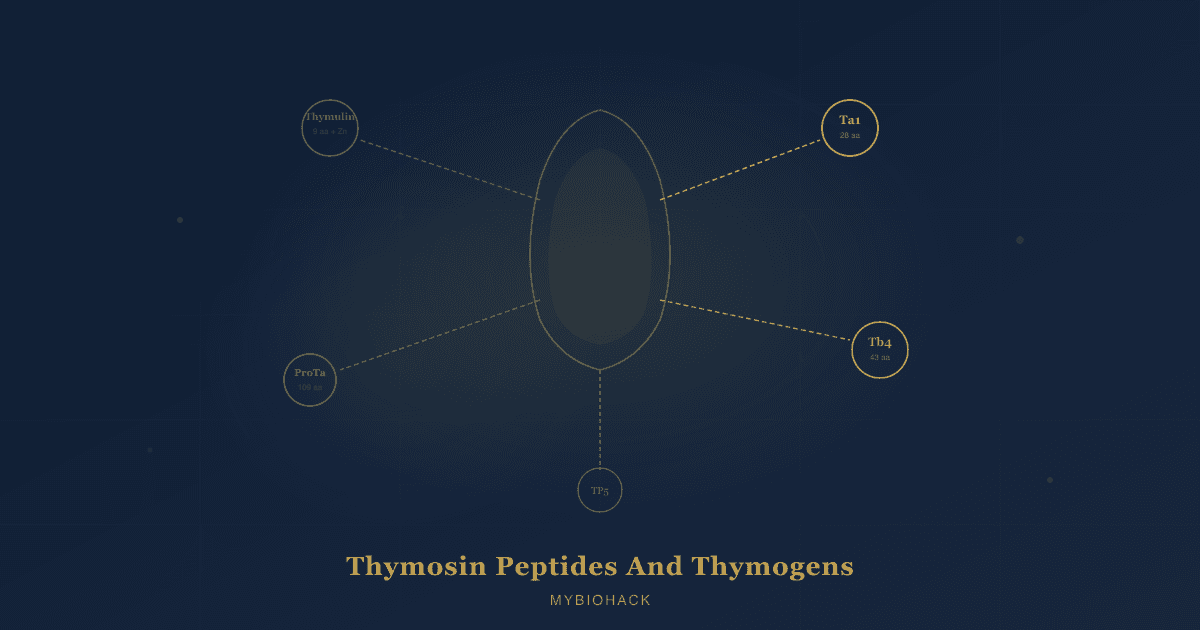
This post extends our broader overview of thymosin peptides and thymogens, which covers the wider family; here the focus is Tα1 specifically.
The synthetic version is called thymalfasin, sold under the brand name Zadaxin, and it is approved or registered in more than 35 countries for hepatitis B, hepatitis C, and as an immune adjuvant. R
It is not FDA-approved in the United States, so any use here is off-label and prescription-only.
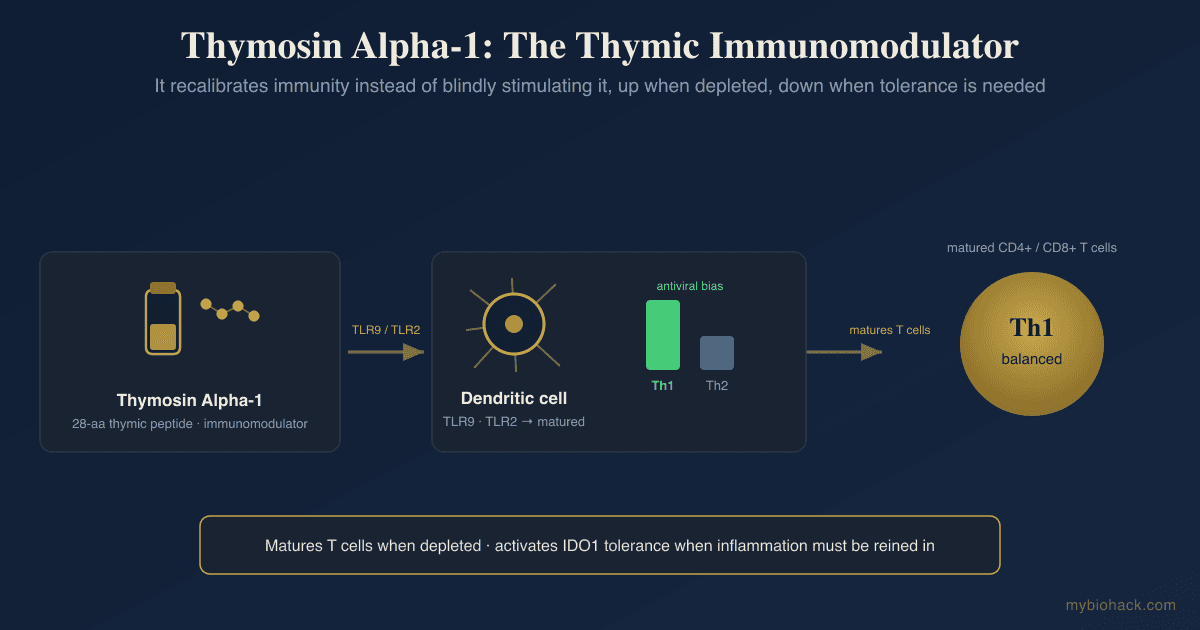
The single most important thing to understand about Tα1 is that it is an immunomodulator, not a stimulant.
It does not just push the immune system harder in one direction.
It restores balance, maturing T cells when they are depleted and reining in runaway inflammation when tolerance is needed, which is why the literature repeatedly calls it a regulator of inflammation, immunity, and tolerance. R
Tα1 belongs to a different functional class than the growth-hormone-axis peptides people often lump in with it.
It is not a secretagogue like tesamorelin or CJC-1295 and ipamorelin, and it is not a tissue-repair peptide like BPC-157.
Its entire job is immune signaling.
Benefits Of Thymosin Alpha-1
The evidence base spans more than 30 clinical trials and over 11,000 subjects, though the quality varies widely by indication. R
I have ordered the benefits below roughly by how strong the evidence is, and I have kept the caveats inline where the data is mixed.

1. It Restores T-Cell Numbers And Reverses Lymphopenia
Tα1's core action is immune reconstitution.
It drives maturation of CD3+ thymocytes into CD4+ helper and CD8+ cytotoxic T cells, which is most visible in states where lymphocytes have been depleted. R
In severe COVID-19 with profound lymphopenia, Tα1 raised circulating CD4+ and CD8+ T-cell counts back toward normal ranges. R
This is the mechanism that makes it interesting in any condition where the adaptive immune system has been drained rather than overactivated.
2. It Rebalances Innate Immunity Toward A Controlled Th1 Response
Tα1 acts on dendritic cells, the antigen-presenting cells that decide what kind of immune response gets mounted.
Signaling through Toll-like receptor 9 (TLR9) and Toll-like receptor 2 (TLR2), it matures dendritic cells and shifts the Th1/Th2 balance toward Th1, the arm that clears intracellular viruses and fungi. R R
This is why it was originally developed against chronic viral infection and invasive fungal disease rather than as a general booster.
3. It Supports Viral Clearance In Chronic Hepatitis B
This is the indication with the cleanest data and the reason Zadaxin exists.
A pivotal randomized controlled trial in chronic hepatitis B found a complete virological response in 40.6% of the Tα1 group versus 9.4% of untreated controls. R
Part of the mechanism is a measurable shift in Th1 versus Th2 cytokine synthesis in hepatitis B patients, favoring the antiviral Th1 arm. R
Hepatitis C is a weaker story worth flagging honestly.
Tα1 combined with interferon showed some benefit historically, but the indication has largely been abandoned in favor of direct-acting antivirals, and the combination-therapy trials never conclusively proved added value. R
4. It Improves Vaccine Response In The Elderly And Immunocompromised
Because the aging thymus produces less of this signal, Tα1 has been tested as a vaccine adjuvant in exactly the populations that respond poorly to vaccines.
In a double-blind placebo-controlled trial in men aged 65 to 99, adding Tα1 to the influenza vaccine augmented the antibody response with no observed toxicity. R R
It also enhanced the immunogenicity of an adjuvanted H1N1 influenza vaccine in hemodialysis patients, a group notorious for poor vaccine responses. R
The signal is consistent enough that reviewers continue to describe it as a promising vaccine-response enhancer. R
5. It Lowers Mortality In Severe Sepsis
Sepsis is not just an infection.
After the initial cytokine storm, many patients collapse into a state of immune exhaustion where they cannot clear the infection, and this is where an immunomodulator can help.
In the multicenter ETASS randomized controlled trial, 28-day mortality was 26.0% with Tα1 versus 35.0% in controls, a roughly 9% absolute reduction. R
The relative risk of in-hospital death was 0.74 (95% CI 0.54 to 1.02), and treated patients survived longer, though the primary endpoint sat right at the edge of significance. R
Systematic reviews and meta-analyses of Tα1 in sepsis have found a consistent trend toward lower all-cause mortality across trials. R R
6. It Showed A Mortality Signal In Severe COVID-19
This is the benefit that generated the most excitement and deserves the most caution.
In a retrospective study of severe COVID-19 in Wuhan, Tα1 cut mortality to 11.11% versus 30.00% in untreated patients, and it did so by restoring depleted lymphocytes and reversing T-cell exhaustion, lowering PD-1 and Tim-3 on CD8+ T cells. R
A systematic review and meta-analysis of moderate-to-critical COVID-19 concluded Tα1 may reduce mortality, while explicitly stating that randomized trials are still required to confirm it. R
The counter-evidence is real and I will not paper over it.
A multicenter retrospective study in critically ill COVID-19 patients found no association between Tα1 and reduced mortality. R
In non-severe COVID-19, Tα1 shortened viral shedding and hospital stay but did not prevent progression or reduce mortality. R
The honest read is that this is a heterogeneous, mostly retrospective literature with a plausible mechanism, not settled proof.

7. It Is Used As An Adjunct In Cancer Immunotherapy
Tα1 has been studied as an immune adjunct in oncology, most rigorously in melanoma.
In a large randomized study of 488 patients with metastatic melanoma, adding Tα1 to dacarbazine (with or without interferon) improved median overall survival with no added toxicity. R
The more provocative finding came from long-term follow-up, where patients who later received the checkpoint inhibitor ipilimumab after Tα1 pretreatment showed dramatically longer survival than those without prior Tα1, suggesting synergy with checkpoint blockade. R
Preclinical work supports this direction, showing Tα1 can protect against the intestinal immunopathology (colitis) that anti-CTLA-4 therapy causes, which is a rare case of an immune adjunct that may reduce a checkpoint drug's toxicity rather than add to it. R
8. It Balances Inflammation With Immune Tolerance
This is the most mechanistically interesting benefit and the one with a genuine catch.
Tα1 does not only turn immunity up.
Through the same TLR9 signaling that matures dendritic cells, it also activates indoleamine 2,3-dioxygenase (IDO1), the enzyme that drives tryptophan catabolism and induces regulatory T cells, establishing a tolerogenic, anti-inflammatory environment. R
That dual nature is why it can help in both immunodeficiency and inflammatory or autoimmune contexts, and it connects to why reflexively suppressing regulatory signals like TGF-Beta1 is often the wrong move.
The catch is covered in the Mechanisms and More Research sections below, because IDO1 activation is not universally desirable.
Dosing And Safety
Tα1 is a prescription peptide and is not FDA-approved in the US, so what follows is a description of how it has been studied, not a protocol to self-administer.
Anyone considering it should work with a physician, and the peptide should come from a licensed pharmacy, not a research-chemical vendor.
The most common studied dose is 1.6 mg given subcutaneously, and the dosing frequency varies by indication.
For chronic hepatitis B, the registered Zadaxin regimen is 1.6 mg subcutaneously twice weekly, typically for six months. R
The metastatic melanoma trials used 1.6 mg daily or near-daily schedules. R
Sepsis and COVID-19 protocols used higher and more frequent dosing, often in the range of 1.6 mg once or twice daily in a hospital setting. R R
On safety, the peptide is unusually clean.
Across more than 30 trials and over 11,000 subjects, Tα1 was consistently well tolerated, with the most common issue being mild injection-site reactions. R
Because it modulates rather than blunts immunity, it does not carry the broad infection risk of conventional immunosuppressants, and rare adverse effects like transient fever, fatigue, or nausea have mostly been reported when it is combined with interferon. R
The main caveats are practical rather than toxicological.
The peptide is a lyophilized powder that must be reconstituted and kept cold, and US access is legally and logistically complicated because it is unapproved here.
Mechanisms Of Action
Simple:
- Tα1 is the thymus's way of telling immune cells to grow up, so it helps the body build mature T cells when they are missing.
- It talks to dendritic cells, the immune system's decision-makers, and nudges them toward the antiviral setting rather than the allergy setting.
- Unusually, it can turn immunity both up and down depending on what the body needs, which is why it is called a modulator rather than a booster.
Advanced:
- TLR9 and TLR2 agonism on dendritic cells. Tα1 functions as an endogenous agonist of TLR9 and TLR2 on both myeloid and plasmacytoid dendritic cells, engaging the MyD88-dependent cascade, driving NF-κB translocation via the p38 MAPK pathway, and inducing IL-12, IFN-α, IFN-γ, and upregulation of CD80, CD86, and MHC class II. R R
- Th1 polarization and NK activation. By maturing antigen-presenting dendritic cells, Tα1 raises the Th1/Th2 ratio (more IFN-γ, less IL-4), enhances cytotoxic CD8+ responses, and activates natural killer cells, biasing the system toward clearance of intracellular viruses, fungi, and tumor cells. R
- IDO1-driven tolerance arm. The same TLR9 engagement activates indoleamine 2,3-dioxygenase in dendritic cells, shunting tryptophan into the kynurenine pathway and inducing regulatory T cells, which is how a single peptide simultaneously supports immunity and tolerance. R This is a genuine double edge, because the tryptophan-to-kynurenine shunt through IDO1 is also part of the neuroinflammatory picture in post-viral illness, so more is not automatically better.
- Reversal of T-cell exhaustion. In lymphopenic, immunoparalyzed states, Tα1 restores absolute CD4+ and CD8+ counts and lowers exhaustion markers PD-1 and Tim-3 on CD8+ T cells, which is the proposed mechanism behind its sepsis and severe-COVID signals. R R
- Context-dependent dendritic-cell effects. Tα1's output depends on what else the dendritic cell is seeing, producing different cytokine profiles when co-stimulated with viral versus bacterial TLR ligands, which is part of why its clinical effect is so indication-specific. R
Genetics
Tα1 works through receptors and enzymes that are themselves genetically variable, so the same dose can plausibly land differently across people.
No trial has yet stratified Tα1 response by these genotypes, so treat this section as a mechanistic map of where individual variation likely lives, not as a tested pharmacogenomic guide.
TLR9
TLR9 is the intracellular Toll-like receptor that senses unmethylated CpG DNA and is the primary receptor through which Tα1 matures dendritic cells.
Promoter variants change how strongly the receptor is expressed and therefore how briskly the downstream response fires.
rs5743836: the C allele in the TLR9 promoter has been associated with earlier spontaneous HBeAg seroconversion in hepatitis B, meaning stronger antiviral immune control through the exact pathway Tα1 engages. R
TLR2
TLR2 is the cell-surface Toll-like receptor for bacterial lipopeptides and a secondary target of Tα1 on dendritic cells.
A missense variant reduces receptor signaling and blunts innate detection.
rs5743708 (Arg753Gln): this loss-of-function variant is associated with increased susceptibility to tuberculosis, cytomegalovirus reactivation, and recurrent or severe infections, marking people whose TLR2 arm is already weaker at baseline. R R
IDO1
IDO1 encodes indoleamine 2,3-dioxygenase, the enzyme Tα1 switches on in dendritic cells to induce tolerance via tryptophan catabolism.
Because this same enzyme drives the kynurenine shunt implicated in post-viral neuroinflammation, its expression level is a plausible modifier of both the benefit and the risk of pushing this pathway. R
More Research
The IDO1 double edge is the most important open question.
Tα1 induces IDO1 to establish tolerance, which is useful in autoimmune or hyperinflammatory contexts, but in post-viral illness the tryptophan-to-kynurenine shunt is part of what drives brain fog, low serotonin, and NAD depletion, so activating IDO1 could theoretically cut both ways in the same patient.
The COVID-19 data illustrate why heterogeneity matters more than headline numbers.
The strongest results came from severely lymphopenic patients, the exact group with the most immune depletion to reverse, whereas non-severe patients got little mortality benefit, which suggests Tα1 helps most where the immune system is exhausted rather than overactive. R R
In Jacob's Junction Dysfunction framework, the chronic immunosuppressive phase of post-viral illness is what he calls Micro-Sepsis (MSS), his coined and still-hypothetical term for sub-lethal sepsis that operates below the diagnostic threshold, with the same neutrophil exhaustion, endotoxin tolerance, and immune paralysis seen in the sepsis literature.
He develops that idea, and where immune-restoring peptides fit, in the Micro-Sepsis chapter and the post-viral immunomodulators chapter of the guide.
Tα1's documented ability to reverse T-cell exhaustion and immunoparalysis in true sepsis is why it is mechanistically interesting for that phase, though it has never been trialed in long COVID specifically, so any application there is extrapolation rather than evidence.
Readers thinking through post-viral immune recovery should start with the long COVID natural treatment protocol for the fuller framework before reaching for an injectable peptide.
Availability is a real-world constraint worth stating plainly.
Because Tα1 is unapproved in the US, most domestic supply flows through compounding pharmacies or unregulated research-chemical channels of variable purity, which is a meaningful risk with any injectable.
The trial quality is the honest bottom line.
The hepatitis B and vaccine-adjuvant data are solid, the sepsis data are suggestive, the melanoma data are encouraging, and the COVID-19 data are a plausible mechanism wrapped in mostly retrospective studies, so this is a peptide with a real signal and an incomplete evidence base rather than a proven therapy.
Jacob Gordon
INHC, FMT-C
Board Certified Health Coach
I spent years battling unexplained chronic illness before discovering biohacking, epigenetics, and functional medicine. Now I share that research at MyBioHack to help others find their own answers.
Book a ConsultationRelated Protocols & Supplements
Deep-dive chapters and recommended supplements for this topic
Quercetin
500mg 2x/day
Vitamin D3 + K2
5000 IU + 200mcg/day
DAO Enzyme
1 cap before meals