Mast Cells (Part 2): Mast Cells And Cancer
By Jacob Gordon, INHC, FMT-CThis article contains affiliate links. As an Amazon Associate, MyBioHack earns from qualifying purchases at no extra cost to you. We only link products we research and stand behind.

This is a multi-part series on mast cells:
Mast Cells (Part 1): Stabilize Mast Cells And Remove Brain Fog
Mast Cells (Part 3): The Mast Cell-Glia Interaction In Chronic Inflammation
In this post we will discuss the angiogenic (growth supporting) factors of mast cells in cancer.
Mast Cell Degranulation
Mast cell degranulation (mast cells releasing chemical signals) serves a multiplex of functions (not an exclusive list):
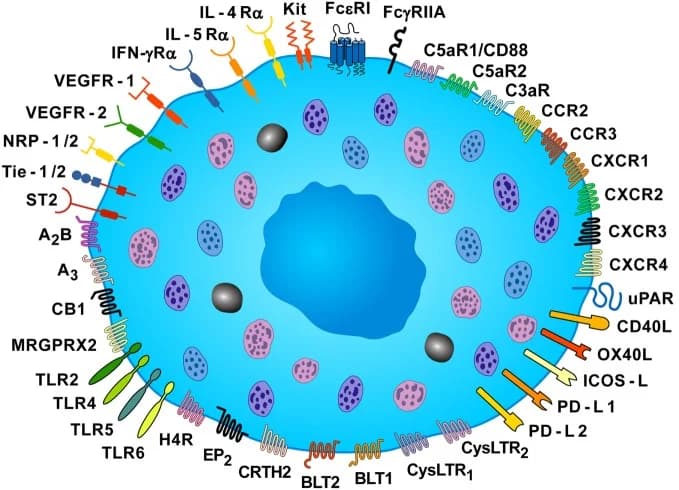
Mast cells have a variety of receptors which produces various effects (proangiogenic, anti-inflammatory, allergy response, etc). R R R R
They can either inhibit the growth of tumors of exacerbate their growth, so targeting mast cells can be a good cancer therapy alternative. R
Through the release of cytoplasmic granules and cytokines (mainly IL-1, TNF-α, IL-6) and growth factors (vascular endothelial growth factor, TGF-β, fibroblast growth factor-2, angiopoietin-1) mast cells are angiogenic (stimulating growth of tumors). R
There is an inverse correlation between IgE (allergic) response and cancer, as IgE (binding to Fc) can act as a tumor supressor. R R
Mast Cells Are Increased In Human Tumors
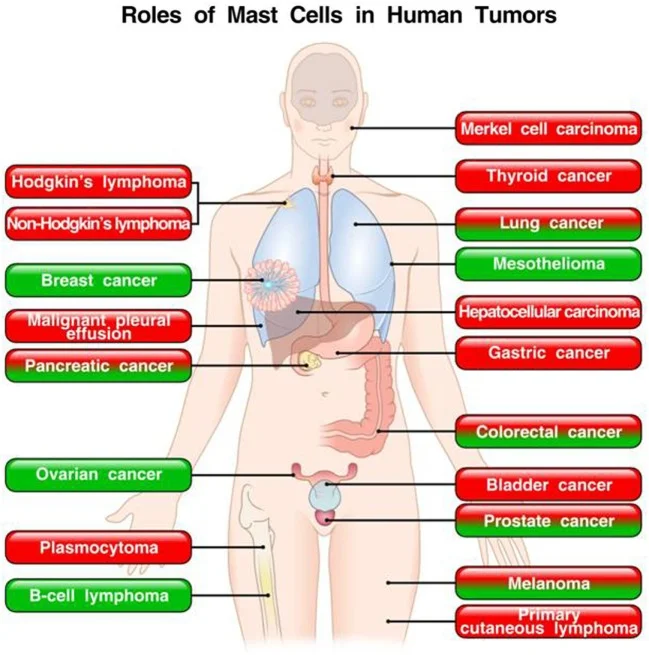
Tumor-associated mast cells (TAMCs) are present in the microenvironment of several human solid and hematologic tumors. R R
Peritumoral and/or intratumoral mast cell density is increased in different types of human cancer. R
These TAMCs produce many growth factors including stem cell factor (SCF, acting on CD117/kit), vascular endothelial growth factors (VEGF, acting on VEGFR-1/2), fibroblast growth factor 2 (FGF-2), angiopoietin 1 (Ang1, acting on Tie2R), chemokine/interluekin 8 (Il-8, acting on CXCR1 and CXCR2) and nerve growth factor (NGF). R R R R R
These growth factors (as well as platelet-derived growth factor-β (PDGF-β), IL-6, IL-10, thymidine phosphorylase (TP), and chymase) are released and stimulate further growth. R R
Mast cells express CCR2, CXCR2, and CXCR3, which can bind to TAMC’s CCL2, CXCL1, and CXCL10 ligands. R R
PGE2 and histamine are chemotactic for mature mast cells (via EP2 receptor and H4R). R R
Leukotriene B4 (LTB4) is a leukotriene chemoattractant involved in inflammation and recruits mast cells via activation of BLT1 and BLT2. R
Osteopontin (OP, upregulated in cancer) induces mast cell migration/degranulation. R R
Tryptase (high in cancer and mast cells) is a proangiogenic factor. R
Chymase remodels the extracellular matrix (ECM), induces angiogenesis by activating metalloproteinases (MMPs), such as MMP-9, which releases proangiogenic mediators. R
Mast Cells Play Different Roles In Different Cancers
Pro Tumor Role Of Mast Cells in Human Cancer: R R
Angioimmunoblastic T-cell lymphoma - Tryptase
Bladder - Tryptase, Toluidine (blue)
Brain - Trypatase, CPA3 R
Cholangiocarcinoma - Toluidine
Colon - Toluidine blue/proteases, Alcian blue/toluidine blue, Chloroacetate esterase
Colorectal - Giemsa, Toluidine, tryptase
Cutaneous lymphoma - Tryptase, Toluidine
Esophagus - Toluidine
Follicular lymphoma - Tryptase
Gastric - Toluidine, Chymase, Tryptase
Hepatocellular - Tryptase
Hodgkin’s lymphoma - Tryptase
Lung - Tryptase, CD117
Malignant pleural effusion - May-Gruenwald–Giemsa toluidine
Melanoma - Gene expression/toluidine, Tyrptase
Merkel cell carcinoma - Tryptase
Pancreas - Tryptase, CD117
Plasmacytoma - Toluidine, Tryptase
Prostate - Tryptase
Skin - Chloroacetate esterase/hematoxylin/toluidine blue
Splenic marginal zone lymphoma - Tryptase
Thyroid - Tryptase
Waldenstrom’s macroglobulinemia - CD117/FcεRI/tryptase
Anti-Tumor Role Of Mast Cells in Human Cancer: R
Breast cancer - CD117, Tryptase, Alcian blue/Giemsa
Colorectal - Tryptase/chymase
Diffuse large B-cell lymphoma - Tryptase
Intestine - Chloroacetate esterase/chymase, Tryptase/CD117
Lung - Tryptase/chymase
Mesothelioma - Tryptase/chymase
Melanoma - Tryptase/chymase
Non-small-cell lung cancer - Tryptase/chymase
Ovarian cancer - Tryptase
Pancreas - CD117
Prostate - CD117, Toluidine blue
Skin - Tryptase/CD117, Giemsa
Angiogenesis & Lymphangiogenesis of TAMCs
VEGFs can be chemotactic for mast cells. R
For example, VEGF-A165 is proangiogenic and VEGF-A165b is antiangiogenic. R
Human neutrophils, under certain circumstances, can produce both pro- and antiangiogenic isoforms of VEGF-A. R
Via production of IL-8, mast cells can make tumor cells chemotherapy drug resistant (via Epithelial-to-mesenchymal transition (EMT)). R R R
Mast Cells Vary According To Tumor Stages
Mast cell density was not correlated with prognosis in superficially invasive melanomas, although low mast cell count in perilesional stroma of deeply invasive melanomas may predict poor survival. R
By suppling MMP9, mast cells were pro-tumorgenic in the initial stages of prostate cancer, but in later stages, was dispensable. R R
VEGF-B (produced by macrophages/mast cells), plays a role in early colon cancer development. R R
Mast Cells Vary According To Their Location
What Activates TAMCs?
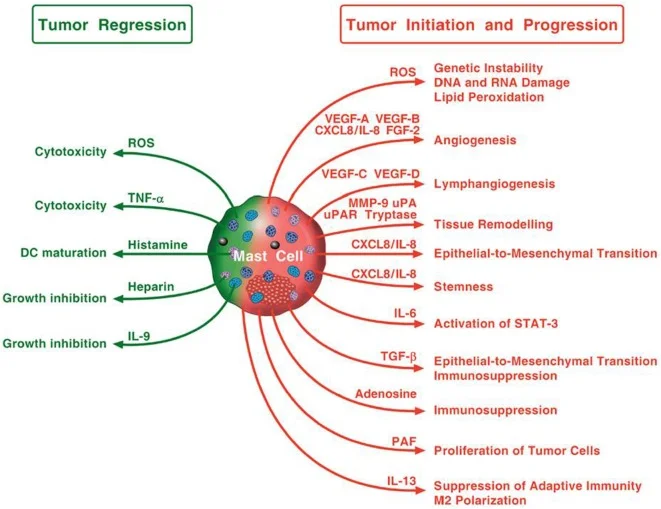
Inflammation (hypoxia, the accumulation of lactic acid/lactate, adenosine, PGE2, IFN-γ, and by low pH - all activate mast cells) creates recruitment (mast cells release SCF, VEGF, Ang1, Tie2). R R R R R R R
Hypoxia (ie increased HIF1a) on mast cells increases il-6 and VEGF-A. R R R
Adenosine (from mast cells and tumors, increased in cancer) is immunosupressive in potentiates mast cells to release histamine production of angiogenic factors from human mast cells and macrophages. R R R R R R R
COX2 -> PGE2 -> angiogenic and lymphangiogenic factors. R
CXCL1, CXCL10, and CXCL12 on mast cells -> IL-8 = angiogenesis/lymphangiogenesis via the recruitment of mast cells to the edge of solid tumors. R R
Back to IgE (without an antigen) induces VEGF-a angiogenesis from mast cells as seen in melanoma growth. R
Alarmins (upregulated in cancer cells) activate mast cells. R R
IL-33 (upregulated in SCC and skin cancers) induces the production of GM-CSF, CXCL8/IL-8, and VEGF-A from mast cells. R R R R
Antitumor IgG immune complexes may activate mast cells. R
OP (high in breast cancer) migrates/degranulates mast cells. R R
Platelet-Actvating Factor (PAF) from mast cells up regulates CXCR4 making them migrate to lymph nodes. R R
How Can We Use Mast Cells In Our Benefit Against Cancer?
Estrogen receptor β (ERβ) antagonists may help with mast-cell promoted tumor growth. R
Killing mast cells (which can cause colon tumor cells to grow) with Fcε-PE40 chimeric toxin inhibits colon tumor development in vivo. R
Inhibition of mast cell degranulation by cromolyn inhibited Myc-induced pancreatic islet tumors experimental pancreatic and thyroid cancers, cholangiocarcinoma and prostate cancer (this one only in mice). R R R R R
Via modulation of p38/P53/p21 mast cells can promote chemotherapy and radiotherapy resistance. R
Blocking the CXCR4–CXCL12 pathway inhibits sunlight-induced skin cancer from mast cells. R
Notch-4 (via Int-3/ANK/IKK/P50) in breast cancer can either become pro- or anti- angiogenic, so inhibiting NF-kB (via GSK3β) may help, although could potentiate VEGF. R R R
Heparin (and HB-EGF) suppresses proliferation and reduces the number of breast cancer cell colonies (such as triple-neg breast cancer). R R R
Toll-like receptor agonists (specifically TLR2/4/6) can activate mast cells against tumor cells. R R R
Practical Epigenetic Actions On TAMCs

MMP9 inhibition:
ER-beta inhibition:
Heparin (…can be taken by prescription, so why not?)
TLR agonism:
Lectins (don’t use if lectin sensitive)
P53 normalization:
VEGF inhibition:
Curcumin (decreases VEGF in cancer, increases VEGF in diabetes) R R R
Green Tea (EGCG also inhibits integrins and MCP-1 resulting in lower migration and adhesion of mast cells/lower angiogenesis and recruitment of inflammatory cells) R R
Il-8 inhibition:
Hif1a inhibition:
Fgf2 inhibition:
Ang1 inhibition:
Primrose Oil (and other GLAs) R
Osteopontin inhibition:
Low Oxalate Intake (possibly) R
Tyrosine kinase inhibition:
Tryptase inhibition:
GSK3β inhibition:
Gleevec (Imatinib mesylate - script only) R
More Research
Other (drug) MC-Cancer Advanced Therapies R
Jacob Gordon
INHC, FMT-C
Integrative Nutrition Health Coach
I cover mold illness, post-viral recovery, methylation, and complex chronic disease, drawing on ten years of clinical research, work inside a functional medicine clinic, and my own recovery from all of it. Every claim here is cited.
Book a ConsultationRelated Protocols & Supplements
Deep-dive chapters and recommended supplements for this topic
Electrolyte Complex
1 scoop/day
CoQ10
200mg/day
Magnesium Glycinate
400mg at bedtime