The Sluggish Gallbladder: Understanding, Preventing, and Reversing Biliary Sludge and Stones
By Jacob Gordon, INHC, FMT-CThis article contains affiliate links. As an Amazon Associate, MyBioHack earns from qualifying purchases at no extra cost to you. We only link products we research and stand behind.
Gallbladder sludge is a precursor to gallstones that most people never hear about until it shows up on ultrasound.
In this post, we will discuss what biliary sludge actually is, what drives it at a mechanistic level, which conditions and environmental exposures overlap with it, and what you can do about it.

Basics Of Gallbladder Sludge
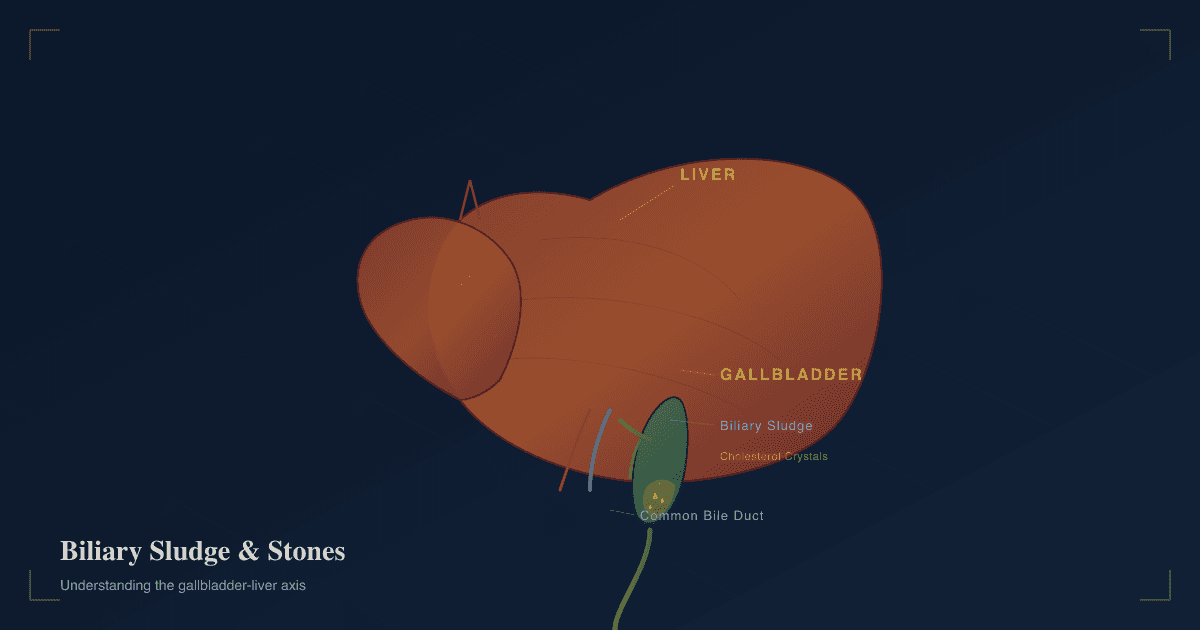
Biliary sludge is a mixture of particulate solids that have precipitated out of bile. R
The three main components are cholesterol monohydrate crystals, calcium bilirubinate granules, and other calcium salts, all suspended in a mucus glycoprotein gel matrix. R
It is detected on transabdominal ultrasound as low-amplitude echoes that layer in the dependent portion of the gallbladder and shift with patient positioning, without acoustic shadowing.
Microscopy of aspirated bile is actually the gold standard for detection, but it is rarely practical in clinical settings. R
Sludge is best thought of as an early, reversible phase of gallstone disease rather than a separate condition. R
The clinical trajectory varies widely: roughly 40% of cases resolve spontaneously, 40% follow a waxing and waning course, and about 20% progress to gallstones. R
Symptoms (when present) include: (not exclusive list)
- Biliary colic
- Bitter taste in the mouth
- Fullness in the upper abdomen
- Nausea after fatty meals
- Right upper quadrant or epigastric pain
- Upper back pain between the shoulder blades
Sludge can cause the same complications as gallstones: acute cholecystitis, acute cholangitis, and acute pancreatitis. R
Asymptomatic patients generally require no intervention beyond removing the precipitating factor.
What Causes Stones And Sludge
Sludge and stones share the same root causes.
Three pathogenic mechanisms must converge: bile supersaturation with cholesterol, gallbladder dysmotility, and accelerated nucleation of crystals. R
The main causes of sludge and stone formation include: (not exclusive list)
- Bacterial overgrowth (certain species produce beta-glucuronidase, which hydrolyzes conjugated bilirubin and promotes pigment stone nucleation; bacterial DNA has been found in both stones and sludge) R
- Ceftriaxone therapy (the antibiotic precipitates as insoluble calcium ceftriaxone in bile)
- Critical illness with low oral intake
- Estrogen therapy (OCP, HRT increases cholesterol saturation index of bile) R
- Gallbladder stasis and dysmotility (the single most important factor) R
- High fructose and refined sugar intake (fructose and total carbohydrate intake independently increase gallbladder disease risk) R
- Insulin resistance and hyperinsulinemia (elevates HMG-CoA reductase activity, boosting hepatic cholesterol synthesis and secretion into bile) R
- Mucin hypersecretion (the gallbladder wall secretes a gel that traps crystals and accelerates nucleation) R
- Octreotide (inhibits CCK release and sphincter of Oddi motility, causing biliary stasis) R
- Pregnancy (estrogen increases biliary cholesterol secretion; progesterone relaxes smooth muscle reducing motility) R
- Prolonged fasting R
- Rapid weight loss (mobilizes cholesterol into bile faster than bile acids can handle it) R
- Solid organ and bone marrow transplantation
- Total parenteral nutrition (zero oral intake halts CCK release; the gallbladder stops contracting)
How The Liver Creates Stones

The liver is where the problem actually starts for most people with cholesterol-type sludge and stones.
Bile is a complex mixture of bile acids, phospholipids (mainly phosphatidylcholine), and cholesterol.
The ratio of these three components determines whether cholesterol stays dissolved or precipitates.
When the liver secretes excess cholesterol relative to bile acids and phospholipids, bile becomes supersaturated and cholesterol monohydrate crystals form. R
When hepatic bile passes into the gallbladder, the gallbladder mucosa modifies it: it concentrates the bile, shifts bilirubin conjugate composition (diglucuronide to monoglucuronide), and adds mucin, albumin, and total protein. R
This gallbladder processing can accelerate nucleation even when the cholesterol saturation index (CSI) of hepatic bile appears normal, which is why the gallbladder's own mucosal function is a critical variable.
Key hepatic drivers of lithogenic bile:
- ABCB11 (BSEP) impairment (reduced bile salt secretion leads to less micellar solubilization of cholesterol)
- ABCB4 dysfunction (insufficient phosphatidylcholine secreted into bile allows unprotected cholesterol to crystallize)
- ABCG5/G8 transporter overactivity (excess cholesterol pumped into the canalicular space)
- CYP7A1 suppression (the rate-limiting enzyme for bile acid synthesis from cholesterol is suppressed by insulin, shrinking the bile acid pool) R
- HMG-CoA reductase upregulation (increased hepatic cholesterol synthesis leads to increased biliary cholesterol secretion)
The bile acid pool size matters enormously: smaller pool = less capacity to hold cholesterol in solution = more crystal nucleation.
Biliary Health And Overlapping Conditions
Estrogens And Estrogenics
Women develop cholesterol gallstones at roughly twice the rate of men at all ages, a gap that begins at puberty and persists through the childbearing years. R
Estrogen drives this through hepatic ESR1 (estrogen receptor alpha), not ESR2.
Activation of ESR1 stimulates SREBP-2, the master regulator of cholesterol biosynthesis, overriding the normal negative feedback that would otherwise suppress cholesterol synthesis when cellular cholesterol is adequate.
This diverts both endogenous and dietary cholesterol into bile. R
Additionally, estrogen activates GPR30 (a membrane estrogen receptor), which produces a separate lithogenic pathway, and the two pathways synergize. R
Deletion of ERα reduces gallstone prevalence from 100% to 30% in high-estrogen mouse models. R
Estrogenics such as BPA and other xenoestrogens are relevant here for the same reason: anything that activates ERα in hepatocytes can increase biliary cholesterol secretion.
Progesterone compounds the problem by relaxing gallbladder smooth muscle, impairing emptying and promoting stasis. This is why sludge incidence reaches up to 30% during pregnancy. R
Insulin Resistance And Sugar
Hyperinsulinemia, the hallmark of insulin resistance, increases HMG-CoA reductase activity and simultaneously suppresses CYP7A1, the enzyme that converts cholesterol into bile acids.
The net result is more cholesterol going into bile and fewer bile acids available to dissolve it. R
High fructose intake drives this pathway via de novo lipogenesis and triglyceride overproduction, suppressing hepatic PPARα and worsening the lithogenic state.
Prospective studies confirm that high total carbohydrate and fructose consumption independently increases biliary sludge and gallstone incidence. R
Mycotoxins And Chemical Toxicity
The liver exports fat-soluble toxins into bile as a route of elimination.
Mycotoxins, particularly aflatoxin and ochratoxin A, are fat-soluble and follow this route: they enter the blood, are filtered by the liver, transferred into bile, pass to the small intestine, and are then reabsorbed via bile acid transporters in enterohepatic circulation. R
This recirculation perpetuates hepatic toxic load and is why binding mycotoxins in the intestine (with cholestyramine, activated charcoal, or zeolite) is critical for clearing them.
When toxins accumulate faster than bile flow can clear them, the result is thickened, sludgy bile. This is a form of biotoxin accumulation.
Heavy mold exposure can trigger the full progression from bile thickening to gallstone formation.
Aflatoxin specifically is a known hapten (a small molecule capable of binding to tissue proteins and generating autoimmune-type responses), and the NCI has linked aflatoxin exposure to gallbladder cancer risk. R
More broadly, drugs and toxins can damage bile duct epithelial cells directly, causing cholestasis, ductopenia, and eventually biliary cirrhosis. R
Parasites In The Bile Ducts
Parasitic biliary disease is more common in travelers and immigrants from endemic regions than most Western clinicians realize. R
The main biliary parasites are:
- Ascaris lumbricoides (migrates from the jejunum through the sphincter of Oddi into the bile duct, causing obstruction, pyogenic cholangitis, and pigment stone formation; Ascaris ova or fragments have been found as the nidus in 10-66% of intrahepatic stones in endemic areas) R
- Clonorchis sinensis and Opisthorchis viverrini (liver flukes that reside in peripheral intrahepatic bile ducts, causing chronic inflammation, duct wall thickening, duct dilatation, impaired bile acid secretion, and non-cholesterol stone formation) R
- Fasciola hepatica (causes hepatic and biliary phase disease with intraductal worm visualization on imaging) R
Clonorchis infection is associated with an increased risk of cholangiocarcinoma with long-term infection. R
Dysbiosis And The Gut-Liver Axis

The gut microbiome regulates the primary-to-secondary bile acid conversion ratio.
Specific gut bacteria with high beta-glucuronidase activity deconjugate bilirubin and drive pigment stone formation.
Others alter the bile acid pool composition in ways that increase cholesterol saturation. R
For a deeper look at fixing dysbiosis, see that post.
Other Linked Conditions
- Fatty liver / NAFLD (shares the same upstream insulin resistance and hepatic cholesterol overproduction pathway)
- Haptens from chemical exposures (can damage bile duct epithelium and drive immune-mediated cholestasis)
- Hypothyroidism (reduces bile acid synthesis and gallbladder motility)
- Mast cell activation (overlaps with biliary symptoms in many post-viral and CIRS patients)
- PCOS (frequently associated with insulin resistance and estrogen dysregulation)
How To Improve Stones And Sludge
1. Increase Bile Flow And Gallbladder Motility
The foundation of treatment is improving gallbladder contraction and bile fluidity so sludge does not accumulate.
TUDCA (tauroursodeoxycholic acid) is one of the strongest interventions available.
It is a hydrophilic bile acid that replaces more toxic, hydrophobic bile acids in the pool, reduces intestinal cholesterol absorption, shifts bile composition toward less lithogenic profiles, and prevents gallstone formation in animal models entirely (0/15 stones vs 15/15 in untreated controls on a lithogenic diet). R
TUDCA improves bile composition including total bile acids, cholesterol, and triglycerides in human trials. R
UDCA (its precursor) showed equivalent or slightly better dissolution of existing stones in head-to-head trials. R
Both work by desaturating bile of cholesterol.
Milk Thistle (Silymarin) is a choleretic that increases bile flow by upregulating bile salt efflux pumps, specifically the bile salt export pump (BSEP). For a deeper look at its mechanisms, see the full milk thistle post.
It also stimulates de novo bile salt synthesis, increasing the bile acid pool size and the abundance of protective bile acids including beta-muricholate and ursodeoxycholate. R
A 3-month interventional study found that milk thistle combined with artichoke and green tea reduced biliary sludge in 64.86% of treated patients, with significant reductions in liver enzymes. R
Standard dose is 150-420mg standardized silymarin extract daily in capsule form.
Curcumin (Turmeric) produces a positive cholekinetic effect, meaning it contracts the gallbladder.
20mg of curcumin contracts the gallbladder by up to 29% within 2 hours on ultrasound. R
40-80mg dosing produced 50-72% reductions in gallbladder size in human subjects.
Curcumin also reduces bile cholesterol saturation index, increases total bile acids and phospholipids in bile, and prevents sludge formation in animal models. R
It acts through FXR (farnesoid X receptor) to regulate bile acid homeostasis and protect against cholestasis. R
Use bioavailable forms (phosphatidylcholine complex) for actual absorption.

Coffee stimulates cholecystokinin (CCK) release, causing direct gallbladder contraction.
Both regular and decaffeinated coffee produce roughly 30% gallbladder contraction and significant CCK elevation above placebo. R
The chlorogenic acids and other non-caffeine compounds interact with enteroendocrine I-cells to mimic a meal signal.
Long-term coffee consumption is associated with up to 45% reduced gallstone risk in dose-dependent epidemiological data.
For coffee enemas specifically, a 2014 clinical study found that patients who performed coffee enemas prior to capsule endoscopy had significantly better image quality, confirming stimulation of bile release. R
The enema format may work through both CCK stimulation and direct hepatic/biliary stimulation from rectal installation. (Note: coffee enemas carry risks including electrolyte disturbance and should be approached with medical guidance only.)
Artichoke Leaf Extract has documented choleretic and cholagogic effects and was part of the combination product that reduced sludge in 64% of patients above. R

2. Reduce Bile Cholesterol Saturation
- Fish Oil / DHA+EPA (reduces biliary cholesterol secretion and stone incidence in animal models)
- Low-lectin, low-fructose diet (removes the upstream insulin resistance driver)
- Phosphatidylcholine (the substrate that ABCB4 transports into bile to protect against free cholesterol crystallization; supplementing PC increases phospholipid content of bile)
- TUDCA (primary recommendation, see above)
- Vitamin C (high dose vitamin C supports bile acid synthesis; low vitamin C is associated with increased gallstone risk) R
3. Address The Root Cause
Sludge almost always resolves when the precipitating factor is removed. R
This means:
- Address mycotoxin exposure with binders (cholestyramine, activated charcoal, zeolite) and cholagogues to increase bile flow
- Correct estrogen excess and reduce estrogenic chemical load (consider DIM for estrogen metabolism support)
- Fix dysbiosis (particularly bacteria with high HDC/beta-glucuronidase activity)
- Improve insulin sensitivity via dietary carbohydrate restriction and exercise
- Treat underlying parasitic biliary infection with appropriate antiparasitics
What To Stay Away From
- Ceftriaxone and octreotide (known iatrogenic causes of sludge) R
- Estrogenic chemicals (BPA, phthalates, zeranol, certain pesticides) R
- High cholesterol diet combined with sedentary lifestyle (saturated fat combined with refined sugars is a known gallstone risk factor) R
- Low fiber diet (fiber binds bile acids in the intestine and prevents reabsorption, maintaining a larger and healthier bile acid pool; low fiber increases secondary lithogenic bile acid production) R
- Mycotoxin exposure (thickens bile and can precipitate stone formation; remediate environment first)
- Oral estrogen/OCP (oral administration causes greater hepatic alterations in bile composition than transdermal; oral estrogen increases biliary cholesterol and reduces chenodeoxycholate synthesis) R
- Prolonged fasting without fat intake (prevents CCK release and gallbladder contraction; some fat intake at each meal is needed to stimulate bile flow)
- Rapid weight loss (mobilizes large amounts of cholesterol into bile; if weight loss is needed, do it slowly)
- Refined sugar and fructose (directly increases bile cholesterol supersaturation via insulin/HMG-CoA reductase pathway and CYP7A1 suppression) R
- Unchecked dysbiosis (particularly H. pylori, Clostridium perfringens, and beta-glucuronidase-producing species)
Testing
Imaging
Transabdominal ultrasound is the primary detection method for biliary sludge.
Sludge appears as low-amplitude echoes that layer in the dependent portion of the gallbladder, shift with patient repositioning, and do not produce acoustic shadowing (which distinguishes sludge from formed stones). R
Endoscopic ultrasound (EUS) is more sensitive for detecting microlithiasis and small stones missed by transabdominal ultrasound.
HIDA scan (hepatobiliary iminodiacetic acid) evaluates gallbladder ejection fraction, which quantifies motility. An ejection fraction below 35% indicates gallbladder dysmotility and biliary dyskinesia. R
Blood Markers
The Hepatic Function Panel (Quest Diagnostics) covers AST, ALT, GGT, ALP, and bilirubin. Elevated GGT and ALP specifically suggest biliary obstruction or cholestasis.
A Comprehensive Metabolic Panel (CMP) and CBC with Differential (Quest Diagnostics) provide the metabolic and hematologic baseline.
Fasting Insulin (Quest Diagnostics) or the Cardio IQ Insulin Resistance Panel assesses the insulin resistance that drives HMG-CoA reductase upregulation and CYP7A1 suppression, the two main metabolic drivers of lithogenic bile.
The Lipid Panel or Cardio IQ Advanced Lipid Panel (Quest Diagnostics) evaluates the cholesterol metabolism pathway feeding into bile supersaturation.
Estradiol and Progesterone should be checked in women with biliary symptoms, particularly if symptoms cycle with menstruation. The DUTCH Sex Hormones (Precision Analytical) provides a more detailed estrogen metabolism profile including 2-OH, 4-OH, and 16-OH pathways.
Comprehensive Panels
I use the Gut Zoomer (Vibrant Wellness) to assess dysbiosis contributions to pigment stone formation, beta-glucuronidase-producing bacteria, and intestinal permeability that disrupts enterohepatic bile acid circulation. The GI-MAP (Diagnostic Solutions) is an alternative with strong parasite detection via PCR.
The Toxin Zoomer (Vibrant Wellness) or Mycotoxins Profile (RealTime Labs) checks mycotoxin load (aflatoxin, ochratoxin A) that thickens bile and drives mast cell degranulation in biliary tissue.
The Hormone Zoomer (Vibrant Wellness) or DUTCH Complete (Precision Analytical) evaluates full estrogen metabolism, as oral estrogen and estrogen dominance are direct drivers of biliary cholesterol supersaturation via ESR1/SREBP-2.
The Hepatic Detox Profile (Doctor's Data) evaluates Phase I and Phase II liver detoxification capacity, relevant for patients with suspected toxin-driven bile thickening.
Stool Testing
The Comprehensive Stool Analysis + Parasitology (Doctor's Data) or Culture, PCR + Parasitology (Doctor's Data) can identify parasitic biliary infections (Clonorchis, Ascaris, Fasciola) that may not be detected on standard ova and parasite exams, particularly in patients with travel history to endemic regions.
Genetics
The Methylation Genetics (Vibrant Wellness) panel is relevant for evaluating bile acid synthesis pathway variants. The Cardio Genetics (Vibrant Wellness) panel covers lipid metabolism genes including cholesterol transport variants linked to gallstone risk.
Mechanisms Of Action
Simple:
- Bile is a mixture of bile acids, phospholipids, and cholesterol.
- When cholesterol exceeds the solubilizing capacity of bile acids and phospholipids, it precipitates as monohydrate crystals.
- The gallbladder's own mucosa concentrates bile and accelerates this process by adding mucin (the nucleating matrix) and shifting bilirubin from stable to unstable conjugate forms.
- When the gallbladder fails to contract fully (dysmotility), sludge accumulates in stagnant bile.
- The liver's cholesterol export machinery (ABCG5/G8) and phospholipid export machinery (ABCB4) determine the baseline cholesterol saturation index of bile.
- Upstream hormones (insulin, estrogen) and diet push these transporters toward a lithogenic state.
Advanced:
- Cholesterol crystallization occurs in two recognized pathways: the classical pathway (direct precipitation of cholesterol monohydrate crystals) and an intermediate liquid crystalline pathway involving lamellar and arc-like liquid crystal intermediates. Estrogen via GPR30 preferentially drives the liquid crystalline pathway; ERα activation drives the classical pathway, and both synergize under high estrogen states. R
- Mucin gel secreted by the gallbladder epithelium acts as the nucleating matrix for crystal growth. Conditions that stimulate mucin hypersecretion accelerate the transition from supersaturated bile to formed crystals. R
- FXR (farnesoid X receptor) is the master bile acid nuclear receptor. When bile acid levels are high, FXR activates, suppressing further bile acid synthesis (CYP7A1) and reducing cholesterol secretion into bile. Disruption of FXR function by toxins, dysbiosis-derived secondary bile acid alterations, or insulin resistance destabilizes the entire system.
- TUDCA/UDCA work by expanding the hydrophilic bile acid pool, displacing toxic hydrophobic species, reducing cholesterol absorption, and directly desaturating bile of cholesterol. R
- Silymarin upregulates BSEP (bile salt export pump), increasing efflux of bile salts from hepatocytes into bile and raising bile salt output up to 49%. It simultaneously increases de novo bile salt synthesis, expanding the pool. R
- Curcumin reduces NPC1L1 expression in the intestine (decreasing cholesterol absorption) and modulates gut microbiota toward compositions associated with lower bile cholesterol saturation index. R
- Beta-glucuronidase (bacterial or epithelial-derived) hydrolyzes conjugated bilirubin back to free bilirubin, which then binds calcium to form calcium bilirubinate, the core component of pigment stones. Bacterial infection, bile stasis, and gallbladder wall injury all increase beta-glucuronidase activity. R
- Parasites (Clonorchis, Ascaris) damage cholangiocytes, impair bile acid secretion, cause cholestasis, and alter bile pH and bicarbonate, driving non-cholesterol stone formation through a distinct mechanism from cholesterol-type disease. R
- Insulin suppresses CYP7A1 mRNA expression in hepatocytes, reducing the rate of bile acid synthesis from cholesterol. Hyperinsulinemia thus shrinks the bile acid pool while simultaneously expanding hepatic cholesterol output, a perfect double hit for bile supersaturation. R

Genetics
ABCG8 (D19H, rs11887534) — Highest Population Risk
This is the most well-established genetic risk factor for cholesterol gallstones in humans, identified by genome-wide association study in Nature Genetics. R
ABCG8 is half of the sterol transporter heterodimer (ABCG5/G8) on the canalicular membrane of hepatocytes that pumps cholesterol into bile.
The D19H variant (Lith9) increases cholesterol transport activity approximately 3.2-fold compared to wildtype. R
The overall odds ratio for gallstone disease in D19H carriers is 2.2, rising to 3.3 for pure cholesterol stones, replicated across German, Chilean, Indian, and Chinese cohorts.
rs11887534 — each H allele increases biliary cholesterol hypersecretion and cholesterol stone risk.
ABCG5 (R50C)
ABCG5 is the partner transporter to ABCG8.
The R50C variant is in high linkage disequilibrium with ABCG8-D19H and contributes to the same lithogenic phenotype. R
rs78338808
ABCB4 (MDR3)
ABCB4 encodes the hepatic phosphatidylcholine translocase that pumps phosphatidylcholine into bile alongside cholesterol.
Phospholipids are essential for solubilizing cholesterol in bile since they form the protective phospholipid bilayer of bile vesicles.
ABCB4 deficiency causes low phospholipid-associated cholelithiasis (LPAC) syndrome, an early-onset, recurrent cholesterol gallstone disease spanning a spectrum from neonatal cholestasis to progressive familial intrahepatic cholestasis type 3 (PFIC3). R
ABCB4 mutations also increase gallbladder cancer risk. R
CYP7A1
CYP7A1 encodes cholesterol-7alpha-hydroxylase, the rate-limiting enzyme in bile acid synthesis from cholesterol.
Reduced CYP7A1 activity shrinks the bile acid pool and increases biliary cholesterol saturation.
Insulin suppresses CYP7A1 transcription, linking insulin resistance genetics directly to lithogenic bile.
FXR / NR1H4
FXR is the master nuclear bile acid receptor.
Animal QTL mapping identified Fxr (Lith7 locus) as a gallstone susceptibility gene: higher FXR expression confers resistance by maintaining tighter regulation of bile acid synthesis and cholesterol secretion. R
FXR polymorphisms likely modulate gallstone susceptibility in humans.
PNPLA3 (I148M)
The PNPLA3 I148M variant, the same polymorphism strongly associated with NAFLD severity, has an inverse association with gallstone risk: carriers may actually have a lower rate of gallstones. R
The mechanism is not yet fully understood.
More Research
- Aflatoxin (mycotoxin) is linked to gallbladder cancer risk by the NCI Division of Cancer Epidemiology and Genetics. R
- Ascariasis equals gallstones as a causative factor of biliary disease in endemic areas (36.7% vs 34.8% in one prospective South African series). R
- Bile acid composition changes dramatically by gut microbiome status: high Bacteroidetes correlates with lower bile cholesterol saturation.
- Curcumin reduced bile cholesterol saturation index (CSI) from 1.64 to 1.08 in high-fat diet hamsters, which is a clinically meaningful reduction in lithogenicity. R
- For biomarker testing I use the Gut Zoomer to assess dysbiosis contributions, and a Toxin Zoomer to check mycotoxin and heavy metal load in clients with unexplained biliary symptoms.
- The cholesterol saturation index (CSI) of gallbladder bile is the most reliable indicator of cholesterol crystallization risk; CSI >1.0 indicates supersaturation. R
- Twin studies estimate genetic factors account for approximately 25% of gallstone risk, with environmental factors responsible for the remaining 75%, making this highly addressable through lifestyle. R
Jacob Gordon
INHC, FMT-C
Board Certified Health Coach
I spent years battling unexplained chronic illness before discovering biohacking, epigenetics, and functional medicine. Now I share that research at MyBioHack to help others find their own answers.
Book a ConsultationRelated Protocols & Supplements
Deep-dive chapters and recommended supplements for this topic
Spore-Based Probiotics
1 cap with food
L-Glutamine
5g 2x/day on empty stomach
Butyrate
300mg 2x/day with meals